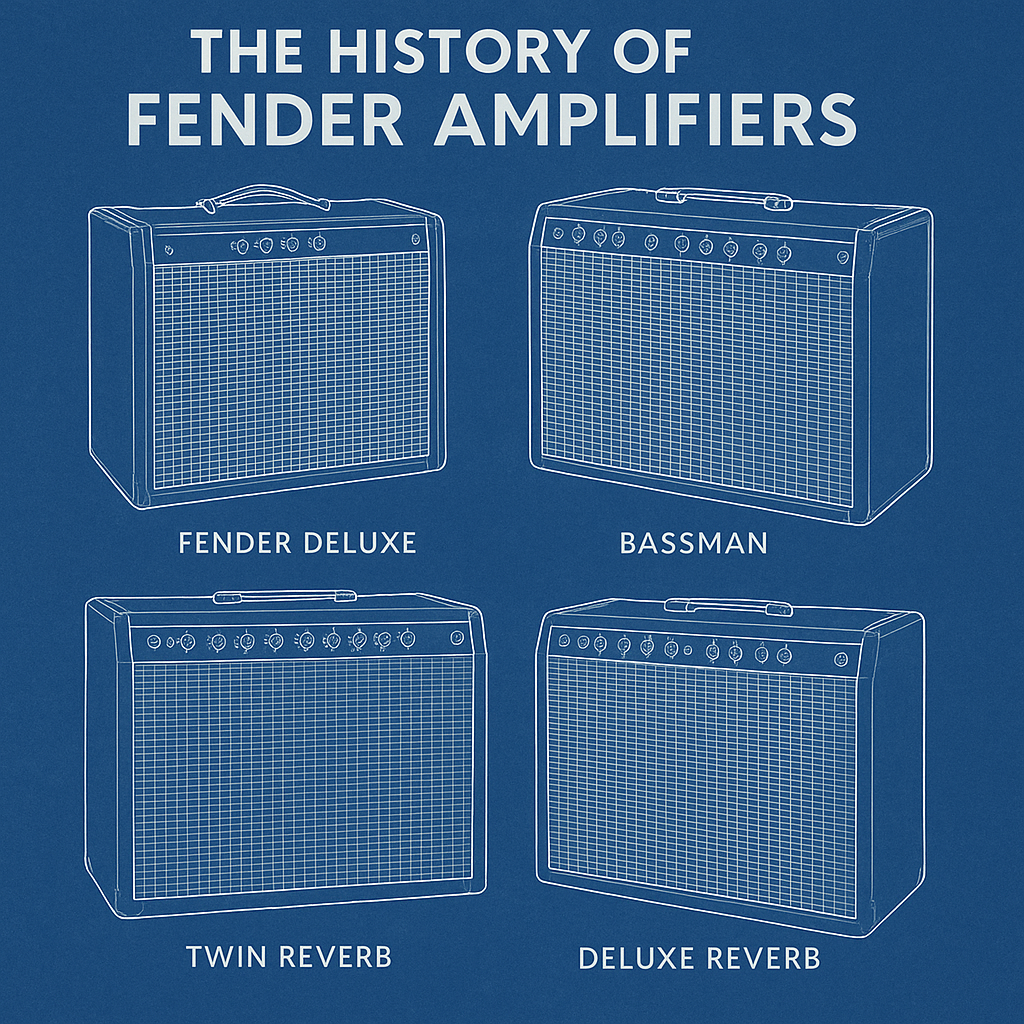
When we talk about the sound of electric guitar, we’re inevitably talking about Fender amplifiers. Since the 1940s, Fender has been at the forefront of amplifier design, helping define the sound of blues, rock ‘n’ roll, country, surf, and more. The clean tones, lush reverb, and musical overdrive of classic Fender amps have made them staples in studios and on stages around the world.
The Birth of Fender Amps (Late 1940s – Early 1950s)
Leo Fender’s first foray into amplifier design came alongside the creation of the Telecaster and Precision Bass. Early Fender amps like the Princeton, Deluxe, and Champion featured simple circuits and modest output, but were revolutionary for their time. These amps came in “TV-front” cabinets and featured tweed-covered pine shells that became iconic in their own right.
Key Early Models:
- Fender Deluxe (5A3, 5B3, 5C3…) – Known for its warm, rich overdrive.
- Fender Princeton – A favorite for students and small gigs.
- Fender Bassman (1952) – Originally a bass amp, it became a cornerstone of guitar tone.
The Tweed Era (1950s)
The “tweed” era saw Fender solidify its reputation. The 5E3 Deluxe, Twin, and Bassman circuits introduced a fuller, more aggressive tone. The 1959 Bassman in particular, with its 4×10 speaker configuration and dual 6L6 output tubes, would later inspire the design of the Marshall JTM45 and countless others.
Tweed Traits:
- Cathode-biased designs
- Saggy, compressed overdrive
- Harmonically rich response
The Brownface and Blonde Eras (Early 1960s)
By the early ’60s, Fender moved to the brownface and blonde tolex coverings. The circuits became more refined, with the introduction of tremolo and improved reverb designs. Models like the Vibrolux, Showman, and Bandmaster became favorites for surf guitarists and instrumental rock bands.
Innovations:
- Harmonic tremolo (as seen in the brownface Super)
- More robust transformers and improved tonal balance
The Blackface Revolution (1963–1967)
In 1963, Fender unveiled the blackface era—a golden age of amp tone. These amps offered cleaner headroom, scooped mids, lush spring reverb, and deep tremolo.
Most Iconic Models:
- Fender Twin Reverb – Loud, clean, and lush; a favorite for pedal users.
- Deluxe Reverb – A studio legend with perfect overdrive at manageable volumes.
- Princeton Reverb – Small but mighty, ideal for recording and jazz.
These amps defined the tones of players like Stevie Ray Vaughan, Eric Clapton, and Mike Bloomfield.
Silverface and the CBS Years (1968–1981)
After CBS acquired Fender in 1965, aesthetic and circuit changes led to the silverface era. Some changes were cosmetic, but others—like altering the negative feedback loop—changed the sound, often making the amps cleaner and stiffer.
Though purists often prefer blackface tones, silverface amps like the Super Reverb, Twin, and Champ still found favor with pros and remain affordable vintage gems.
Modern Era and Reissues (1982–Present)
In the 1980s and ’90s, Fender began reissuing its classic amps, starting with the ‘65 Twin Reverb and Deluxe Reverb. The Custom Shop also developed hand-wired recreations like the ‘57 Deluxe and ‘59 Bassman LTD.
More recently, Fender has embraced modern players with innovations like:
- Tone Master Series – Lightweight digital modeling of classics
- Hot Rod Series – Affordable workhorse amps
- Blues Junior – A modern classic with vintage vibes
Legacy and Influence
Fender amps are more than gear—they’re instruments in their own right. Their clean tones and pedal-friendly voicings have made them the platform of choice for artists across genres.
Famous Fender Amp Users:
- Jimi Hendrix – Used a Twin Reverb early on
- Keith Richards – Fender Champ in the studio
- George Harrison – Used a Showman during Let It Be sessions
- Buddy Guy – A lifelong user of the Super Reverb
- John Mayer – Known for his love of the Two-Rock-meets-Deluxe tone
Conclusion
From dusty tweed boxes to sleek blackface heads, Fender amplifiers have helped define the voice of the electric guitar. Whether you’re chasing vintage mojo or modern reliability, there’s a Fender amp for every player—and their legacy continues to hum from backlines around the world.