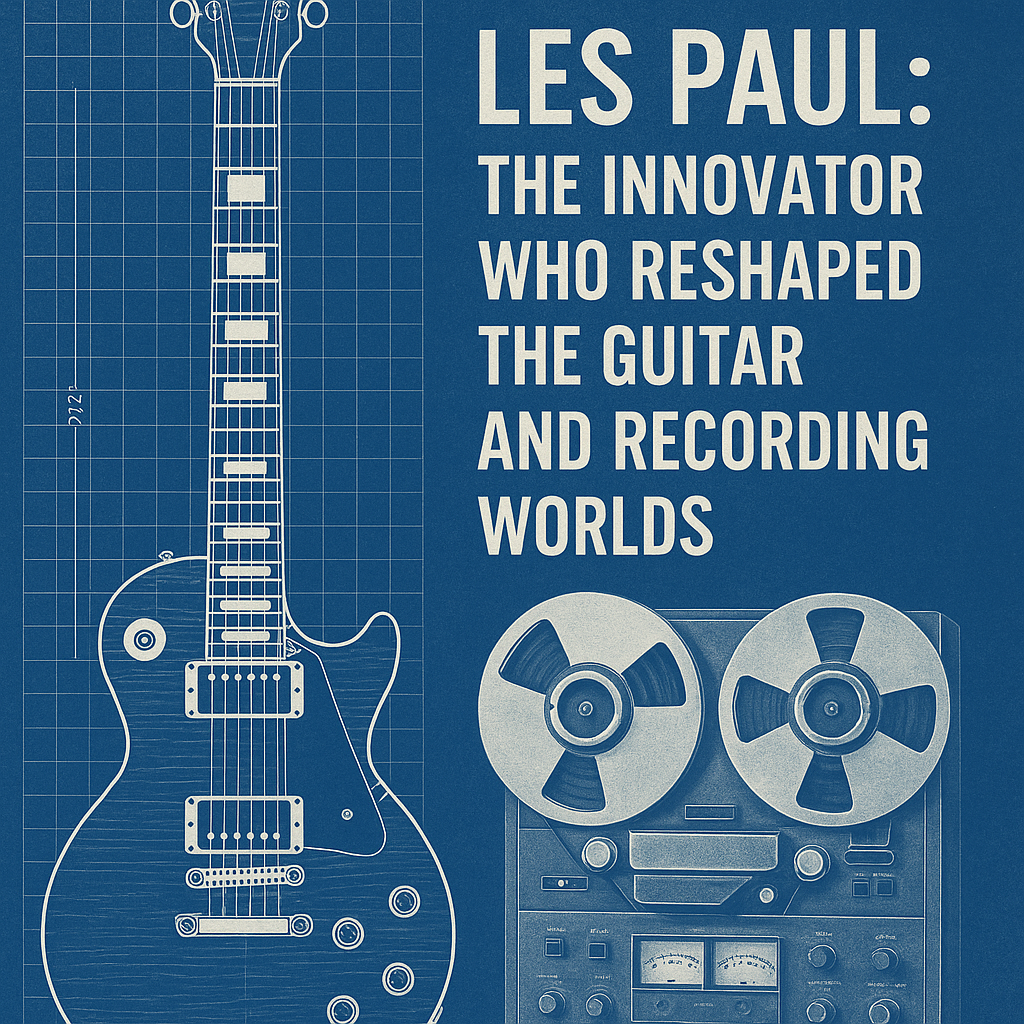
Les Paul’s name is instantly recognisable to musicians, thanks in large part to the iconic Gibson Les Paul guitar. But beyond his blazing guitar licks and hit records, Les Paul was a prolific inventor whose innovations transformed the very fabric of music. From the invention of the solid-body electric guitar to groundbreaking developments in recording technology, his work left a lasting legacy on both the instruments we play and how we capture sound.
The “Log”: Birth of the Solid-Body Electric Guitar
In the 1940s, Les Paul introduced a crude but revolutionary concept: “The Log”—a 4×4 block of pine with a guitar neck, strings, and two pickups attached. He mounted guitar “wings” on the sides to make it look more conventional, but the focus was clear: reduce feedback and enhance sustain by using a solid body.
At the time, mainstream guitars were hollow-bodied and suffered from feedback when amplified. Les Paul’s design challenged this norm and laid the groundwork for what would become the modern electric guitar. Though initially rejected by Gibson, the idea eventually evolved into the now-legendary Gibson Les Paul, launched in 1952.
Multi-Track Recording: Rewriting the Studio Playbook
Just as he reimagined the guitar, Les Paul also reimagined how music could be recorded.
In the late 1940s and early 1950s, he pioneered multi-track recording, allowing different instruments (or takes) to be recorded separately and layered together. This was a massive leap from the “one-take” method of live mono recording.
His innovation began with sound-on-sound techniques using acetate discs, and later, modifying Ampex tape machines to record multiple tracks independently. This enabled:
- Overdubbing vocals and instruments
- Experimentation with arrangements
- Cleaner production
- Greater artistic control in the studio
Songs like “How High the Moon” (with Mary Ford) showcased this technique, where Mary’s harmonies and Les’s guitar parts were recorded in layers—something unheard of at the time.
Other Innovations and Techniques
1. Tape Delay & Echo Effects
Les Paul manipulated tape machines to create slapback echo, reverb, and other time-based effects. These would later become staples in rock, pop, and country production.
2. Variable Speed Recording
He experimented with recording at one speed and playing back at another, creating interesting tonal effects and pitch changes—a precursor to later studio tricks used by artists like The Beatles.
3. Guitar Design Features
While working with Gibson, Les advocated for features like:
- A carved maple top for brightness and sustain
- Set necks for better resonance
- Humbucking pickups (later refined by Seth Lover) to reduce noise and enhance tone
Influence and Legacy
Les Paul’s ideas went on to shape countless aspects of music:
- Guitar manufacturing was forever altered, with companies like Fender and Gibson racing to innovate in solid-body design.
- Modern recording studios adopted and built upon his multi-tracking concepts.
- Artists like The Beatles, Jimi Hendrix, Frank Zappa, and Prince benefited directly from his inventions.
In recognition of his impact, Les Paul received a Grammy Lifetime Achievement Award, was inducted into the Rock and Roll Hall of Fame, and has a permanent place in the National Inventors Hall of Fame.
Final Notes
Les Paul didn’t just play music—he engineered its future. His blend of artistry and innovation paved the way for modern electric guitar tone and contemporary recording techniques. Every time a guitarist plugs into a solid-body instrument or a producer lays down layered tracks in a DAW, they’re working in a world shaped by Les Paul.