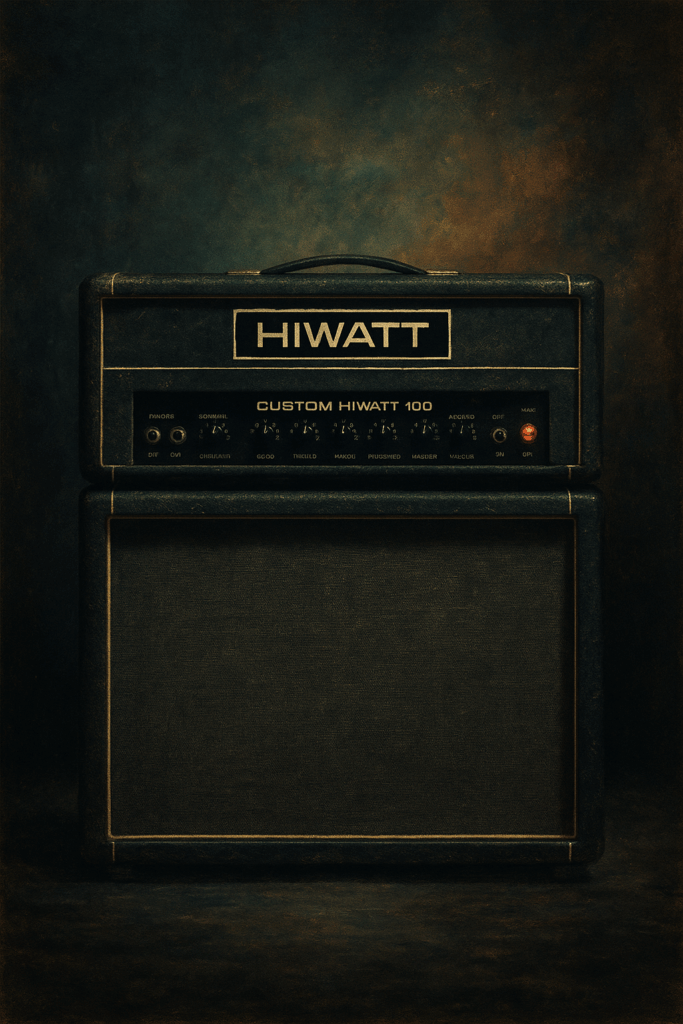
Hiwatt amplifiers occupy a unique space in the pantheon of British guitar amplification. Known for their military-grade build quality, massive headroom, and crystalline clarity, Hiwatt amps were the secret weapon behind some of rock’s loudest and most precise tones. While not as commercially ubiquitous as Marshall or Vox, Hiwatt earned a cult following among discerning players who needed volume, articulation, and road-ready reliability.
Origins: The Birth of Hiwatt
Hiwatt was founded in the mid-1960s by Dave Reeves, an engineer and amp technician who previously worked for Sound City and Mullard. Dissatisfied with the inconsistent quality of other British amps at the time, Reeves began building his own line of amplifiers under the Hiwatt name, focusing on rugged construction and clean, powerful tone.
From the beginning, Reeves set out to build amps with unmatched attention to detail—hand-wired turret board construction, high-spec components, and steel chassis were all standard. These amps were designed to survive the rigors of professional touring and deliver consistent tone night after night.
The Classic Hiwatt Sound
Unlike Marshalls, which are known for their midrange bark and distortion, Hiwatt amps excelled in high headroom, tight low end, and sparkling top-end clarity. Their design incorporated Partridge transformers, EL34 tubes, and precision wiring that allowed players to push their amps hard without losing articulation. The result was a clean-but-loud sound that took pedals beautifully and sliced through band mixes like a scalpel.
Famous Models
Hiwatt DR103 (Custom 100)
The flagship amp. A 100-watt behemoth with clean, thunderous output and pristine note separation. It was built like a tank and capable of extreme volume without breakup. It remains the most iconic Hiwatt model.
Hiwatt DR504 (Custom 50)
The 50-watt version of the DR103, delivering similar tonal characteristics at slightly more manageable volumes. Perfect for players who wanted Hiwatt tone without blowing out windows.
Hiwatt SA212 Combo
A combo version designed more for studio or smaller stage applications. Still powerful and clean, with a slightly warmer response due to the closed-back combo cabinet.
Hiwatt DG103 and DG504
Part of the David Gilmour Signature Series, these amps were based on the exact specifications of Gilmour’s modded Custom Hiwatts used during Pink Floyd’s legendary ’70s tours and recordings.
Hiwatt Bulldog Series & Studio/Stage Amps
In later years, Hiwatt introduced more modern takes and reissues, as well as smaller studio-friendly amps for home and recording use. Some newer models feature master volumes and modern conveniences without sacrificing tonal purity.
Legendary Players
David Gilmour (Pink Floyd)
Perhaps the most famous Hiwatt user, Gilmour used a pair of Custom 100s (DR103) extensively in the ’70s and beyond. His combination of Hiwatt heads, WEM cabinets, and custom effects gave him that expansive, spatially rich tone heard on Dark Side of the Moon, Wish You Were Here, and The Wall. Gilmour’s sound is a benchmark for clean, articulate lead tones with ambient modulation.
Pete Townshend (The Who)
A foundational Hiwatt player. Townshend’s explosive live performances were powered by multiple DR103 heads into towering speaker cabinets. His tone was big, bold, and brutally loud—perfect for The Who’s stadium-shaking rock.
Jimmy Page (Led Zeppelin)
While primarily associated with Marshall and Supro, Page used Hiwatt amps for clean tones and studio experimentation, particularly in later Zeppelin albums and live performances.
Jimi Hendrix
Though mostly tied to Marshall, Hendrix was known to experiment with Hiwatts in the studio. He reportedly appreciated the clean headroom and clarity when layering multiple guitar parts.
Alex Lifeson (Rush)
Lifeson used Hiwatts during Rush’s early and mid-70s era, especially during 2112 and A Farewell to Kings. Their clarity helped his complex chord voicings and delay-laden textures shine.
Kurt Cobain (Nirvana)
Cobain reportedly used a Hiwatt SA212 combo during the Bleach era. He appreciated its clean tones and robustness for small clubs and early gigs.
Legacy and Modern Relevance
Despite Dave Reeves’ untimely death in 1981, Hiwatt amplifiers have persisted—largely thanks to their stellar reputation and demand among tone connoisseurs. Ownership and manufacturing shifted several times over the decades, but the classic designs have been faithfully reissued and celebrated.
Modern boutique builders often cite Hiwatt circuits as the gold standard for clean, high-headroom designs. Today, players looking for a pedal platform amp with near-military-grade construction still turn to Hiwatt or Hiwatt-inspired clones.
Conclusion
Hiwatt amplifiers carved out a distinct niche with their precise engineering, thunderous clean tone, and legendary durability. Favoured by sonic architects like Gilmour and Townshend, these amps proved that clean doesn’t have to mean sterile. Whether blasting arenas or layering textured studio tracks, Hiwatt’s signature sound remains a benchmark for British amplifier excellence.