When it comes to shaping how a guitar feels and even sounds, fret wire plays a much bigger role than many players realise. From vintage-spec skinny frets to the jumbo wire preferred by modern shredders, the gauge and material of your frets can directly influence playability, tone, and the overall lifespan of your instrument’s fingerboard. Let’s dive into the history, the types of fret wire available, and how each impacts your playing experience.
A Brief History of Fret Wire
The earliest stringed instruments used gut or wire frets tied around the neck. As modern fretted instruments like guitars and mandolins developed through the 18th and 19th centuries, luthiers began embedding fixed metal fret wire into fingerboards for precision and durability.
In the 20th century, as electric guitars rose to prominence, manufacturers like Fender and Gibson began standardising fret wire sizes. Gibson’s Les Pauls of the ‘50s used narrower frets, while Fender favoured slightly taller wire on their Stratocasters and Telecasters. As player preferences evolved — especially in the ’80s shred era — fret wire grew taller and wider, giving birth to today’s “jumbo” and “super jumbo” varieties.
Fret Wire Gauges: The Key Types
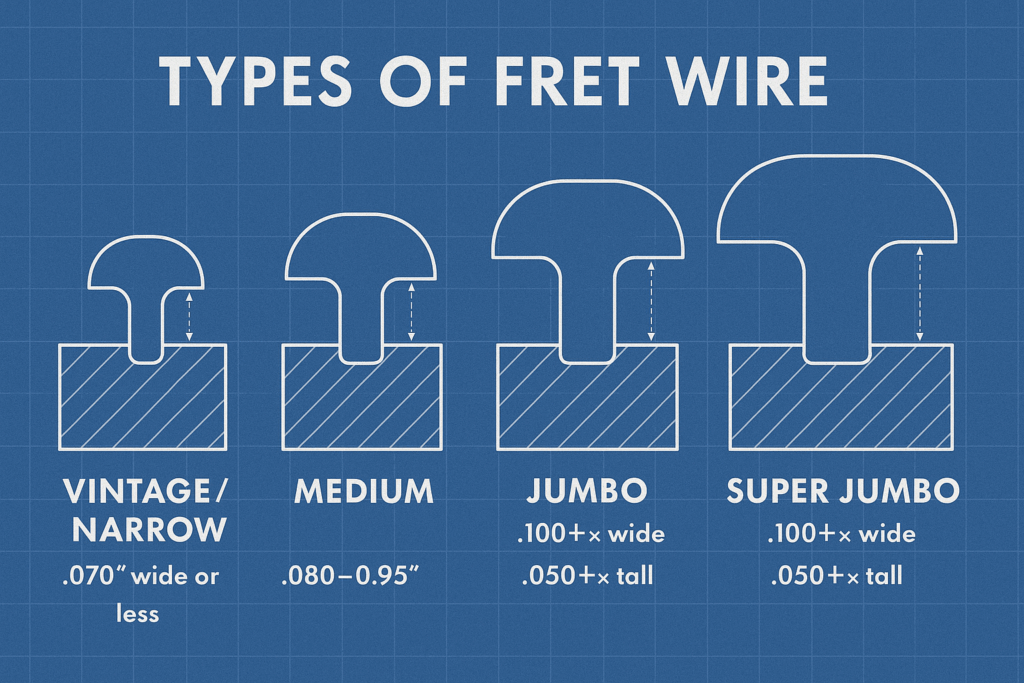
Fret wire is typically measured in crown width (how wide the fret is across the top) and crown height (how tall it is above the fingerboard). Here are the main categories:
Vintage / Narrow (.070” wide or less)
- Examples: Dunlop 6230, Jescar 37080
- Feel: Classic, low-profile
- Best for: Players seeking that ‘50s Fender feel or those who don’t bend aggressively
- Pros: Subtle fretting feel; notes sit “closer” to the fingerboard
- Cons: Less sustain, can wear faster
Medium (.080”–.095”)
- Examples: Dunlop 6105, Jescar 47104
- Feel: Balanced — not too tall, not too wide
- Best for: Players who want versatile fret height for both rhythm and lead work
- Pros: Great all-rounder; suits many genres
- Cons: May feel too small for heavy benders or legato players
Jumbo (.100”+ wide, .050”+ tall)
- Examples: Dunlop 6100, Jescar 57110
- Feel: Smooth for bending and fast legato
- Best for: Blues, metal, shred, high-gain players
- Pros: Easy bending, less fingerboard contact, longer lifespan
- Cons: Can feel “clunky” for players with a lighter touch; can intonate poorly if not leveled well
Super Jumbo / Extra Wide
- Examples: Jescar 58118, custom stainless options
- Feel: Maximum height and width
- Best for: Technical players, slide players, or those with a light fretting hand
- Pros: Minimum drag, ideal for fast or expressive playing
- Cons: May cause tuning/intonation issues if improperly installed
How Fret Wire Affects Playability
1. Bending & Vibrato:
Taller frets make it easier to grab and bend strings without your fingers dragging on the fingerboard. This is why many lead players and soloists prefer medium-jumbo or jumbo wire.
2. Speed & Legato:
Flatter, taller frets with polished surfaces reduce friction — ideal for hammer-ons, pull-offs, and sweep picking.
3. Chording & Intonation:
Narrow or lower frets give more direct contact with the fingerboard, preferred by rhythm players or those with a lighter touch. But pressing too hard on tall frets can cause notes to go sharp.
4. Fatigue & Comfort:
Some players find low frets require more finger effort, especially during long sessions. Taller frets can reduce hand fatigue — but they can also highlight uneven fretting technique.
Tone: Does Fret Wire Really Make a Difference?
Yes — but subtly. While fret material and gauge don’t change tone as drastically as pickups or wood, they can subtly affect:
- Sustain: Taller frets can improve sustain by minimizing contact with the wood.
- Attack: Stainless steel frets often give a slightly brighter and “zingier” top-end compared to nickel-silver.
- Dynamic feel: Lower frets yield a softer response; higher frets give a snappier, more immediate attack.
Materials: Not Just About Size
Most fret wire is made from nickel-silver (NS), which is soft and traditional. But alternatives are available:
- Nickel-Silver (18% NS): Warm tone, easy to work with, wears faster.
- Stainless Steel: Harder, longer-lasting, brighter tone, more work-intensive to install.
- EVO Gold: A copper-titanium alloy with warm tone and longer wear, less bright than stainless.
Choosing the Right Fret Wire for You
Here are a few guiding thoughts:
| Player Type | Recommended Gauge | Notes |
|---|---|---|
| Vintage purist | Narrow/low (e.g. 6230) | Matches ’50s/’60s spec |
| Blues / Classic Rock | Medium-jumbo (e.g. 6105) | Great for bends, not too tall |
| Metal / Shred | Jumbo or Super Jumbo | Great for speed and clarity |
| Jazz / Fingerstyle | Medium or narrow | Comfort and dynamic control |
| Slide Guitar | Tall frets (jumbo or SS) | Avoid bottoming out during slides |
Final Thoughts
Fret wire might be one of the most overlooked parts of a guitar, but it’s also one of the most crucial for tailoring your ideal feel and tone. Whether you’re chasing buttery bends, lightning-fast legato, or vintage-correct mojo, the right fret wire can make your guitar feel like it was built just for you.