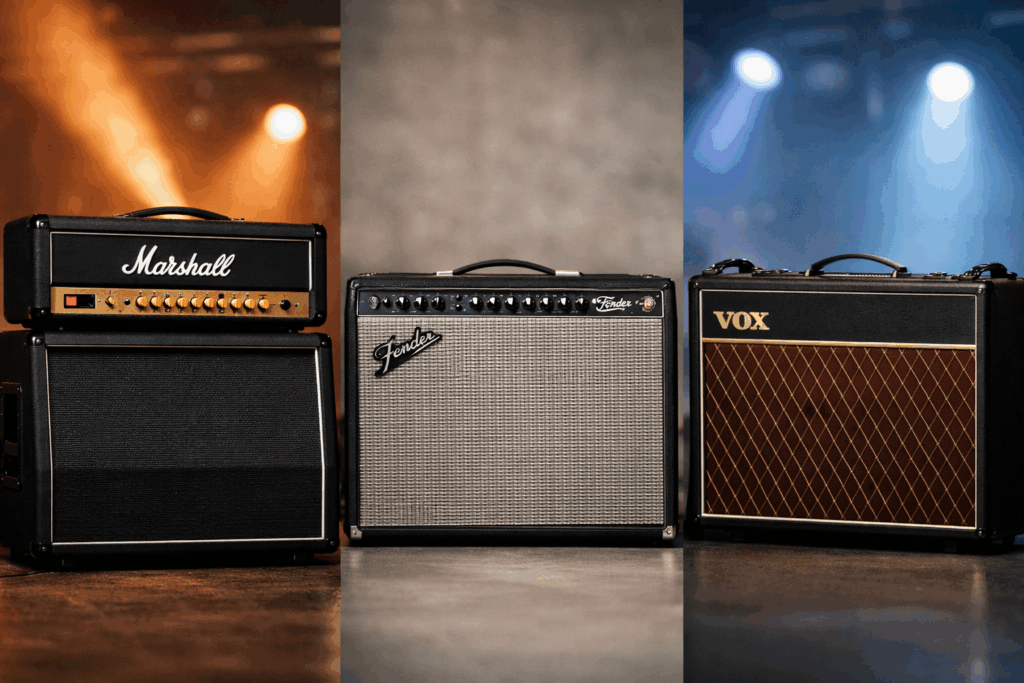
When guitarists talk about tone, three amplifier brands inevitably dominate the conversation: Marshall, Fender, and Vox.
Each represents a distinct sonic philosophy, shaped by geography, musical culture, and circuit design. Understanding how they differ will help you choose the right amp for your playing style, guitar, and musical goals.
Fender: Clean Headroom and American Clarity
Fender amplifiers are the benchmark for clean tone. Designed in the US during the 1950s and ’60s, classic Fender circuits prioritise clarity, sparkle, and wide dynamic range.
What Fender Sounds Like
- Bright, glassy highs
- Tight, controlled low end
- Scooped mids that leave space in a mix
- Huge clean headroom before distortion
Classic models like the Twin Reverb and Deluxe Reverb stay clean at volumes where other amps are already breaking up. When they do distort, it’s smooth and rounded rather than aggressive.
Best For
- Country, surf, funk, jazz
- Pedal-based rigs
- Players who want pristine cleans and dynamic response
In short: Fender amps are a clean canvas—perfect if your tone comes from pedals, fingers, or pickups rather than amp distortion.
Vox: Chime, Compression, and British Character
Vox amps sit between Fender clarity and Marshall aggression, but with a character all their own. The iconic AC30 helped define British pop and rock in the 1960s.
What Vox Sounds Like
- Brilliant, chiming top end
- Forward upper mids
- Natural compression as the amp is pushed
- Early breakup compared to Fender
Vox amps don’t stay clean for long. Instead, they transition quickly into a harmonically rich, jangly overdrive that responds beautifully to picking dynamics.
Best For
- Indie, Britpop, classic rock
- Rhythm-heavy playing
- Jangle, edge-of-breakup tones
In short: Vox amps excel at expressive, mid-rich tones that sparkle and grind at the same time.
Marshall: Power, Punch, and Rock Authority
Marshall amps were born from a desire to be louder and meaner than American designs. The result is the sound of rock itself—bold, mid-focused, and unapologetically aggressive.
What Marshall Sounds Like
- Thick, punchy midrange
- Strong low-end thump
- Aggressive upper mids when driven
- Iconic crunchy to high-gain distortion
From the classic Plexi to the snarling JCM800, Marshall amps are designed to be pushed hard, producing harmonically dense distortion that cuts through a band mix.
Best For
- Rock, hard rock, punk, metal
- Players who rely on amp overdrive
- Power chords, lead work, and sustain
In short: Marshall amps are about authority, volume, and attitude.
Side-by-Side Tone Comparison
| Brand | Core Character | Breakup Style | Famous For |
|---|---|---|---|
| Fender | Clean, bright, open | Late, smooth breakup | Clean tones, pedal platforms |
| Vox | Chimey, mid-forward | Early, compressed | Jangle, edge-of-breakup |
| Marshall | Thick, aggressive | Strong, crunchy drive | Rock distortion |
Which One Is Right for You?
Choosing between Marshall, Fender, and Vox isn’t about which is better—it’s about which complements your playing.
- Choose Fender if you want pristine cleans and rely on pedals
- Choose Vox if you love chime, touch sensitivity, and vintage British tone
- Choose Marshall if your sound lives in overdrive and power
Many players ultimately own more than one, because each fills a different tonal role.
Final Thoughts
Marshall, Fender, and Vox didn’t just build amplifiers—they defined entire musical movements. Whether you’re chasing glassy cleans, jangly crunch, or roaring distortion, understanding these tonal differences helps you get closer to the sound in your head.