Few companies have shaped the sound of electric guitar as profoundly as Boss. From bedroom players to stadium-filling professionals, Boss pedals have become a universal language of tone—recognisable by their bold colours, tank-like enclosures, and near-bulletproof reliability.
Since the mid-1970s, Boss has defined what a compact effects pedal should be, creating designs that are not only sonically influential but also culturally iconic.
Origins: Boss and the Rise of the Compact Pedal
Boss was launched in 1973 as a division of Roland, initially producing accessories and rhythm machines. The real turning point came in 1977 with the release of the Boss CE-1 Chorus Ensemble.
Derived from Roland’s legendary JC-120 Jazz Chorus amplifier, the CE-1 was the world’s first standalone chorus pedal. Large, mains-powered, and expensive by the standards of the day, it nonetheless changed guitar tone forever—introducing lush modulation that quickly became a studio staple.
Soon after, Boss refined its vision with the now-legendary compact pedal format: stompboxes that were affordable, consistent, and tough enough for constant touring.
The Golden Era: Late 1970s to 1980s
The late ’70s and ’80s were a creative explosion for Boss. Many of the pedals released during this era are still in production—or revered in vintage circles.
Iconic Boss Pedals
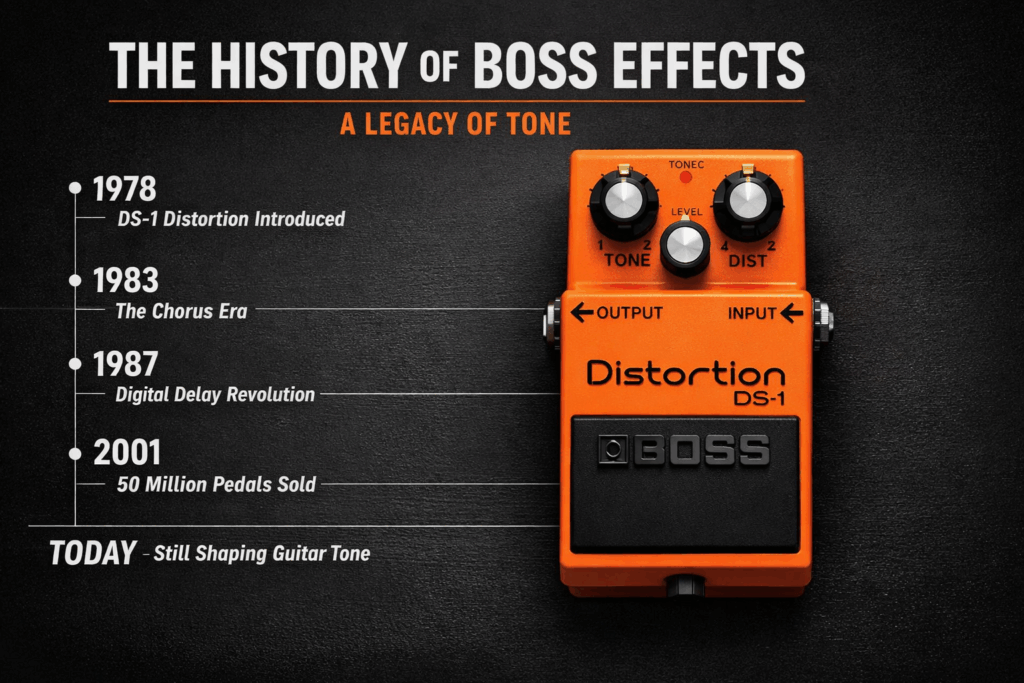
- Boss DS-1 Distortion (1978) One of the best-selling pedals of all time. Sharp, cutting, and aggressive, the DS-1 became synonymous with rock and punk.
- Boss SD-1 Super OverDrive (1981) A warmer, more dynamic drive with asymmetrical clipping—hugely influential and still a favourite boost for valve amps.
- Boss CE-2 Chorus (1979) Compact, warm, and musical, the CE-2 refined the CE-1 concept into pedalboard-friendly perfection.
- Boss DM-2 Analog Delay (1981) Dark, organic repeats that remain some of the most sought-after analog delay tones ever produced.
These pedals helped standardise effects layouts, control sets, and expectations across the industry. If you know how to use one Boss pedal, you can use almost all of them.
Boss and the Players Who Defined Eras
Boss pedals didn’t just shape tones—they shaped genres.
- Kurt Cobain used the DS-1 (and later DS-2) to fuel the raw, explosive sound of Nirvana.
- Prince relied heavily on Boss modulation and drive pedals for his shimmering funk-rock tones.
- The Edge built vast rhythmic soundscapes with Boss delays, choruses, and digital units.
- Johnny Marr famously used Boss chorus pedals to create the lush, layered textures of The Smiths.
From post-punk to metal, pop to shoegaze, Boss pedals quietly powered countless classic records.
Reliability as a Design Philosophy
One reason Boss pedals are so widely used is simple: they almost never break. Their cast-metal enclosures, recessed knobs, and dependable footswitches were engineered for life on the road.
While boutique pedals often chase vintage quirks or extreme character, Boss has always prioritised consistency—a pedal bought today should behave predictably on any stage, anywhere in the world.
This reliability also made Boss pedals a favourite of rental companies, touring musicians, and studios, further cementing their place in modern music history.
Digital Innovation and Modern Boss
Boss embraced digital technology early, releasing the Boss DD-3 Digital Delay in 1986—a pedal that became an industry standard and remains in production decades later.
In recent years, Boss has bridged past and present with the Boss Waza Craft range, offering Japanese-made pedals with refined circuits, vintage voicing, and modern flexibility. Pedals like the CE-2W and DM-2W demonstrate how deeply Boss understands its own legacy.
Boss Effects Today: A Lasting Legacy
Boss pedals are often a guitarist’s first effects—and just as often, their last. Whether you’re building a minimalist board or a complex stereo rig, Boss remains the backbone of modern pedal culture.
From analog classics to cutting-edge digital designs, Boss effects represent something rare in the gear world: genuine universality. They are tools, icons, and reference points—pedals that don’t just follow trends, but quietly define them.