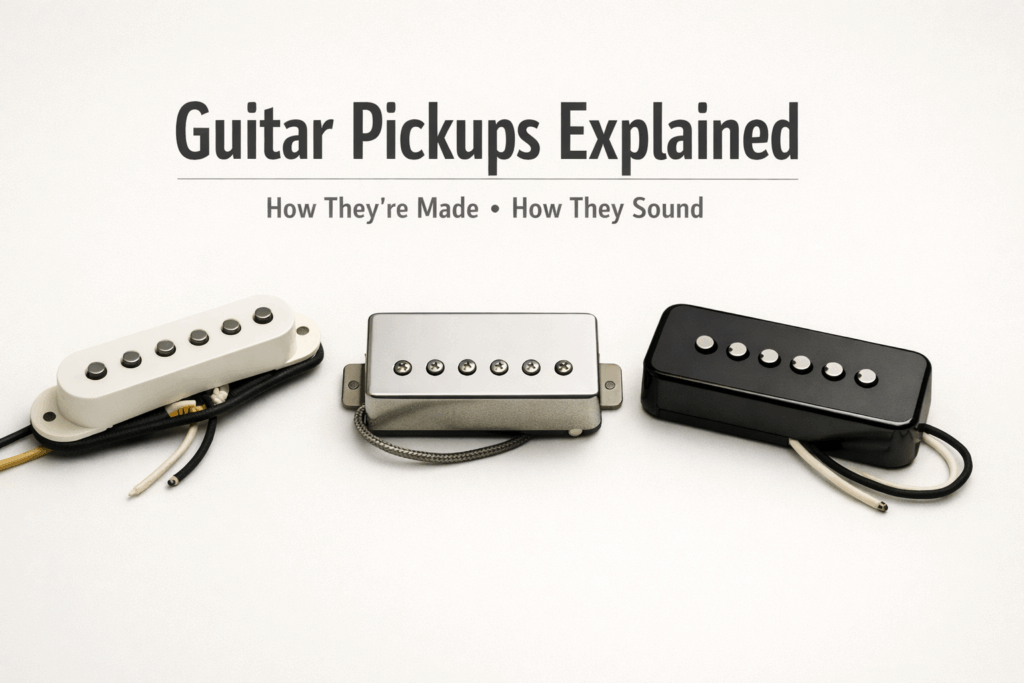
If wood is the soul of a guitar, pickups are its voice.
Whether you’re dealing in vintage PAFs, hot-rodded ceramic monsters, or boutique hand-wound single coils, understanding pickups is essential — not just for tone chasing, but for buying, selling, and valuing instruments accurately.
At The Guitar Marketplace, we regularly see guitars whose entire personality is defined by what’s under the strings. So here’s a deep dive into the main pickup types, how they’re constructed, and how they actually sound in the real world.
1. Single-Coil Pickups
How They’re Made
Classic single-coils — like those found in a Fender Stratocaster or Fender Telecaster — consist of:
- Six individual magnetic pole pieces (usually Alnico)
- Fine copper wire wrapped thousands of times around a bobbin
- Simple two-conductor wiring
The number of windings (measured in DC resistance) affects output and tone. Vintage-style coils are typically lower output, while “overwound” versions push the amp harder.
How They Sound
- Bright
- Clear
- Articulate
- Dynamic
- Slight natural compression when pushed
They are famous for:
- Glassy cleans
- Funk rhythm snap
- Texas blues bite
- Country twang
The downside? 60-cycle hum. Single coils are inherently noisy in certain environments.
2. Humbuckers
How They’re Made
Invented in the 1950s to eliminate noise, humbuckers use:
- Two coils wired out of phase
- A bar magnet beneath the coils
- Adjustable pole screws on one side
The two coils cancel electrical hum — hence the name.
Classic examples appear in the Gibson Les Paul Standard and Gibson SG Standard.
Magnet types matter:
- Alnico II – softer, sweeter
- Alnico V – tighter, punchier
- Ceramic – hotter, more aggressive
How They Sound
- Thicker
- Warmer
- Higher output
- More sustain
- Less noise
They’re the backbone of:
- Classic rock
- Hard rock
- Jazz
- Modern gain tones
Compared to single-coils, humbuckers compress more and emphasise mids.
3. P90 Pickups
How They’re Made
P90s sit somewhere between a single-coil and a humbucker in design:
- Single wide coil
- Bar magnets underneath
- Larger coil surface area than Strat-style pickups
You’ll commonly find them in a Gibson Les Paul Junior or Gibson ES-330.
How They Sound
- Raw
- Punchy
- Thick but still articulate
- Gritty when pushed
They hum like single-coils, but they have more midrange and girth. Think snarling rock ’n’ roll and expressive blues.
4. Active Pickups
How They’re Made
Active pickups (like those from EMG) include:
- Lower-wind coils
- Onboard preamp circuitry
- 9V (or 18V) battery power
The internal preamp boosts and shapes the signal before it hits your amp.
How They Sound
- Very high output
- Extremely tight low end
- Compressed
- Consistent
- Minimal noise
Perfect for modern metal, drop tunings, and precise high-gain articulation.
They lack some of the organic dynamic variation of passive pickups — but that’s often the point.
5. Mini Humbuckers, Filter’Trons & Other Variants
Mini Humbuckers
Found in guitars like the Gibson Les Paul Deluxe:
- Tighter bass
- Brighter top end
- More focused than full-size humbuckers
Filter’Trons
Originally developed by Gretsch:
- Lower output
- Chimey highs
- Clear low end
- Less midrange thickness
They sit beautifully between Fender clarity and Gibson warmth.
What Actually Changes the Tone?
When evaluating pickups — especially in a vintage retail context — consider:
1. Magnet Type
Alnico II vs V vs ceramic dramatically alters attack and feel.
2. Output / Wind Count
More windings = more output and mids, but often less clarity.
3. Coil Construction
Scatter-wound vs machine-wound can subtly change harmonic complexity.
4. Pot Values
500k pots = brighter.
250k pots = smoother.
Passive vs Active: The Big Divide
| Passive | Active |
|---|---|
| Organic dynamics | Consistent output |
| Sensitive to touch | Compressed feel |
| Can be noisy | Very quiet |
| React strongly to amp | More pre-shaped tone |
Final Thoughts: Why Pickups Matter in the Marketplace
From a retail perspective, pickups can:
- Significantly affect value (original PAFs vs modern replacements)
- Change a guitar’s entire tonal identity
- Influence buyer demographic
A 1960s Strat with original grey-bottom pickups tells a different story than one routed for humbuckers.
At The Guitar Marketplace, we see time and again that understanding pickups isn’t just about tone — it’s about history, originality, and intent.
Because in the end, pickups aren’t just components.
They’re the translators between wood, string, and speaker.
And sometimes, they’re the difference between “nice guitar” and “never selling this one.” 🎸