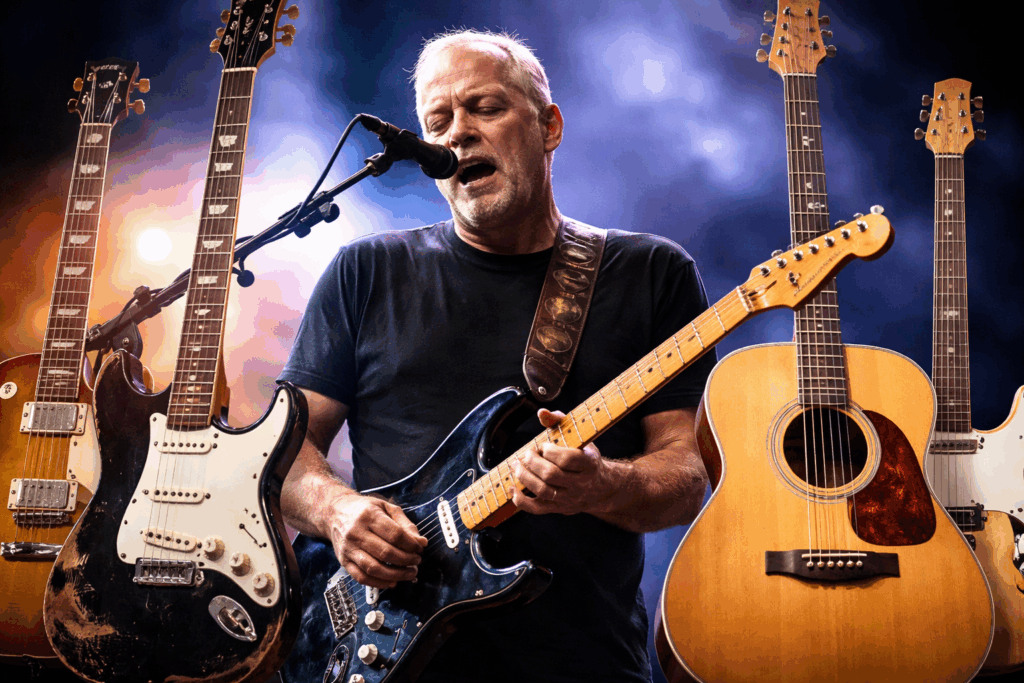
Few guitarists are as instantly recognisable—or as emotionally expressive—as David Gilmour. Best known as the sonic architect behind Pink Floyd, Gilmour’s sound is not defined by speed or flash, but by sustain, phrasing, and immaculate tone. Central to that sound is a carefully chosen collection of guitars that evolved alongside his career. From battered Stratocasters to iconic Les Pauls and understated acoustics, here’s a deep dive into the guitars that shaped David Gilmour’s legendary voice.
The Black Strat – Fender Stratocaster (1969–1986, 1990s)
No guitar is more closely associated with David Gilmour than his famous Black Strat. Originally a late-60s Fender Stratocaster, this instrument underwent countless modifications over the years, reflecting Gilmour’s relentless pursuit of the perfect tone.
Key features evolved over time:
- Black refinish over a sunburst body
- Maple and later rosewood necks
- Various pickup combinations (including early single-coils and later EMG setups)
- Shortened tremolo arm for expressive vibrato
The Black Strat defined the soaring leads on albums like The Dark Side of the Moon, Wish You Were Here, and The Wall. Its glassy clarity and vocal sustain remain the benchmark for Stratocaster tone.
Fender Stratocaster Variants – The Workhorses
Beyond the Black Strat, Gilmour relied on several other Stratocasters throughout his career:
- A 1957 reissue Strat used heavily in the 1980s
- Candy Apple Red and sunburst Strats for touring redundancy
- Signature Stratocasters built to replicate his preferred specs
These guitars ensured consistency on stage while preserving the expressive touch that defines his playing.
Gibson Les Paul – Sustain and Authority
While Strats dominated his rig, Gilmour turned to Gibson Les Pauls when thicker sustain was required. A Goldtop with P-90s and later a Les Paul Custom famously delivered the iconic Comfortably Numb solos during late-70s and early-80s performances.
The Les Paul brought:
- Increased sustain
- Mid-range punch
- A darker, more authoritative voice
This contrast perfectly complemented the Strat’s chime, expanding Gilmour’s tonal palette.
Fender Telecaster – Studio Precision
Though less visible live, Telecasters played an important studio role. Gilmour used them for rhythm parts and layered textures, most notably on early Pink Floyd recordings. Their cutting clarity helped define the band’s spacious mixes.
Acoustic Guitars – Emotion Unplugged
Gilmour’s acoustic work is equally iconic. He has long favoured Martin and Guild acoustics, using them for classics like Wish You Were Here.
These guitars emphasised:
- Warm, balanced projection
- Clear note separation
- A natural, intimate feel
They proved that Gilmour’s expressiveness transcends amplification.
Lap Steel & Pedal Steel – Atmospheric Colour
For gliding, vocal-like melodies, Gilmour incorporated lap steel guitars, particularly on The Dark Side of the Moon. These instruments added an otherworldly quality that became a hallmark of Pink Floyd’s sonic identity.
David Gilmour’s Guitar Philosophy
What sets Gilmour apart isn’t sheer quantity of gear, but thoughtful selection. Each guitar served a musical purpose—whether it was the articulate shimmer of a Strat, the singing sustain of a Les Paul, or the raw honesty of an acoustic. Combined with his phrasing, bends, and subtle vibrato, these instruments became extensions of his voice.
For players and collectors alike, Gilmour’s guitars remind us that tone is as much about feel and restraint as it is about equipment.