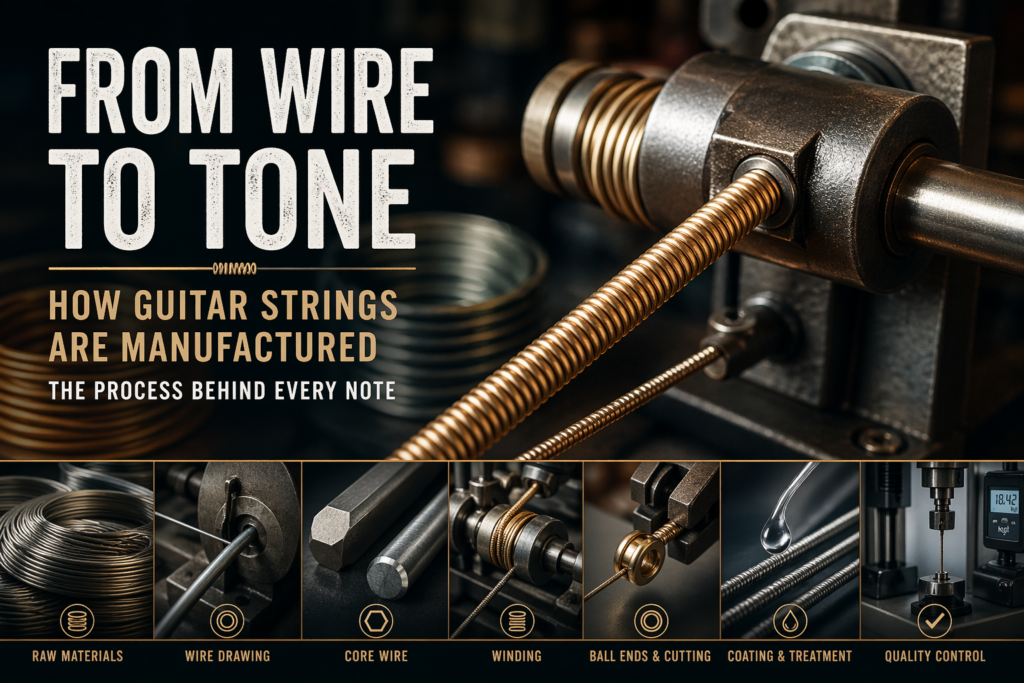
If you’ve ever opened a fresh pack of strings, there’s a certain ritual to it—the shine, the feel, even the smell. But behind that simple packet is a surprisingly intricate manufacturing process that blends metallurgy, precision engineering, and a bit of old-school craft. In this piece for The Guitar Marketplace, we’re taking a look at how guitar strings are made—from raw metal to the final product that shapes your tone.
The Raw Materials: All About the Alloys
At the heart of every guitar string is metal wire, but not just any wire. The materials used are carefully selected to balance tone, durability, and feel.
- High-carbon steel is used for plain strings (like your high E, B, and often G)
- Nickel-plated steel is common for electric guitar wound strings—offering warmth and balance
- Pure nickel provides a softer, vintage-style tone
- Phosphor bronze and 80/20 bronze dominate the acoustic world for their bright, resonant character
- Stainless steel offers increased longevity and a sharper attack
The process begins with large coils of wire—often referred to as music wire—manufactured to incredibly tight tolerances.
Drawing the Wire: Precision at a Microscopic Level
Before a string can be wound or cut, the metal must be drawn down to its exact thickness.
This is done through a process called wire drawing, where thick rods of metal are pulled through progressively smaller dies. Each pass reduces the diameter while increasing tensile strength.
This stage is absolutely critical—variations of even a fraction of a millimetre can affect tuning stability, feel, and intonation.
Core Wire Creation: The Foundation of the String
For wound strings, the core wire forms the backbone.
There are two main types:
- Hex core – A six-sided core that grips the wrap wire tightly, resulting in a brighter tone and more stable construction
- Round core – A traditional design that allows more flexibility and often produces a warmer, more vintage feel
The core wire is cut to length and prepared for winding.
Winding the Strings: Where Tone Takes Shape
This is where things get really interesting.
A wrap wire—usually nickel or bronze—is tightly wound around the core under controlled tension. The consistency of this winding is crucial:
- Too loose, and the string will feel uneven and unstable
- Too tight, and it can become brittle or lose resonance
Different winding styles also come into play:
- Roundwound – The most common, offering brightness and texture
- Flatwound – Smoother feel, darker tone (favoured in jazz)
- Halfwound (groundwound) – A compromise between the two
At this stage, the tonal character of the string really begins to emerge.
Ball Ends & Cutting: Finishing the Structure
Once wound, strings are cut to length and fitted with ball ends (for most electric and steel-string acoustics).
The ball end is secured by twisting or crimping the string wire tightly around it. This connection must be rock-solid—it’s the anchor point that holds tension when the string is tuned to pitch.
Coating & Treatment: Extending String Life
Many modern strings receive additional treatments to improve longevity:
- Polymer coatings (like those used by Elixir Strings) help resist dirt, sweat, and corrosion
- Cryogenic treatment is sometimes used to relieve internal stresses in the metal
- Anti-rust plating adds another layer of durability
These processes can significantly extend string life—but sometimes at the cost of a slightly altered feel or tone.
Quality Control: The Final Check
Before packaging, strings go through rigorous testing:
- Tensile strength tests ensure they won’t snap under tension
- Diameter checks confirm consistency
- Tone and feel testing (yes, often by real players)
Only once they pass inspection are they sealed—often in airtight packaging to prevent oxidation.
The End Result: Small Details, Big Impact
It’s easy to overlook just how much engineering goes into a set of strings. From the choice of alloy to the shape of the core and the precision of the winding, every step plays a role in how your guitar sounds and feels.
For players and collectors alike—especially those dealing in vintage or high-end instruments—the right strings can make all the difference. Whether you’re chasing a warm, broken-in blues tone or a bright, cutting modern sound, it all starts here.