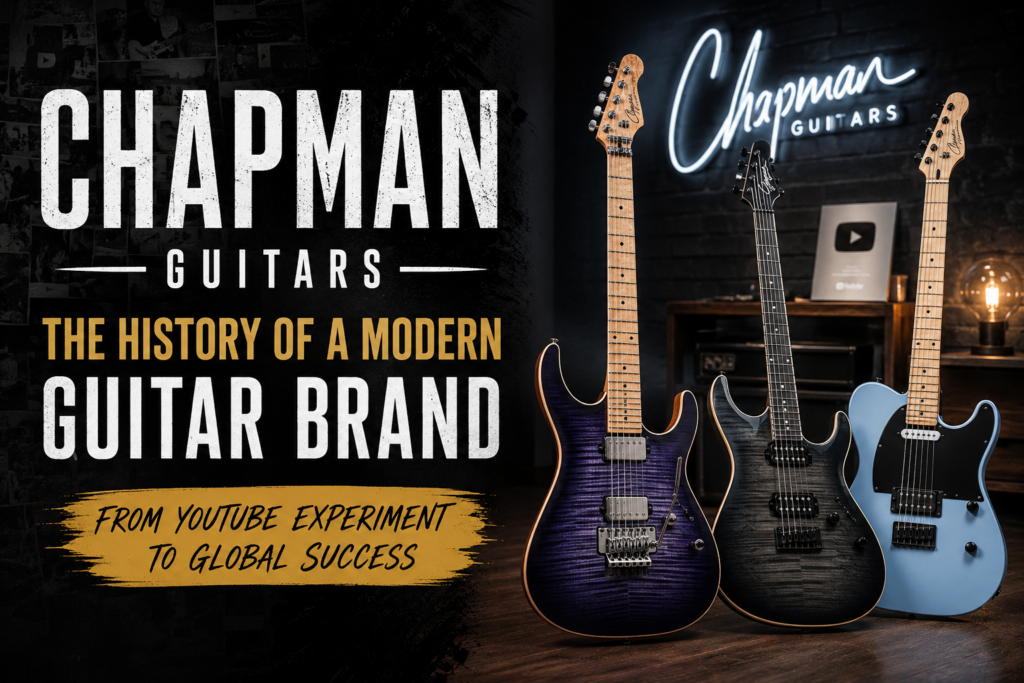
The History of Chapman Guitars
Few guitar companies have emerged in the twenty-first century with as much fanfare, controversy, and innovation as Chapman Guitars. Founded in 2009 by British guitarist and internet personality Rob Chapman, Chapman Guitars represented a new approach to instrument design—one that relied heavily on community feedback and direct engagement with players rather than traditional corporate product development.
In an industry dominated by historic names such as Fender, Gibson, and PRS Guitars, Chapman entered the market as a disruptive force. The company’s rise coincided with the growth of YouTube guitar culture, social media marketing, and a new generation of players seeking premium specifications at accessible prices.
Today, Chapman Guitars has become one of the most recognisable modern guitar brands, offering instruments ranging from affordable beginner models to professional-grade instruments used by touring musicians around the world.
The Origins of Chapman Guitars
The story begins with Rob Chapman, a British guitarist who built a following through online forums, demonstrations, and eventually YouTube content. During the late 2000s, Chapman became increasingly aware that many guitarists were frustrated with the compromises often found in mid-priced instruments.
Rather than creating another traditional guitar company, Chapman proposed an unusual concept: allow players themselves to help design the guitars.
Working alongside manufacturing partners in Asia, Chapman launched the first production model—the ML-1. The guitar combined familiar styling with modern specifications that players frequently requested, including jumbo frets, quality hardware, coil-splitting options, and contemporary neck profiles.
The initial production run sold quickly, proving there was a market for community-driven guitar design.
The Rise of the ML Series
The ML-1 became the foundation of the company’s success.
Inspired loosely by classic double-cutaway designs but featuring its own distinctive contours, the ML-1 appealed to rock, metal, blues, and fusion players alike. It offered versatility, modern playability, and specifications that would typically be found on significantly more expensive instruments.
As demand grew, Chapman expanded the ML range with numerous variations:
- ML-1 Traditional
- ML-1 Modern
- ML-3 Tele-style models
- ML-Jr single-cut designs
- Baritone models
- Seven-string and extended-range instruments
- Signature artist versions
This diversification allowed Chapman to attract players across multiple genres while maintaining a consistent brand identity.
The YouTube Effect
One of the most significant factors behind Chapman’s success was its embrace of online media.
Unlike traditional guitar manufacturers that relied heavily on magazine advertising and dealer networks, Chapman Guitars flourished through YouTube reviews, demonstrations, livestreams, and social media engagement.
Rob Chapman’s own channel became one of the largest guitar-focused YouTube channels in the world, generating millions of views and exposing the brand to an international audience.
This direct-to-consumer communication helped create a loyal customer base while allowing the company to receive immediate feedback from players.
The approach would later influence numerous other modern guitar brands that adopted similar online-first marketing strategies.
Partnership with Andertons Music Co.
A key part of Chapman’s early growth was its close relationship with Andertons Music Co., one of the United Kingdom’s largest music retailers.
Frequent appearances alongside Lee Anderton introduced Chapman guitars to a broader audience and helped establish credibility among players who may have been hesitant to purchase from a relatively new brand.
The partnership also played a significant role in expanding the visibility of guitar-related content online, helping fuel the growth of the modern guitar YouTube ecosystem.
Modern Features for Modern Players
From the beginning, Chapman focused on delivering contemporary specifications.
Common features included:
- Stainless steel frets on premium models
- Locking tuners
- Compound-radius fingerboards
- Roasted maple necks
- Ergonomic body contours
- Coil-splitting electronics
- High-output humbuckers
- Extended-range options
These specifications appealed to players seeking modern performance without paying custom-shop prices.
Many models blended traditional aesthetics with contemporary functionality, making them attractive to both vintage enthusiasts and progressive players.
Evolution of Manufacturing
Like many modern guitar brands, Chapman utilised several manufacturing facilities throughout its history.
Early instruments were primarily produced in Asia, with manufacturing moving between different factories as the company evolved. Over time, Chapman introduced tiered product ranges that included:
Standard Series
Affordable instruments designed to provide excellent value for newer players and working musicians.
Pro Series
Higher-specification models featuring premium woods, upgraded hardware, and enhanced finishing processes.
Signature Models
Artist-focused instruments developed in collaboration with professional musicians.
This multi-tiered approach enabled the company to serve a wide range of budgets while maintaining consistent design philosophy.
Artist Collaborations
As Chapman Guitars matured, the company developed relationships with numerous artists.
Rather than focusing exclusively on established superstar endorsements, Chapman often partnered with modern session players, YouTube educators, and touring musicians whose audiences closely aligned with the brand’s customer base.
This approach reflected the company’s digital-first identity and helped foster a sense of authenticity among players.
Challenges and Controversies
Like many rapidly growing modern brands, Chapman Guitars has faced its share of challenges.
Questions regarding manufacturing consistency, changes in production facilities, and various online controversies occasionally generated discussion within the guitar community. However, the company has generally responded by refining quality-control processes and continuing to evolve its product lineup.
The visibility that helped build the brand also meant that scrutiny from customers and online communities was often intense.
Despite these challenges, Chapman remains a significant player in the contemporary guitar market.
Chapman Guitars Today
Today, Chapman Guitars occupies a unique position within the industry.
It stands as one of the earliest examples of a guitar company built largely through online communities and digital engagement. What began as a player-driven experiment has grown into a globally recognised brand offering instruments across multiple price points and styles.
The company’s influence extends beyond the guitars themselves. Chapman demonstrated that social media, direct customer feedback, and online content could play a central role in building a successful musical instrument business.
In many ways, Chapman Guitars helped pioneer the modern blueprint for launching and growing a guitar brand in the digital age.
Conclusion
Chapman Guitars represents one of the most fascinating success stories in modern guitar history. By combining community-driven design, contemporary specifications, and innovative online marketing, the company challenged traditional industry norms and carved out its own place in a crowded marketplace.
While the guitar world will always revere the great historic brands, Chapman proved that there is still room for innovation and fresh ideas. From the original ML-1 to today’s extensive catalogue, the company continues to demonstrate how modern technology and player feedback can shape the future of guitar design.
For players seeking modern performance, practical features, and a guitar built with direct input from the community, Chapman remains one of the most interesting brands to emerge in the twenty-first century.