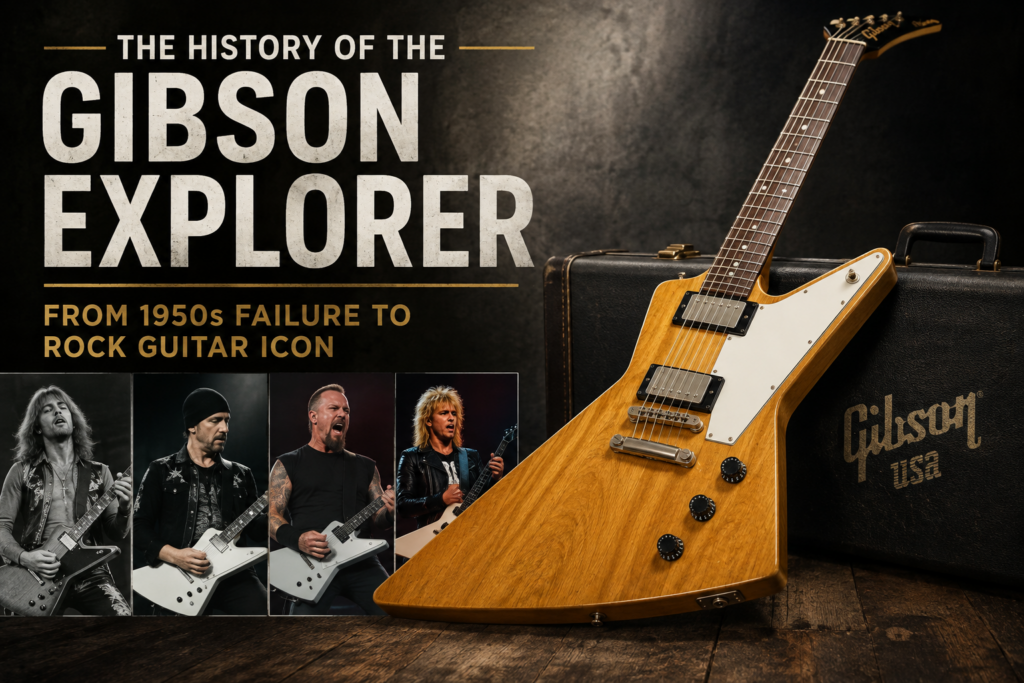
Few guitars have undergone quite the transformation in reputation enjoyed by the Gibson Explorer. Introduced at the end of the 1950s as a radically futuristic alternative to the conventional electric guitar, the Explorer was initially a commercial disappointment. Yet decades later, its angular silhouette would become one of the most recognisable shapes in rock and heavy metal.
From its origins in Gibson’s experimental Modernistic series to its adoption by players such as Allen Collins, The Edge, James Hetfield and Matthias Jabs, the story of the Explorer is one of a guitar arriving considerably earlier than the audience that would eventually embrace it.
Gibson Looks to the Future
By the middle of the 1950s, Gibson found itself facing an increasingly serious challenge from Fender. Instruments such as the Telecaster and Stratocaster represented a distinctly modern approach to guitar design, with solid bodies, bolt-on necks and striking shapes that contrasted sharply with Gibson’s more traditional catalogue.
Gibson had entered the solidbody market with the Les Paul in 1952, but the company was still closely associated with archtops and comparatively conservative designs.
Under company president Ted McCarty, Gibson began experimenting with instruments that looked dramatically different from anything it had produced before.
The result was a group of guitars generally referred to as Gibson’s Modernistic series.
The best known were the Flying V and Explorer, while another design — eventually known as the Moderne — has become one of the great mysteries of vintage guitar history.
Gibson filed design patents for its futuristic guitar shapes during the 1950s, with the Explorer eventually reaching production in 1958.
And even by today’s standards, it was a remarkably bold instrument.
The Original 1958 Explorer
The Explorer’s huge asymmetrical body looked unlike almost anything else available at the time.
Its extended bass-side upper bout and sharply angled lower section gave it an almost science-fiction appearance, while the distinctive six-in-line headstock added to the futuristic aesthetic.
But underneath the radical shape was a guitar constructed using some very familiar Gibson ideas.
Original Explorers featured a set mahogany neck, 24.75-inch scale length, Tune-o-matic bridge and stopbar tailpiece, and two humbucking pickups.
However, the bodies and necks of the original instruments were constructed from korina, Gibson’s name for limba wood.
Korina was also used for the original Flying V and gave these instruments their distinctive pale golden appearance.
The electronics were similarly straightforward, with two humbuckers controlled by individual volume controls and a master tone control.
Most importantly, those late-’50s Explorers were fitted with Gibson’s now legendary PAF humbuckers.
On paper, then, the Explorer shared much of the DNA of a late-’50s Les Paul.
Visually, however, it may as well have come from another planet.
A Guitar Nobody Wanted
Today, an original 1958 or 1959 Explorer is among the most desirable Gibson electrics ever produced.
In the late 1950s, things were very different.
The Explorer simply didn’t sell.
The design was too unconventional for many guitarists of the period, particularly when the market was still dominated by relatively traditional-looking instruments.
Production numbers were consequently extremely small. Estimates vary, but only a tiny number of original korina Explorers were completed during the initial production period.
Some remaining original bodies and parts appear to have been assembled or shipped later, adding another layer of complexity for vintage guitar historians.
Whatever the exact production total, the important point is that the original Explorer was an emphatic commercial failure.
Gibson discontinued it.
Ironically, that failure would eventually help make the original instruments some of the rarest and most valuable solidbody guitars in existence.
The Explorer Finds Its Audience
Although Gibson had largely abandoned the model, the Explorer’s reputation gradually began to grow during the 1960s.
One of the most important figures in this transformation was Rick Derringer, who became associated with an original korina Explorer.
The guitar also found an influential supporter in Eric Clapton, who owned and was photographed with a late-’50s Explorer during the 1970s.
As rock music became louder and visually more theatrical, the Explorer suddenly began to make considerably more sense.
A design that had looked almost absurdly futuristic in 1958 looked perfectly at home on a 1970s rock stage.
And guitarists were beginning to notice.
Gibson Brings the Explorer Back
Growing interest in the original instruments eventually convinced Gibson to revisit the design.
A small number of korina-style instruments appeared during the 1970s, before the Explorer returned more substantially to Gibson’s catalogue in 1976.
The revived Explorer retained the fundamental shape of the original but was typically constructed from mahogany rather than korina.
These 1970s Explorers arrived at exactly the right moment.
Hard rock was becoming heavier, stages were becoming bigger, and guitarists increasingly wanted instruments that looked as powerful as they sounded.
The Explorer had finally found the musical environment it had been designed for nearly two decades earlier.
Allen Collins and Southern Rock
One of the guitarists most closely associated with the Explorer during the 1970s was Allen Collins of Lynyrd Skynyrd.
Collins played a 1958 Gibson Explorer, and the sight of the enormous korina guitar became closely connected with his stage image.
His use of the Explorer helped demonstrate that the instrument wasn’t simply a visual novelty.
Its Gibson-style scale length, twin humbuckers and substantial construction could produce the thick, sustaining tones players expected from the company’s more conventional solidbody guitars.
The Explorer could essentially deliver some of the characteristics players loved about a Les Paul while offering an entirely different playing experience and visual identity.
The Explorer Enters Heavy Metal
If the 1970s rehabilitated the Explorer, the 1980s turned it into an icon.
The rise of heavy metal created an almost perfect environment for Gibson’s forgotten futuristic guitar.
Suddenly, angular body shapes were everywhere.
Companies such as Jackson, Charvel, B.C. Rich, Hamer, ESP and Ibanez were producing increasingly aggressive-looking instruments aimed at hard-rock and metal players.
The Explorer no longer looked unusual.
It looked like a blueprint.
One particularly prominent Explorer player was Matthias Jabs of Scorpions, whose Explorer-shaped instruments became a familiar sight during the band’s rise to international success.
But perhaps no guitarist would become more closely associated with the shape than Metallica’s James Hetfield.
James Hetfield and the Explorer Shape
Hetfield’s relationship with Explorer-style guitars helped cement the design as one of the defining silhouettes of thrash metal.
During Metallica’s early years, Hetfield famously played a white Japanese-made Explorer-style guitar rather than an original Gibson. He would later become strongly associated with ESP Explorer-style instruments, including his well-known “EET FUK” and “MX” guitars.
The association became so strong that, for an entire generation of metal players, the Explorer silhouette was practically synonymous with Hetfield.
Its physical design also suited his playing style remarkably well.
The large body provided a substantial platform for aggressive rhythm playing, while the extended rear section gave the instrument a dramatic appearance when worn relatively low.
By the late 1980s, the shape that had struggled to find buyers thirty years earlier had become one of heavy metal’s defining visual symbols.
The Edge and a Different Side of the Explorer
The Explorer’s story isn’t exclusively about hard rock and metal.
The Edge of U2 has also been one of the model’s most prominent users.
He acquired a 1976 Gibson Explorer early in U2’s career, and the guitar became an important part of the band’s early sound.
Combined with his characteristic delay-heavy effects and Vox amplification, the Explorer demonstrated a very different tonal personality from the thick distorted sounds with which the model is often associated.
Its appearance on songs including “I Will Follow” helped establish the Explorer as an important instrument in U2’s history.
The Edge’s use of the guitar is a useful reminder that there is nothing inherently “metal” about an Explorer.
At heart, it is still a twin-humbucker Gibson.
Why Does an Explorer Sound Different From a Les Paul?
The Explorer and Les Paul share several fundamental Gibson ingredients: a 24.75-inch scale length, set neck, twin humbuckers and Tune-o-matic-style hardware.
Nevertheless, players often describe Explorers as having a slightly different character.
The Explorer’s large solid body contains considerably more wood than many conventional guitar designs, while its construction differs from the maple-capped mahogany formula associated with the classic Les Paul Standard.
Pickup choice, individual pieces of timber, hardware, setup and amplifier choice ultimately have a far greater influence than body outline alone, but a good Explorer is often characterised by a powerful fundamental response, strong sustain and plenty of midrange authority.
Those characteristics help explain why the design became such a natural fit for high-gain guitar sounds.
Epiphone and the Explorer
The Explorer design has also appeared extensively under Gibson’s Epiphone brand.
Epiphone versions have made the shape available at considerably lower prices and have included everything from straightforward production instruments to recreations inspired by the original korina models.
This has been particularly important because genuine vintage korina Explorers exist in an entirely different financial universe from the guitars most musicians can realistically own.
Modern Epiphone recreations have allowed players to experience something much closer visually to the legendary 1958 specification without requiring the budget of a major vintage collector.
The Explorer Family Expands
Over the decades Gibson has repeatedly experimented with the Explorer formula.
There have been numerous finishes, pickup configurations and construction variations, along with limited editions and artist-associated instruments.
The Explorer has also provided the basis for related Gibson designs.
Perhaps the most notable is the Explorer E2, introduced around the end of the 1970s. These instruments took the basic Explorer concept in a more elaborate direction, often using multi-piece or figured construction and upscale appointments.
Later decades brought further variations as Gibson periodically reinterpreted its Modernistic designs for new generations.
Meanwhile, the original 1958 korina specification became something Gibson’s Custom Shop would revisit through increasingly detailed historic reissues.
The Explorer’s Influence Beyond Gibson
Perhaps the clearest indication of the Explorer’s importance is the number of guitars it inspired.
Explorer-derived shapes became a major part of the hard-rock and metal guitar industry.
ESP’s MX-style instruments are an obvious example, but the influence can also be seen throughout countless angular guitars produced since the late 1970s.
The idea was repeatedly exaggerated, sharpened and modernised.
In that sense, Gibson’s designers had correctly predicted the future.
They were simply around twenty years too early.
Vintage Explorers
Original 1958 and 1959 korina Explorers now sit among the most valuable electric guitars ever made.
Their desirability comes from an extraordinary combination of factors.
They are exceptionally rare, visually distinctive and equipped with many of the same desirable features found on Gibson’s golden-era instruments — including PAF humbuckers and late-’50s construction.
Provenance can make particular examples even more important.
As with any extremely valuable vintage guitar, however, originality is critical. Pickups, hardware, finishes, repairs and even the authenticity of the underlying instrument can have enormous implications for value.
The rarity and value of genuine examples also mean that the Explorer is a model where careful authentication is particularly important.
From Failure to Classic
The Gibson Explorer is one of the best examples of a musical instrument being judged very differently by successive generations.
In 1958, it was simply too radical.
By the 1970s, it looked exciting.
By the 1980s, it looked almost inevitable.
Today, the Explorer sits alongside the Les Paul, SG, Flying V and ES-335 as one of Gibson’s most recognisable electric guitar designs.
Perhaps the greatest irony is that Gibson’s designers had originally intended the Explorer to prove that the company could build a guitar for the future.
They succeeded.
The problem was that the future hadn’t arrived yet.
For collectors, the original korina Explorers represent some of the rarest treasures of Gibson’s golden era. For rock and metal players, the shape represents power, volume and attitude. And for guitar design more broadly, the Explorer remains evidence of just how far ahead of its time Gibson’s Modernistic experiment really was.
Nearly seventy years after its introduction, the guitar that nobody wanted has become impossible to ignore.