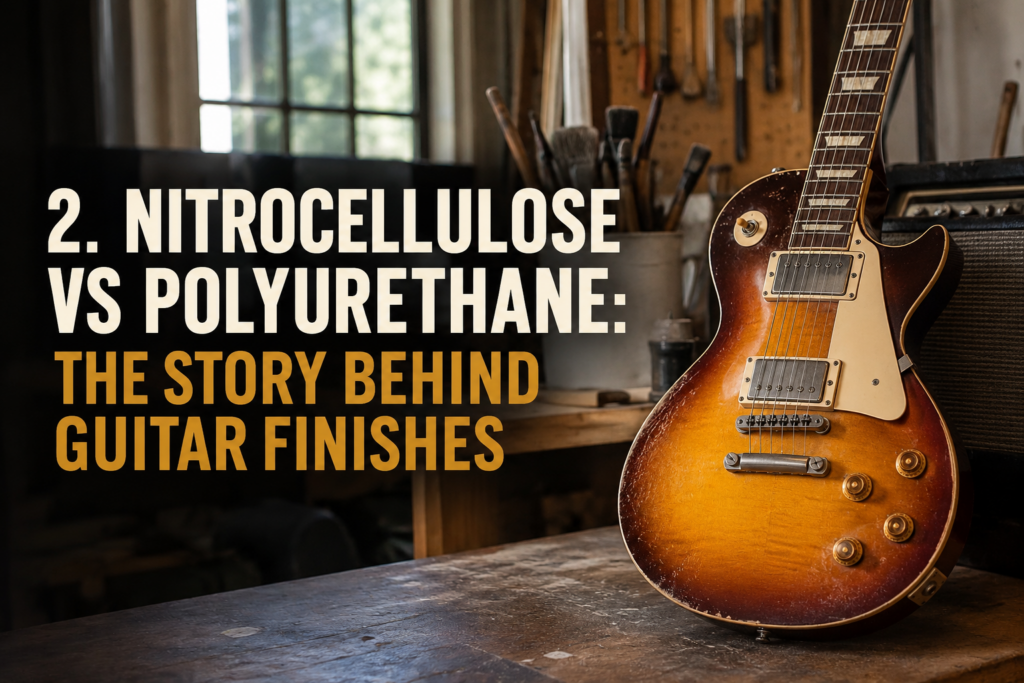
There’s something rather special about the finish on a guitar. Whether it’s a beautifully aged sunburst Les Paul, a vintage Fender Stratocaster with a slightly yellowed body, or a modern guitar with a flawless high-gloss finish, the coating on an instrument plays a surprisingly important part in its overall character.
But have you ever wondered why some guitars seem to age gracefully, developing worn patches, fine cracks and a lovely vintage appearance, while others look almost exactly the same decades after leaving the factory?
Much of the answer comes down to the type of finish used. Two of the most common finishes in the electric guitar world are nitrocellulose lacquer and polyurethane. Both have their advantages, both have their fans, and the debate over which is better has been going on for years.
So what exactly is the difference, why did guitar manufacturers move from one to the other, and does the finish really make a difference to the way a guitar sounds?
The Early Days of Guitar Finishes
To understand the nitro versus polyurethane debate, it helps to look back at the history of guitar manufacturing.
During the early days of electric guitar production, nitrocellulose lacquer was widely used by manufacturers such as Fender and Gibson. Originally developed for the automotive industry during the 1920s, it offered a relatively quick-drying, attractive finish that could be applied in multiple thin coats and polished to a beautiful shine.
By the 1950s and 1960s, nitrocellulose had become closely associated with some of the most iconic guitars ever produced. Think of the original Fender Stratocasters and Telecasters, or the classic Gibson Les Paul models of the same era. Their finishes have become an important part of what makes these instruments so desirable today.
Nitrocellulose lacquer also had another interesting characteristic. Unlike some modern finishes, it continued to change as the guitar aged. Colours could become warmer, clear coats could develop a yellowish tint, and the surface could gradually develop small cracks known as finish checking.
At the time, these weren’t necessarily considered desirable features. They were simply signs of an instrument getting older. But as vintage guitars became increasingly collectable, those signs of age started to become part of their appeal.
What Makes Nitrocellulose So Special?
For many guitar enthusiasts, nitrocellulose lacquer represents the traditional approach to guitar finishing.
One of its biggest attractions is the way it ages. Over several decades, a nitro finish can develop a unique appearance that gives each instrument its own personality. A once-bright white guitar might take on a warmer cream colour, while a sunburst finish can gradually develop a slightly darker, more vintage appearance.
Then there are the little details. Small areas of wear around the edges, patches where the finish has become thinner, and the fine lines of finish checking can all contribute to the character of an older instrument.
Nitrocellulose is also generally easier to repair than many modern finishes. Because fresh lacquer can blend with existing lacquer, experienced repair technicians can often carry out touch-ups without leaving obvious signs of the work.
Of course, nitro isn’t without its disadvantages.
It’s relatively delicate compared with modern alternatives, making it more susceptible to scratches, dents and general wear. It can also react with certain materials, including some guitar stands and case linings, so a little extra care is needed when storing an instrument.
And while some players love the way nitro ages, others would rather their guitar stayed looking pristine for as long as possible.
The Arrival of Polyurethane
As guitar production developed during the late 1960s and into the 1970s, manufacturers began looking for more durable and efficient alternatives to traditional nitrocellulose lacquer.
Polyurethane finishes offered an attractive solution.
Unlike nitrocellulose, polyurethane creates a tougher, more resistant coating that can withstand the everyday knocks and scratches associated with regular playing. It also provides a consistent, glossy appearance that can remain remarkably stable over many years.
For manufacturers producing guitars on a much larger scale, these finishes offered several practical advantages. They could provide excellent protection, deliver a reliable appearance across large production runs and help reduce the time and effort involved in finishing instruments.
Fender was among the manufacturers that embraced polyurethane during this period, introducing it to its guitars in the late 1960s.
Polyurethane gradually became a popular choice across the industry, and today it’s used on a huge range of guitars, from affordable beginner instruments to high-end professional models.
It’s worth mentioning that polyester is another modern guitar finish, often discussed alongside polyurethane. Although they’re different materials, both are known for their durability and are widely used in contemporary guitar manufacturing.
Nitro vs Polyurethane: What’s the Difference?
So, if you’re choosing between a guitar with a nitrocellulose finish and one with polyurethane, what should you actually expect?
The most obvious difference is durability.
Polyurethane is generally much harder wearing. It’s more resistant to scratches, everyday knocks and changes in appearance over time. If you want a guitar that will continue looking relatively new after years of regular use, polyurethane is often the more practical option.
Nitrocellulose, on the other hand, is more likely to show the effects of age and playing. For some people, that’s precisely the attraction. Rather than fighting against the passing years, a nitro-finished guitar can develop a character of its own.
There are also differences in appearance and feel. Nitro finishes are often applied in thinner coats and can have a slightly softer feel, particularly as they wear. Polyurethane finishes can produce an exceptionally smooth, glossy surface that feels more substantial under the hand.
Then there’s the question of maintenance. Nitro finishes generally require a little more care, particularly when it comes to cleaning products, storage and contact with certain materials. Polyurethane is typically more forgiving.
Neither finish is automatically better, though. It really depends on what you want from your instrument.
Does the Finish Affect the Sound?
This is where things get particularly interesting.
Ask a group of guitar enthusiasts whether nitrocellulose makes a guitar sound better than polyurethane, and you’re likely to get some fairly passionate opinions.
Some players believe that thinner nitrocellulose finishes allow the wood to resonate more naturally, producing a more open and responsive sound. Others argue that polyurethane creates a barrier that can restrict the natural vibration of the instrument.
It’s certainly an interesting debate, but the reality is a little more complicated.
The thickness and overall construction of a finish can influence the way a guitar’s wood vibrates, particularly on acoustic instruments. However, when it comes to electric guitars, the difference between nitrocellulose and polyurethane is generally considered much less significant than factors such as pickups, body construction, hardware and setup.
There’s also very little convincing evidence to suggest that the finish material alone makes a dramatic difference to the sound of an electric guitar.
That doesn’t mean players are imagining the differences they experience. The feel of the neck, the way the finish responds to temperature, and even the psychological connection with a particular instrument can all influence how enjoyable it is to play.
Sometimes, the appeal of a guitar goes well beyond what comes out of the amplifier.
Why Collectors Love an Aged Nitro Finish
One of the most interesting aspects of the nitro versus polyurethane debate is the way finishes can influence a guitar’s collectability.
Vintage guitars from the 1950s, 1960s and early 1970s are often associated with nitrocellulose lacquer, and many collectors particularly appreciate instruments that have retained their original finishes.
A naturally aged nitro finish can tell a story. The faded colour, worn edges and small imperfections can provide clues about how an instrument has been used and cared for over the years.
This is also part of the appeal of relic guitars. Manufacturers such as Fender and Gibson have produced instruments designed to recreate the appearance of well-used vintage guitars, complete with worn finishes and aged hardware.
Of course, an original vintage finish can be particularly important when it comes to collectability. A refinished guitar may look fantastic, but originality and condition can have a significant influence on its desirability and value.
That doesn’t mean polyurethane guitars can’t become collectable. Far from it. Plenty of iconic instruments produced with modern finishes have earned their place in guitar history. A guitar’s significance ultimately comes down to much more than the coating on its body.
So, Which Finish Is Better?
As with many things in the guitar world, there’s no definitive answer.
Nitrocellulose lacquer has history on its side. It’s closely associated with some of the most famous guitars ever made, ages in a distinctive way and offers an appeal that’s difficult to replicate. For vintage enthusiasts and collectors, it’s easy to understand why it remains so desirable.
Polyurethane, meanwhile, offers practicality, durability and consistency. It’s ideal for players who want an instrument that can handle regular use without developing too many signs of wear.
If you’re someone who loves the idea of a guitar gradually developing its own character, nitro might be the finish for you. If you’d rather spend less time worrying about scratches and more time playing, polyurethane could be the better choice.
Ultimately, neither finish makes a guitar inherently superior. Some of the greatest recordings in music history were made using instruments with both types of finish.
And perhaps that’s the most important thing to remember. Whether it’s a beautifully aged vintage Stratocaster or a modern polyurethane-finished Les Paul, a great guitar is still a great guitar.
The finish might influence its appearance, feel and collectability, but it’s the music you make with it that really matters.