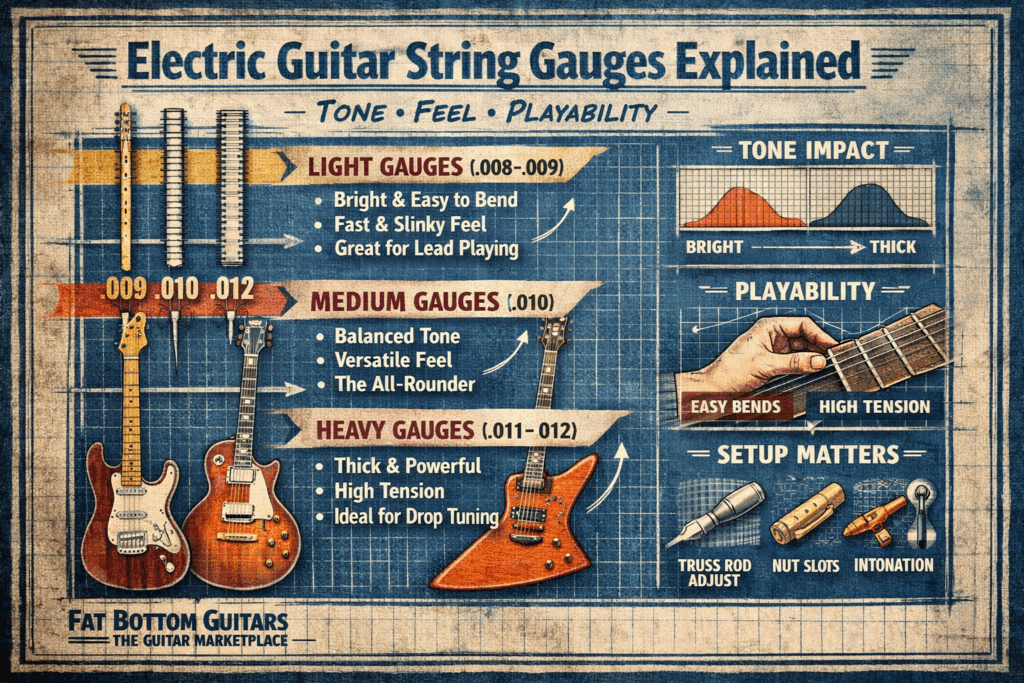
Choosing the right string gauge is one of the most overlooked yet transformative decisions a guitarist can make. Two identical guitars can feel and sound radically different simply because they’re strung with different gauges. Whether you’re chasing vintage blues tone, modern metal precision, or effortless bends, string gauge plays a crucial role in shaping both your sound and your relationship with the instrument.
Let’s break down how different electric guitar string gauges affect tone, feel, and playability – and how to choose the right set for your style.
What Is String Gauge?
String gauge refers to the thickness of each string, measured in thousandths of an inch. A set labelled .010–.046, for example, has a high E string that is .010” thick and a low E that is .046”.
Common electric guitar gauges include:
- Extra Light: .008–.038
- Light: .009–.042
- Regular/Medium: .010–.046
- Heavy: .011–.049 / .012–.052
Each brings its own sonic and physical character.
Light Gauges (.008s – .009s): Speed, Sparkle & Easy Bends
Light strings are favoured by players who prioritise comfort, fast playing, and expressive bending.
Sonic Characteristics
- Brighter top-end
- Slightly less low-end body
- Snappier attack
- More “zing” and sparkle, especially clean
Feel & Playability
- Very easy to bend and vibrato
- Less resistance under the fingers
- Ideal for fast lead work and intricate phrasing
- Can feel “slinky” or soft on longer scale guitars
Who They Suit
- Blues, pop, indie, funk, classic rock
- Players with a light touch
- Vintage-style Strats and Teles
- Players who favour expressive bends and vibrato
Trade-offs:
Light gauges can feel less stable for heavy picking, may go out of tune more easily, and can sound thinner on darker guitars.
Medium Gauges (.010s): The All-Rounder
.010s are the most popular gauge for electric guitar – and for good reason. They strike a balance between tone, feel, and tuning stability.
Sonic Characteristics
- Full, balanced tone
- Strong midrange presence
- Good sustain without sacrificing brightness
- Works well clean or driven
Feel & Playability
- Moderate tension
- Comfortable bends without feeling flimsy
- Stable under both light and heavy picking
- Feels “right” to many players across genres
Who They Suit
- Rock, blues, pop, alternative, classic rock
- Players who want versatility
- Les Pauls, SGs, PRS, Strats – virtually everything
If you’re unsure where to start, .010s are the benchmark gauge for most electric guitars.
Heavy Gauges (.011s – .012s): Power, Punch & Precision
Heavier strings are about authority: thicker tone, more sustain, and greater control over dynamics.
Sonic Characteristics
- Stronger low end
- Thicker mids
- Smoother highs
- More acoustic presence and projection
- Enhanced sustain
Feel & Playability
- Higher tension
- More resistance when bending
- Excellent tuning stability
- Better for aggressive picking and drop tunings
Who They Suit
- Jazz, metal, hard rock, slide guitar
- Players who pick hard
- Drop tunings or baritone setups
- Shorter scale guitars (e.g. Gibsons) often suit heavier gauges well
Trade-offs:
Heavier strings can fatigue the hands more quickly and may require setup changes (nut slots, truss rod, intonation).
How String Gauge Affects Your Guitar’s Behaviour
Beyond feel and tone, gauge also impacts the physical response of the instrument:
Tuning Stability
Heavier strings tend to stay in tune better, especially under aggressive playing or alternate tunings.
Sustain & Resonance
Thicker strings transfer more energy to the body, often producing longer sustain and fuller resonance.
Setup Requirements
Changing gauge significantly often requires:
- Truss rod adjustment
- Intonation tweaks
- Nut slot filing (especially moving heavier)
Scale Length Matters
- Fender scale (25.5”): Feels tighter – lighter gauges often feel stiffer
- Gibson scale (24.75”): Feels slinkier – heavier gauges feel more manageable
Hybrid Sets: Best of Both Worlds
Many modern players favour hybrid gauges like .009–.046 or .010–.052, combining light treble strings for bends with heavier bass strings for punch and tuning stability.
These are excellent for:
- Players who bend a lot but want solid rhythm tone
- Drop tunings without sacrificing lead feel
- Modern rock and alternative styles
Famous Players & Their Gauges
A few real-world reference points:
- Jimi Hendrix: .010s–.038s (with heavier bass strings reversed on a right-handed Strat)
- Billy Gibbons: famously light (.007s or .008s)
- Stevie Ray Vaughan: .012s–.013s (with extreme tension and power)
- Slash: .011s
- Jazz players: often .012s or heavier flatwounds
The takeaway? There’s no “correct” gauge – only what supports your style and hands.
Choosing the Right Gauge for You
Ask yourself:
- Do I bend a lot or play mostly rhythm?
- Do I prefer effortless playability or maximum tone?
- Am I in standard tuning or frequently dropping down?
- Do my hands fatigue easily?
A great approach is to experiment: try one gauge up or down from your current set and feel the difference. It’s one of the cheapest and most impactful upgrades you can make.
Final Thoughts
String gauge is more than just a number on a packet – it’s a fundamental part of your instrument’s voice and feel. The right gauge can unlock new tone, improve comfort, and even inspire different playing styles.
Whether you’re setting up a vintage Strat for glassy blues, a Les Paul for thick rock tones, or a modern superstrat for technical precision, choosing the right strings is where the relationship between player and guitar truly begins.