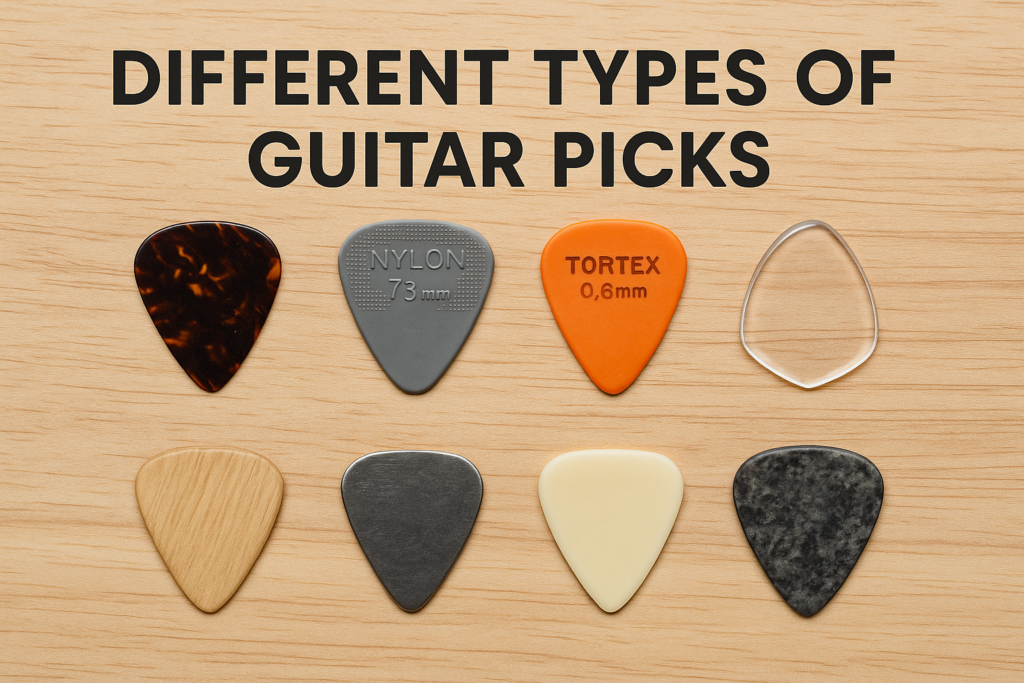
Whether you’re just picking up your first guitar or you’ve been playing for years, one small yet essential accessory can make a surprising difference in your tone and technique: the guitar pick. Often overlooked, guitar picks come in a wide variety of materials, shapes, and thicknesses — each affecting your playing experience in unique ways. In this post, we’ll break down the differences to help you find the pick that’s right for you.
1. Pick Materials: What They’re Made Of and Why It Matters
The material of a pick plays a big role in tone, grip, and durability. Here are some common types:
Celluloid
- Tone: Bright and crisp
- Feel: Smooth, flexible
- Pros: Classic material with a vintage tone; widely available
- Cons: Can become slippery when sweaty; wears down faster
Nylon
- Tone: Warm and soft
- Feel: Flexible and grippy (especially with molded grips)
- Pros: Great for strumming and beginners
- Cons: Can feel too soft for aggressive playing; may lose shape over time
Delrin/Tortex (by Dunlop)
- Tone: Balanced with a slight attack
- Feel: Matte texture, low-slip surface
- Pros: Durable, popular among rock and metal players
- Cons: Slightly more rigid; can be noisy when striking strings
Acrylic
- Tone: Clear and articulate
- Feel: Hard, smooth, glass-like
- Pros: Great for fast picking and definition
- Cons: Can be slippery without added grip texture
Wood, Metal, Bone, and Stone
- Tone: Unique and varied (often very bright or aggressive)
- Feel: Rigid, sometimes rough
- Pros: Exotic tone and appearance
- Cons: Not forgiving; can damage strings or wear quickly depending on the material
2. Pick Thickness: How Thick Should Your Pick Be?
The thickness of a pick influences your control, flexibility, and tone:
Thin (0.40 – 0.60 mm)
- Tone: Bright, trebly
- Best For: Strumming chords, acoustic guitar
- Feel: Very flexible
- Pros: Easy strumming, low resistance
- Cons: Less control for precise picking or heavy attack
Medium (0.60 – 0.80 mm)
- Tone: Balanced
- Best For: Versatile players who strum and pick
- Feel: Moderate flexibility
- Pros: Great all-around choice
- Cons: May lack the responsiveness some advanced players need
Heavy (0.80 – 1.20 mm)
- Tone: Warm, full-bodied
- Best For: Lead playing, rock, blues
- Feel: Firm with low flex
- Pros: Excellent control, more volume
- Cons: Not ideal for soft acoustic strumming
Extra Heavy (1.20 mm and up)
- Tone: Thick and punchy
- Best For: Metal, jazz, technical playing
- Feel: Very rigid
- Pros: Speed and precision
- Cons: May feel too stiff for rhythm work
3. Shape and Size: Comfort vs. Precision
Pick shape also influences how it feels in your hand and how it interacts with the strings.
- Standard (351 Shape): The most common shape — good for all styles
- Jazz Picks: Smaller and pointier — favored for fast, accurate picking
- Teardrop: Smaller, used often for acoustic or mandolin
- Triangle Picks: Larger, good grip, three usable edges
- Sharkfin or Multi-edge Picks: Offer multiple attack options in one pick
4. Specialty Picks: Worth Trying?
Some picks have added features:
- Grip-enhanced picks: Textured surfaces or rubber grips to reduce slipping
- Thumb picks: Wrap around the thumb — ideal for fingerstyle or banjo
- Hybrid picks: Combine pick and fingerpick elements for unique playstyles
Conclusion: Choosing the Right Pick for You
There’s no one-size-fits-all pick — your ideal choice depends on your instrument, playing style, and personal feel. Start by experimenting with a variety of materials and thicknesses. You’ll quickly notice how such a small tool can make a big difference in your tone and technique.
Remember: the best pick is the one that feels right in your hand and sounds right to your ears.