Iconic instruments that stole the spotlight on the silver screen
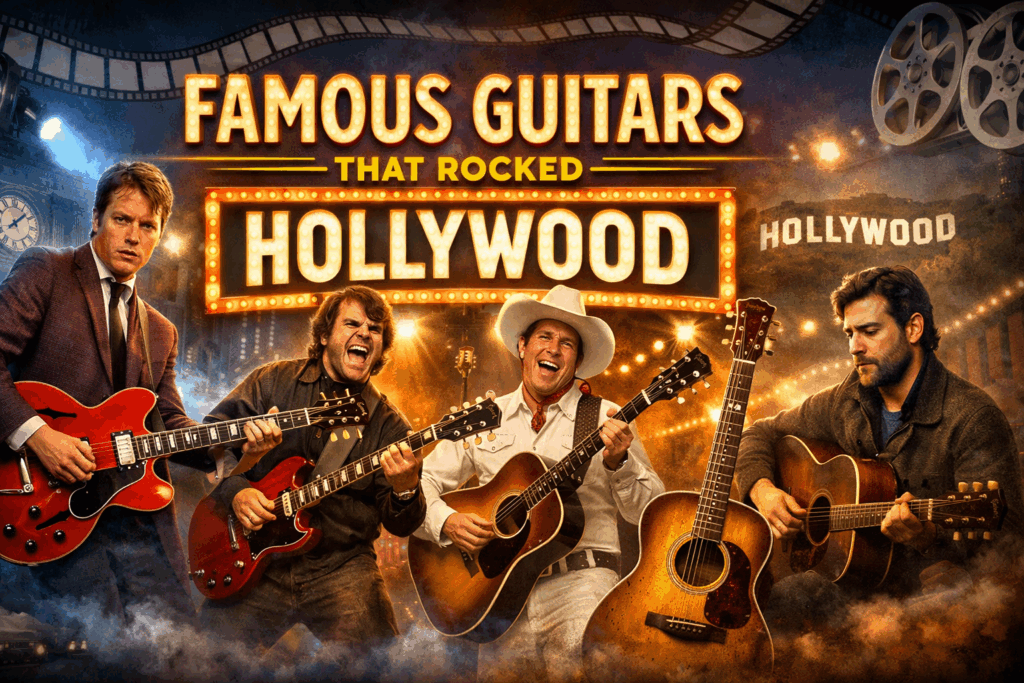
Guitars and cinema have always had a natural connection. Both capture emotion, personality, and cultural moments. Over the decades, certain instruments have become almost as memorable as the characters who played them on screen. From time-traveling rock riffs to school-of-rock shredding and country classics, Hollywood has showcased some truly unforgettable guitars.
Here are some of the most famous guitars ever featured in films.
Marty McFly’s Cherry Red ES-345
Perhaps the most famous guitar scene in movie history appears in the 1985 classic Back to the Future. During the Enchantment Under the Sea dance, Marty McFly (played by Michael J. Fox) grabs a Gibson ES-345 and launches into an electrifying rendition of Johnny B. Goode.
The irony, of course, is that the ES-345 didn’t actually exist in 1955—the year the scene takes place. The model was introduced in 1959. But the anachronism hardly matters; the moment perfectly captures the rebellious energy of rock ’n’ roll and remains one of cinema’s most beloved musical scenes.
The cherry red semi-hollow body guitar, complete with split parallelogram inlays and stereo Varitone circuitry, became permanently associated with time travel and teenage rock heroics.
Dewey Finn’s Gibson SG
Few films capture the joy of playing guitar quite like School of Rock. In the film, Dewey Finn—played by Jack Black—teaches a class of prep-school students the power of rock.
His weapon of choice throughout much of the movie is a Gibson SG, a guitar historically associated with loud amps and hard-rock attitude. It’s a fitting choice for Dewey’s larger-than-life personality and the film’s message that rock music is about expression rather than perfection.
The SG itself has deep cinematic pedigree thanks to players like Angus Young and Tony Iommi, so seeing it front and centre in a movie celebrating rock culture felt entirely appropriate.
The Ennio Morricone-Inspired Fender Telecaster
In Desperado, directed by Robert Rodriguez, the guitar becomes both a musical instrument and a symbol of vengeance.
The mysterious mariachi, played by Antonio Banderas, carries a guitar case filled with weapons—but he also performs haunting flamenco-inspired pieces that recall the dramatic soundtracks of Ennio Morricone’s spaghetti western scores.
Although the film features multiple guitars, the visual language of the lone guitarist wandering dusty towns owes much to the twang and bite historically associated with the Fender Telecaster, an instrument synonymous with Western and cinematic soundscapes.
Buster Scruggs’ Cowboy Guitar
The opening story of The Ballad of Buster Scruggs presents one of the most charming musical gunslingers in modern cinema.
Played by Tim Blake Nelson, Buster rides the frontier dressed in bright white while cheerfully singing Western songs and strumming an acoustic guitar. The instrument becomes part of his character—equal parts troubadour, outlaw, and storyteller.
The guitar represents the long tradition of American folk and cowboy music that shaped the mythology of the American West, echoing artists like Gene Autry and Roy Rogers.
Llewyn Davis’ 1960s Folk Guitar
The 2013 film Inside Llewyn Davis beautifully captures the early-1960s Greenwich Village folk scene.
Actor Oscar Isaac performs much of the music live on screen, typically with a vintage small-body acoustic guitar reminiscent of instruments made by Gibson and Martin during the folk revival era.
The stripped-down acoustic performances perfectly reflect the era that produced legends like Bob Dylan, where songwriting and storytelling mattered far more than flashy gear.
When Guitars Become Characters
In many films, guitars are more than just props—they become part of the storytelling. The right instrument can instantly communicate personality: rebellious, soulful, mysterious, or heroic.
From Marty McFly’s ES-345 introducing rock ’n’ roll to the 1950s, to the SG-powered classroom revolution of School of Rock, cinema has helped cement the mythology of the guitar in popular culture.
And for guitar players watching at home, these moments often serve as inspiration. After all, how many players first dreamed of picking up a guitar after seeing one on the big screen?