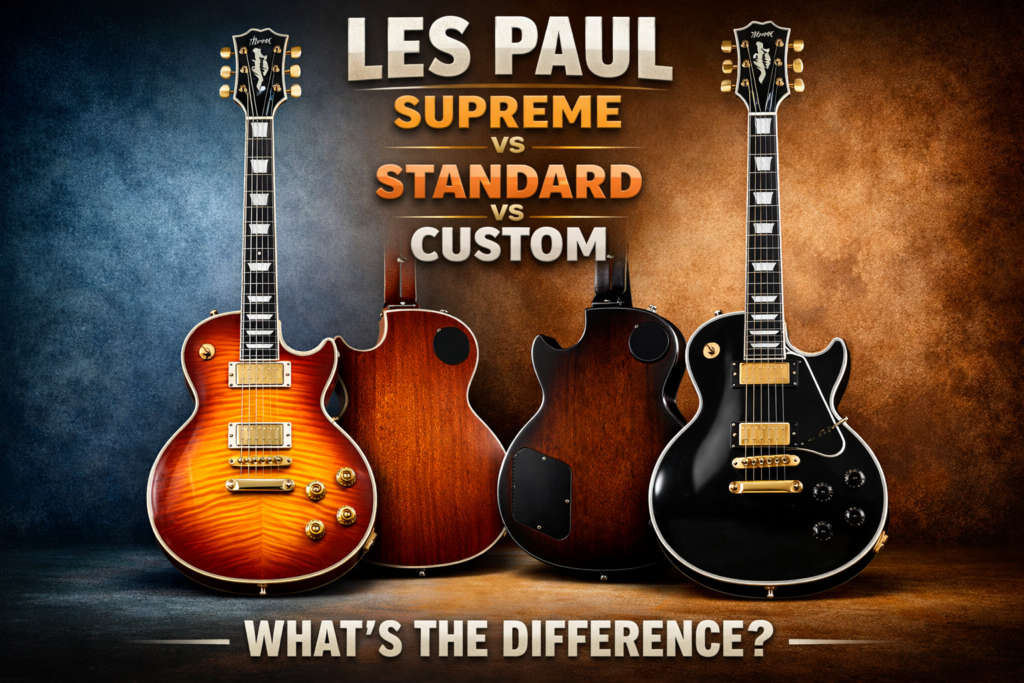
At first glance, the Gibson Les Paul Supreme looks like just another high-end Les Paul—flame maple top, gold hardware, and unmistakable single-cut silhouette. But spend a little time with one, and it becomes clear that the Supreme occupies a unique position in Gibson’s lineup. It isn’t simply a more luxurious Standard or a flashier Custom—it’s a fundamentally different take on what a Les Paul can be.
The Gibson Les Paul Supreme
The Les Paul Supreme was introduced in the early 2000s as a premium, visually striking evolution of the classic design. Its goal was simple: take the Les Paul formula and push it further—both aesthetically and structurally.
The most immediately noticeable feature is the fully carved maple body, with highly figured maple on both the top and the back. Unlike traditional Les Pauls, there’s no separate mahogany back with a maple cap—instead, the Supreme uses a chambered construction that enhances resonance and reduces weight.
Another defining detail is the absence of rear control cavity covers. The electronics are installed from the front, meaning the back remains a seamless piece of carved maple—something rarely seen on a Gibson solid body.
Visually, the Supreme leans heavily into Custom Shop territory, often featuring:
- Bound headstocks with split-diamond inlays
- Ebony fingerboards
- Extensive multi-ply binding
- Highly figured AAAA maple tops
It’s a guitar designed to stand out—even among other Les Pauls.
The Gibson Les Paul Standard
The Les Paul Standard is the benchmark—the model most players picture when they think of a Les Paul.
Traditionally, it features:
- Mahogany body with a carved maple cap
- AA or AAA flame maple tops (depending on year/spec)
- Modern or traditional weight relief
- Rear-routed electronics cavity
Tonally, the Standard delivers the classic Les Paul sound: thick, sustaining, and mid-forward, thanks to the mahogany/maple combination and humbuckers.
Compared to the Supreme, the Standard is more rooted in tradition. It balances aesthetics and performance without pushing too far into luxury or experimentation.
The Gibson Les Paul Custom
The Les Paul Custom—often called the “Black Beauty”—takes a different approach. Rather than emphasising figured maple, it leans into elegance and refinement.
Typical features include:
- Mahogany body (often with a maple cap depending on era)
- Ebony fingerboard with block inlays
- Multi-ply binding on body and headstock
- Gold hardware as standard
The Custom is about feel and finish as much as tone. It often has a slightly tighter, more focused response compared to a Standard, partly due to its construction and ebony board.
Key Differences at a Glance
1. Construction & Materials
- Supreme: Chambered, carved maple top and back (no traditional mahogany back)
- Standard: Mahogany body + maple cap
- Custom: Typically mahogany body (with or without maple cap depending on era)
This is the biggest structural difference—and it directly impacts weight, resonance, and tonal character.
2. Weight & Resonance
The Supreme is typically lighter and more resonant due to its chambered design. It often feels more “alive” acoustically.
By contrast:
- Standards vary depending on weight relief
- Customs are often the heaviest and most solid-feeling
3. Electronics Access
- Supreme: No rear cavity—clean, uninterrupted back
- Standard/Custom: Traditional rear control cavity plates
This is a small but significant design distinction that highlights the Supreme’s more complex construction.
4. Aesthetic Philosophy
- Supreme: Maximum visual impact—figured maple everywhere
- Standard: Classic bursts and understated flame
- Custom: Formal, tuxedo-like elegance (often in black or solid finishes)
The Supreme is arguably the most visually extravagant production Les Paul Gibson has made.
5. Neck & Feel
While specs vary across years, Supremes often feature:
- Slimmer, more modern neck profiles
- Ebony fingerboards
- Highly polished finishes
Standards and Customs can vary more widely depending on era, reissue, or production year.
Tonal Differences
Because of its construction, the Supreme tends to sound:
- Slightly brighter and more open
- More acoustically resonant
- Less dense in the low mids than a traditional Les Paul
Meanwhile:
- Standard: Balanced, classic Les Paul tone
- Custom: Tighter, more focused, often slightly darker
The Supreme doesn’t abandon the Les Paul sound—but it does reinterpret it.
Where Does the Supreme Sit in the Lineup?
The Les Paul Supreme isn’t a direct upgrade over a Standard or Custom—it’s more of an alternative flagship.
It appeals to players who want:
- A lighter Les Paul
- A more modern, resonant feel
- High-end aesthetics without going full Custom Shop
In many ways, it sits between production and Custom Shop—borrowing elements from both.
Final Thoughts
The Gibson Les Paul Supreme is what happens when Gibson takes its most iconic design and allows itself a bit more freedom. It retains the DNA of a Les Paul, but reworks the formula with different materials, construction techniques, and a clear emphasis on visual impact.
If the Standard is the blueprint and the Custom is the formalwear, the Supreme is the showpiece—bold, refined, and just a little bit unconventional.