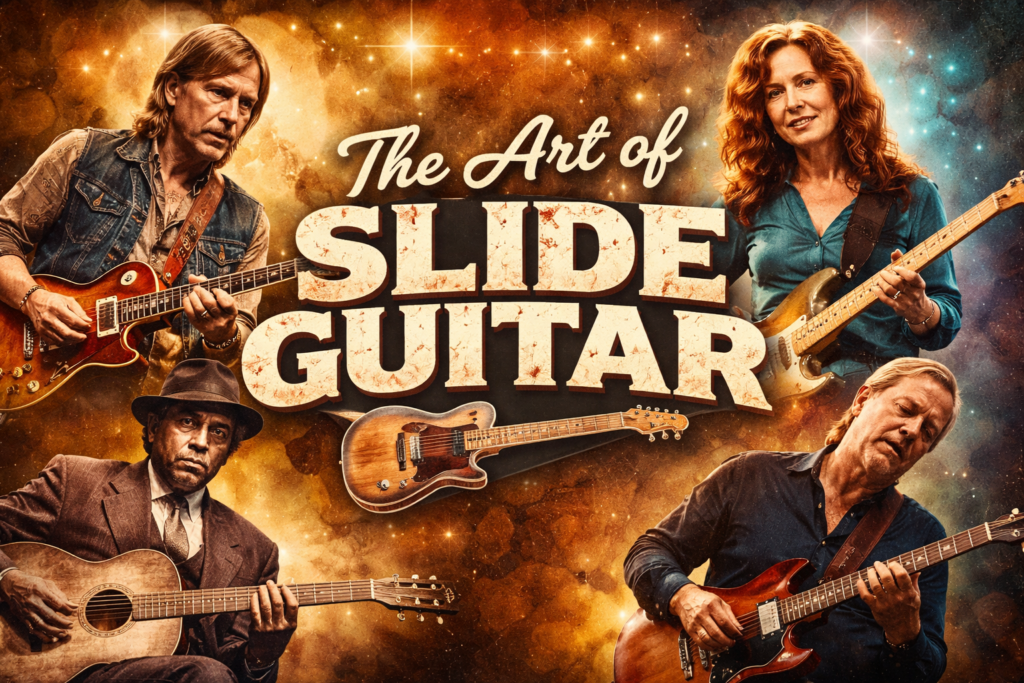
Slide guitar is one of the most expressive techniques in the guitarist’s arsenal. It blurs the line between voice and instrument, allowing notes to glide seamlessly between pitches, mimicking the human voice in a way few other techniques can. From dusty Delta blues to soaring arena rock, slide guitar has shaped the sound of entire genres—and produced some of the most distinctive players in music history.
What Is Slide Guitar?
At its core, slide guitar involves placing a smooth object—typically a glass, metal, or ceramic slide—over a finger and gliding it along the strings instead of pressing them down against the frets. This creates a fluid, vocal-like sound with continuous pitch control.
Traditionally, players favour open tunings such as Open D or Open G, which allow full chords to ring out with a single bar of the slide. The technique can be applied to standard electric or acoustic guitars, as well as specialised instruments like resonators and lap steels.
Slide playing demands precision. Because the slide doesn’t press the string to the fretboard, intonation is entirely in the player’s hands—literally. Muting unwanted string noise, controlling vibrato, and maintaining pitch are all essential skills that separate beginners from masters.
Roots in the Blues
Slide guitar traces its origins to the American South in the early 20th century, deeply embedded in Delta blues tradition. Early players used whatever they had—knife blades, bottlenecks, or metal pipes—to coax haunting, vocal tones from their instruments.
Legends like Robert Johnson and Son House used slide to create raw, emotional performances that still resonate today. Their playing wasn’t about technical perfection—it was about feeling, storytelling, and atmosphere.
As blues evolved and electrified, slide guitar came with it. Muddy Waters brought the technique into Chicago’s amplified scene, laying the groundwork for modern electric slide guitar.
Slide Guitar in Rock and Beyond
As blues fed into rock, slide guitar found new life—and new heroes.
Duane Allman
Often considered the definitive slide guitarist, Allman’s work with The Allman Brothers Band—particularly on At Fillmore East—set a benchmark for melodic, lyrical slide playing. His tone, sustain, and phrasing made the slide sing like a human voice.
Derek Trucks
A modern master, Trucks expanded the vocabulary of slide guitar with influences from Indian classical music and jazz. Playing mostly in open E on a Gibson SG, his control over microtonal phrasing is unmatched.
George Harrison
Harrison brought slide guitar into mainstream pop, particularly in his post-Beatles solo work. His melodic, restrained approach prioritised songcraft over flash.
Bonnie Raitt
Combining blues authenticity with pop sensibility, Raitt’s slide playing is both tasteful and emotionally direct. Her use of open tunings and clean phrasing has influenced generations.
British Blues and Rock Slide Icons
The UK played a huge role in bringing slide guitar to global audiences during the blues boom of the 1960s and ’70s.
Eric Clapton
While not exclusively a slide player, Clapton’s work on tracks like Layla (particularly the Duane Allman collaboration) helped cement slide guitar in rock’s DNA.
Jimmy Page
Page used slide to create atmospheric textures, notably on tracks like In My Time of Dying, blending blues roots with heavier rock dynamics.
Rory Gallagher
Gallagher’s raw, aggressive slide style stood apart—often played on a battered Stratocaster with ferocious energy.
Modern Slide Innovators
Slide guitar continues to evolve, with modern players pushing boundaries in tone and technique.
Jack White
White brings a raw, almost primitive energy to slide guitar, often using unconventional gear and tunings to create unique textures.
Ben Harper
Known for his lap steel work, Harper blends slide guitar with folk, soul, and blues influences.
Ariel Posen
A contemporary standout, Posen’s clean, lyrical slide playing sits comfortably in modern roots and ambient music.
Why Slide Guitar Still Matters
Slide guitar endures because it’s fundamentally expressive. It removes the rigid grid of frets and replaces it with something more fluid, more human. Whether it’s the haunting cry of Delta blues or the soaring sustain of Southern rock, slide guitar remains one of the most emotionally direct ways to play the instrument.
For players, it offers a completely different perspective on the fretboard. For listeners, it offers a sound that feels alive—unpredictable, vocal, and deeply personal.
Final Thoughts
From Robert Johnson to Derek Trucks, slide guitar has travelled a remarkable journey—crossing continents, genres, and generations. Yet its essence remains unchanged: a simple piece of glass or metal, gliding across strings, turning technique into pure emotion.