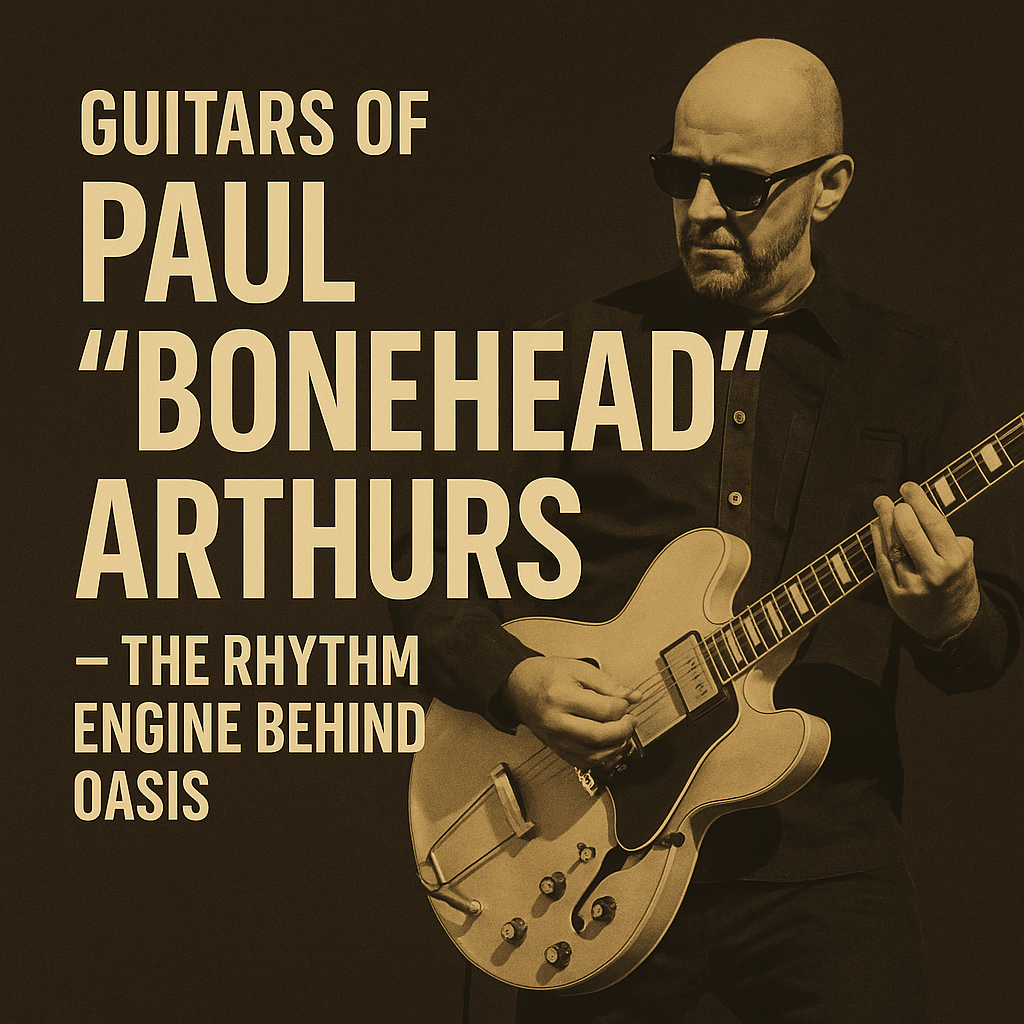
When people talk about the guitar sound of Oasis, much attention rightly goes to Noel Gallagher: his leads, his riffs, his archetypal role. But the rhythmic backbone of those early records and live shows was provided by his co‑founder and rhythm guitarist Paul “Bonehead” Arthurs. His choice of guitars and his rig played a huge part in cementing that chunky, strummed‑open‑chord Britpop attack that powered songs like “Live Forever”, “Supersonic” and “Wonderwall”.
This post will chart the main guitars Bonehead used throughout his Oasis tenure: from the early years, through the peak and up to reunion era usage — and how those instruments tie into the sound, the studio work and the live rig.
1. The early years: Japanese Epiphones and the heartbeat of Definitely Maybe
Bonehead joined what became Oasis in 1991 and played through the debut album Definitely Maybe (1994) and beyond. According to his Wikipedia entry, he used a Japanese‑made Epiphone Riviera as his main instrument during his time with the band.
– The key guitar: a 1982/84 Japanese built Epiphone Riviera (semi‑hollow / semi‑solid) which he still plays.
– Why this matters: The semi‑hollow construction gives a resonance and “breathing” tone that sits well with strummed open‑chords, and the lighter body compared with full solid bodies helps with live reliability (less feedback) when chords are pushed hard.
– On Definitely Maybe countless rhythm takes by Bonehead on that instrument helped give the foundational bedrock of the band’s sound. His playing may be understated but it’s essential.
– According to gear listings, his rig during the mid‑90s used a fairly “dry but punchy” amp stack (for example, a Marshall JCM800/2203) combined with his Riviera.
Take‑away for readers: If you’re chasing that classic early‑Oasis rhythm sound, consider a semi‑hollow guitar with humbuckers (like the Riviera) run into a cranked tube amp, then keep your strums tight and chunky.
2. (What’s The Story) Morning Glory era: consolidating the tone
As the band moved into (What’s the Story) Morning Glory? (1995), Bonehead’s role expanded slightly (he also used Mellotron, piano, Hammond organ on the record) but his rhythm guitar remained critical.
– His trusty Riviera remained his go‑to. He has said he is still playing his original 1984 guitar on the 2025 tour.
– Why this matters: That same instrument, tweaked and locked in, meant that the rhythmic DNA of the band remained consistent. Whether on the big open chords of “Wonderwall” or the driving verses of “Roll With It”, Bonehead’s rhythm guitar was the engine.
– On the live front: The rig at mega‑shows like Knebworth 1996 was massive, but even then the backbone was Bonehead’s rhythm strumming with his semi‑hollow guitar delivering clarity, punch and a bit of sparkle. (See gear breakdowns of those shows.)
Pro tip for readers: A semi‑hollow guitar like the Riviera works well for rhythm guitarists in big live settings — slightly less heavy than a full Les Paul, a bit more open tone, while still beefy enough. Setting the amp to a tight, mid‑range rich tone helps cut through.
3. Later years & departure – exploring additional instruments
After 1997 and into 1999, and especially around Standing on the Shoulder of Giants, Bonehead’s tenure with Oasis came to an end (he officially left in 1999).
– In that era, his guitar choices broadened. For example, a Gibson Les Paul Studio Ebony 1999 is listed as one of his guitars.
– Why this matters: As the band’s sound evolved (heavier production, more effects and layered guitars), Bonehead’s role shifted slightly. The use of different instruments reflects a willingness to adapt.
– For collectors/deep‑dive readers: These later guitars are less iconic than his Riviera, but they indicate how a rhythm guitarist in a major band evolves gear‑wise as the musical context changes.
4. Reunion and legacy: the 2024‑25 return and signature model
In 2024/25, Oasis re‑emerged for the Live ’25 tour, and Bonehead returned to the fold. Impressively, he remains using his original 1984 Riviera.
– In conjunction with this, the guitar manufacturer Epiphone has released the “Bonehead Riviera” signature model — a faithful recreation of his main instrument.
– Why this matters: Signature models are often built to replicate the tone and feel of a musician’s main guitar — so for rhythm‑guitar fans wanting to channel that Bonehead vibe, this is a clear option.
– Legacy note: Bonehead might not always get front‑page gear‑hero status, but his consistency, his tone, and his guitar choice form a major part of the Oasis story — which makes his main guitar all the more interesting.
5. Technical summary: What to look for if you want the “Bonehead rhythm” sound
Here’s a quick checklist oriented toward guitar‑players reading your blog:
- Guitar type: Semi‑hollow or semi‑solid body (such as the Epiphone Riviera) with humbucking pickups.
- Tone setting: Emphasise mid‑range (the strums need to cut through), tight low end, and clarity on top for open chords.
- Amplifier: Tube amp cranked, plenty of depth but not overly saturated—Bonehead’s rig used Marshall stacks in live contexts.
- Strings & chords: Standard tuning, chunky rhythm strums, bar‑chords and open chords interwoven; minimal effects for purity of sound.
- Live vs studio: In studio you might dial back the gain and add a little compression; live you must ensure clarity under the mix—semi‑hollow body helps avoid over‑muddiness.
- Consistency: The fact Bonehead stuck with his main guitar for decades (including the 2025 tour) signals that having a trusted instrument is key to locked‑in rhythm tone.
Conclusion
Paul “Bonehead” Arthurs may not always be the first name cited when people talk about guitar heroes, but his impact on Oasis’s sound is undeniable — and his choice of guitar is part of what made that sound work. His trusty Japanese‑made Epiphone Riviera set the template for the band’s rhythm guitar tone; his consistency over the years – both live and in studio – means that for rhythm‑guitarists aspiring to capture that Britpop strum‑attack, the guitar story matters.
From early underground shows to stadium gigs, from Definitely Maybe to the 2025 reunion, the gear‑story is compelling. For your blog readers, diving into his main instrument, how it was used, and how they might approximate the rhythm tone themselves can make for a rich, informative piece.