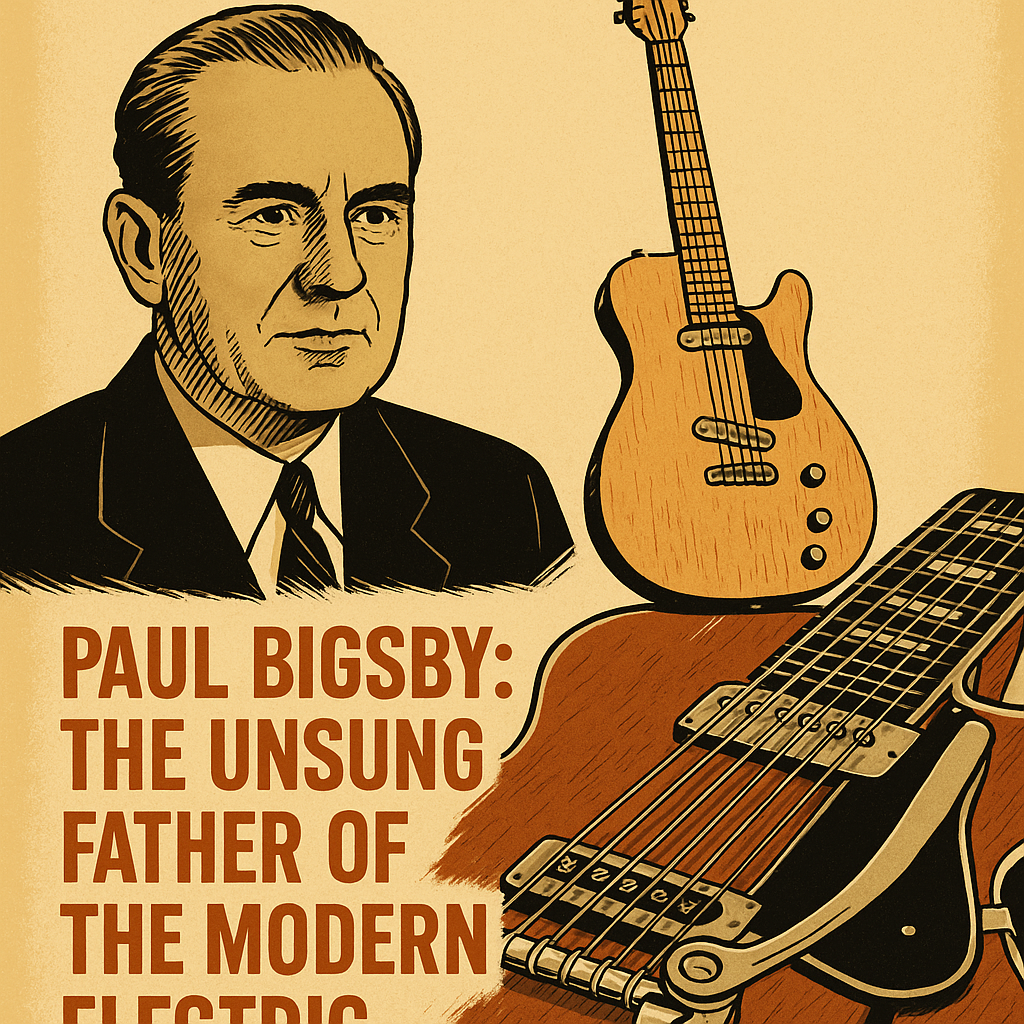
In a world often dominated by the big names like Leo Fender and Les Paul, Paul Adelburt Bigsby remains an under‑celebrated visionary. Yet his fingerprints are all over modern electric guitar design. Whether via the headstock, the tailpiece, or the idea of a guitar built to sustain like a steel instrument, Bigsby’s work quietly changed the game. In this post we’ll trace how he got there, what he did, and why your next guitar (or print design) should nod to him.
1. Origins: From motorcycles to steel guitars
Bigsby began life far away from the guitar world. Born in 1899 in Elgin, Illinois, he moved to Los Angeles and worked in mechanics and pattern‑making for motorcycles.
Curiously, he turned his technical skills toward musical instruments when the West Coast Western‑swing scene needed luxurious steel guitars and innovative players. He hand‑built instruments for steel‑guitar stars (e.g., Earl “Joaquin” Murphy) and began pushing boundaries.
What this background gave him: metal‑working precision, mechanical thinking, and an instinctive will to build gear that worked beyond the norm. That path led him to his first landmark contributions.
2. Early Solid‑Body Guitars & the “Six‑in‑a‑Row” Headstock
In 1948 Bigsby built a bespoke solid‑body electric guitar (for Merle Travis) that featured several design innovations: the strings anchored through the body for sustain, a neck‑through or thick‑body construction, and a headstock with six tuning pegs in a row.
This guitar arguably influenced the later designs of Fender (especially the Telecaster and Strat) and others by showing that rock‑ready sustain and rapid tuning access could be engineered into an electric guitar form.
For a boutique guitar shop like yours, this is fertile ground: Bigsby’s early one‑off builds sit at the intersection of rare, vintage and foundational design. That headstock layout, that body construction, the idea of “guitar as machine” rather than just wood + strings — these were Bigsby’s subtle revolutions.
3. The Bigsby Vibrato Tailpiece: Changing How Guitars Play
Perhaps the most visible Bigsby legacy is the vibrato (often mis‑called the “whammy bar”) tailpiece: the Bigsby Vibrato Tailpiece.
Introduced around 1951 (though its prototype roots go back a bit earlier), this spring‑loaded arm allowed players to bend the pitch of notes or entire chords in a controlled way.
Why does this matter?
- It expanded the expressive palette of electric guitars: you could now add subtle vibrato, chord warbles or dives in a way that acoustic guitars couldn’t do easily.
- It didn’t require routing of the body (unlike many later trem systems). Bigsby’s design fit on guitars with top‑mount installations, making it accessible.
- It became a status and aesthetic statement: sliding the arm, seeing the metal bar, hearing the subtle warble — it became part of the electric guitar’s identity (especially in rockabilly, jazz‑fusion, country guitar).
In one blog piece, an author described installing a Bigsby on a Gibson Les Paul and discovering that the guitar “could look cooler” and “sounded different” as a result—it changed the way the instrument felt and was played.
For your store/blog, you could use this to draw a parallel: many vintage guitars feature Bigsby systems or retrofits; for print artwork you could riff on the “vibrato arm” as a motif—“Tone Arm of the Bigsby Era” or “Vibrato, Meet ‑50s Motorbike DNA” (given Bigsby’s background with bikes).
4. Legacy: Influence On Solid‑Body Design, Headstocks & Industry
Bigsby’s impact is wider than just one gadget. A few key threads:
- The “six tuners in a row” headstock (as on Bigsby’s early solid‑body) is echoed in many Fender designs and countless others.
- His solid‑body thinking (anchor the strings into the body, maximize sustain, build a guitar that could compete with steel guitars in terms of tone) fed into the broader evolution of the electric guitar.
- The Bigsby vibrato system became ubiquitous on hollow‑body and semi‑hollow guitars (Gretsch, Gibson, Epiphone, etc.) and remains factory‑installed or retrofittable today.
- Although Bigsby didn’t scale into high‑volume production of guitars (he preferred artisan building, and by the mid‑1950s shifted focus toward the vibrato unit) his niche innovations fed major manufacturers.
Thus when you handle a vintage guitar with a Bigsby, or any solid‑body with six‑in‑a‑row tuners, you’re holding a piece of Bigsby’s DNA.
5. Implications for Collectors, Players & Retailers
Given your boutique rare‑guitar business and print‑led aesthetic, here are some practical take‑aways:
- Vintage guitars equipped with original Bigsby vibratos or Bigsby‑built solid‑bodies carry designer‑heritage value. That provenance can enhance collectibility.
- From a player‑perspective, a Bigsby system offers a different vibe than a Floyd‑Rose or vintage Strat tremolo: more subtle, warble‑friendly, suited to country‑twang, rockabilly, jazz, blues. Myriad community posts confirm this.
- From a marketing angle: you could create print or poster designs themed around Bigsby’s road‑to‑innovation (motorcycles → steel guitar → solid‑body → vibrato) and offer them in your store.
- Historically‑informed blog content builds trust and brand identity: your blog post can position The Guitar Marketplace not just as a retailer, but as a source of guitar culture.
6. Closing Thoughts
While legends like Leo Fender and Les Paul command headlines, Paul Bigsby quietly shaped the very shape, feel and expressiveness of the electric guitar. From his early steel‑guitar work to that now‑iconic vibrato arm, his imprint is subtle yet pervasive.
In the boutiques, auctions and print‑runs you deal with every day, the Bigsby touch keeps turning up—whether in headstock design, hardware aesthetic, or the very idea of “guitar as innovation machine.” Next time you strap in, give a nod to Bigsby. You’re not just playing history—you’re playing a legacy of mechanical genius, creative problem‑solving and rock‑ready reinvention.