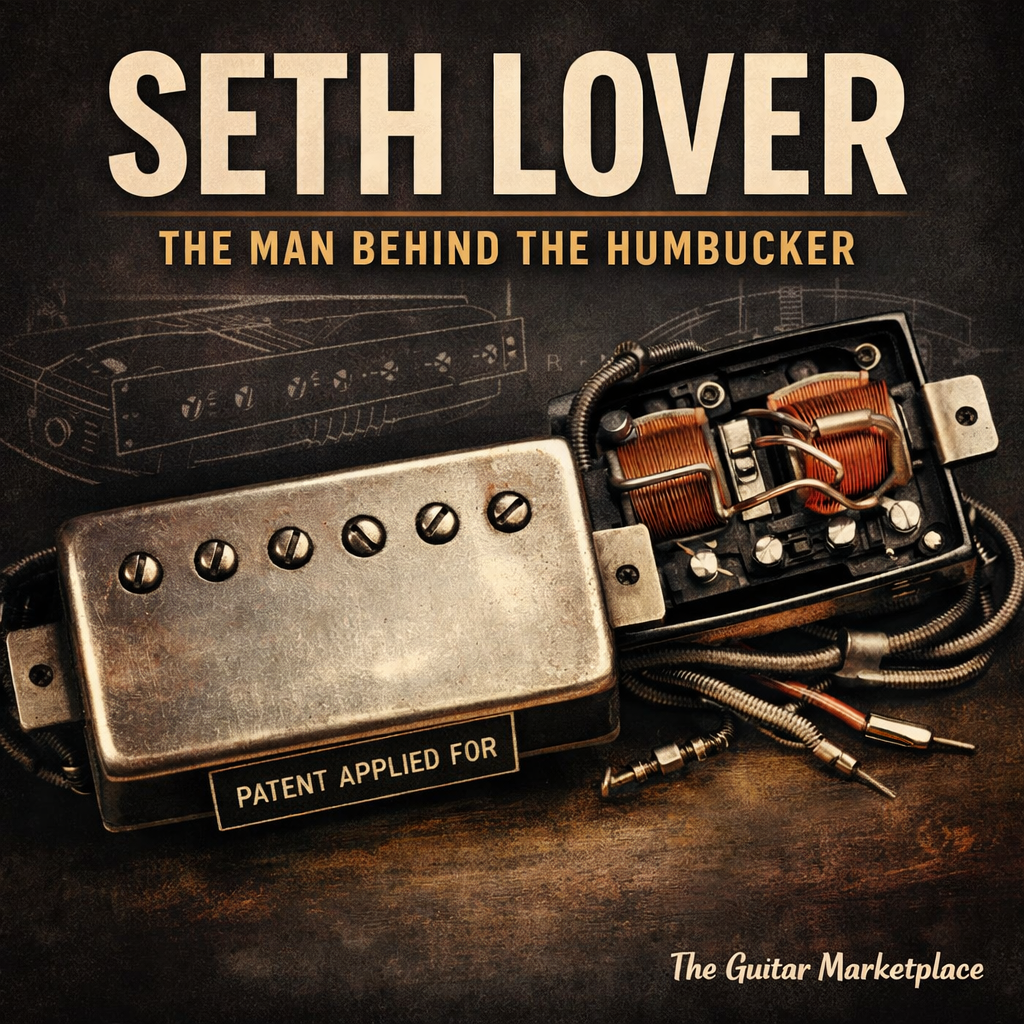
When guitarists talk about iconic electric-guitar tones — from blues to rock to jazz — one name, tucked into the pages of guitar history but monumentally significant, stands out: Seth E. Lover. Rarely a household name outside of amp and pickup aficionados, Lover’s inventions and engineering contributions helped shape the sound of modern music.
📐 Early Life and Path to Design
Born in 1902 in Greenfield, Massachusetts, Seth Lover began his career not as a musician but as an engineer. His mechanical ingenuity and deep understanding of electronics would put him on a path that intersected with the nascent electric guitar industry in the mid-20th century.
In the 1930s and ’40s, as electric amplification began evolving beyond experimental stages, Lover worked as an engineer at Gibson Guitar Corporation, where his role expanded into pickup design — a field that would ultimately define his influence.
🔊 The Problem: Single-Coil Noise
Electric guitars in the early 1950s predominantly used single-coil pickups — like those in Fender’s early models or Gibson’s own P-90s. While musically expressive, single coils had a notorious downside: 60-cycle hum and electromagnetic interference, especially when used with higher gain amps or in electrically noisy environments.
Players and engineers alike were searching for a solution — something that could maintain rich tone but reduce unwanted noise.
🎶 The Breakthrough: Humbucking Pickups
In 1955, Seth Lover solved this problem with his most famous invention: the humbucking pickup.
What Made It Revolutionary?
A humbucker uses two coils wound in opposite directions with opposite magnetic polarity. This design doesn’t just capture string vibrations — it also cancels out electromagnetic hum. The result?
- Warmer, thicker tone
- Reduced noise
- Greater clarity at higher volumes
Gibson’s new pickup debuted in the Les Paul Custom model and was eventually marketed as the “Patent Applied For” (PAF) humbucker. It didn’t take long for players to notice — and for other companies to follow.
Within a few years, humbuckers became a defining part of electric guitar sound, prized by bluesmen, jazz players, and rock icons alike.
🛠 Championing Tone: Work Beyond the Humbucker
While the humbucker is Lover’s most famous contribution, his impact went deeper:
- Electronics & design philosophy: Lover helped refine pickup construction standards during a period of rapid evolution in guitar amplification.
- Collaborations & consulting: After leaving Gibson, he continued consulting for other manufacturers, sharing insights that influenced tonal design beyond a single brand or model.
- Passion for the instrument: Despite working behind the scenes, Lover cared deeply about how guitars felt and sounded in the hands of real players — a perspective that informed his engineering choices.
🎸 Legacy in Modern Guitars
Today, humbuckers are ubiquitous — from classic Gibson Les Pauls and SGs to boutique creations and signature models of every stripe. Many modern players might not know Seth Lover’s name, but they certainly know the sound he made possible:
✔ Thick, punchy rhythms
✔ Smooth, singing leads
✔ Noise-free tone at any volume
Even as pickup technology expands — including active designs, hybrid coils, and novel magnet materials — the basic humbucker layout remains a cornerstone of electric guitar tone.
🧠 Remembering the Man, Not Just the Machine
Seth Lover passed away in 1997, but his work lives on every time a humbucker-equipped guitar gets plugged in, cranked up, and heard for the first time. His legacy reminds us that innovation in music often happens not on stage, but in the workshop — where engineers and luthiers solve the challenges that unlock new creative possibilities.
💡 Fun Fact: Early Gibson humbuckers bore the cryptic label PAF (“Patent Applied For”) before patents were granted. Today, original PAFs are among the most coveted vintage pickups on the market.