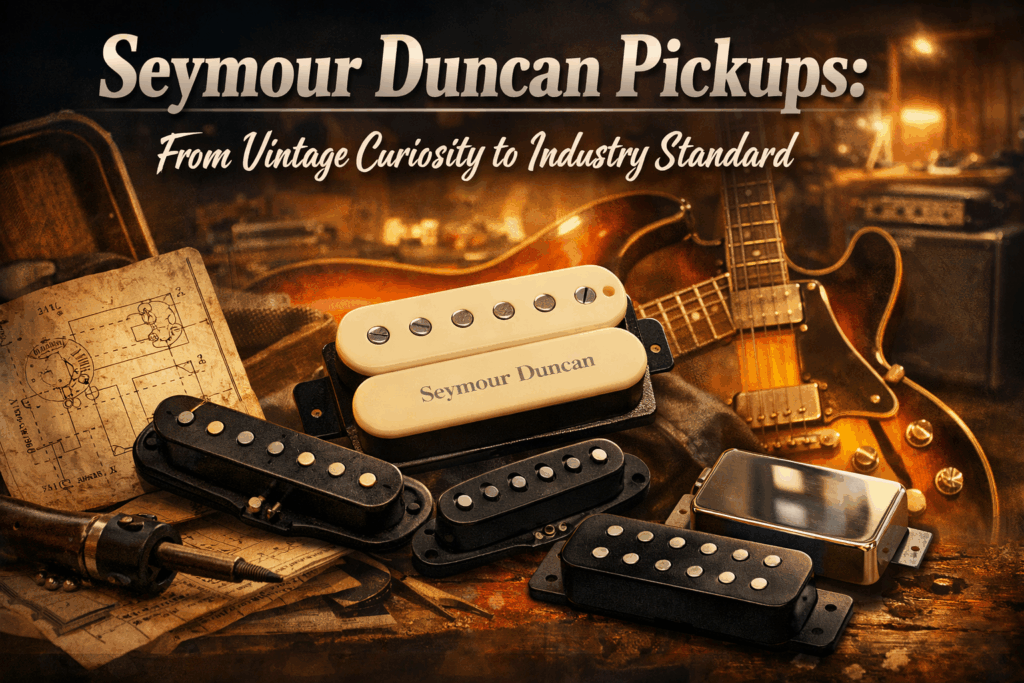
Few names in the world of electric guitar pickups carry as much weight as Seymour Duncan. What began as one man’s fascination with vintage tone has grown into one of the most influential pickup companies in modern music, shaping the sound of countless guitarists across rock, blues, metal, jazz, and beyond.
This is the story of Seymour Duncan pickups — their origins, evolution, and enduring impact on electric guitar tone.
The Origins: Seymour W. Duncan and the Search for Tone
The story starts with Seymour W. Duncan himself. Born in 1952, Duncan developed an early obsession with guitars and electronics, inspired by the tones of late-’50s Gibson humbuckers and early Fender single-coils.
In the late 1960s, while repairing guitars for friends and local musicians, Duncan began rewinding pickups by hand, carefully dissecting old units to understand how magnet type, coil wire, and winding patterns affected tone. His early reputation grew through word of mouth, especially among players desperate to revive dead or weak vintage pickups.
A pivotal moment came in the early 1970s when Duncan was asked to rewind a pickup for Jeff Beck. That relationship would soon lead to one of the most famous pickups of all time.
The Birth of Seymour Duncan Pickups (1976)
In 1976, Seymour Duncan officially founded Seymour Duncan Pickups in Santa Barbara, California. At a time when factory guitar pickups were often inconsistent and uninspiring, Duncan’s approach was refreshingly focused on tone, feel, and musicality rather than mass production.
His mission was simple:
- Recreate the best vintage pickup tones
- Improve consistency and reliability
- Offer musicians meaningful tonal choices
This philosophy quickly resonated with professional players and repair shops alike.
Iconic Designs That Defined an Era
The JB Model
Originally wound for Jeff Beck, the JB (SH-4) humbucker became one of the most recorded pickups in history. With its strong midrange, tight low end, and singing sustain, it helped define hard rock and metal tones from the late 1970s onward.
The ’59 Model
Inspired by late-’50s PAF humbuckers, the ’59 Model delivered clarity, warmth, and vintage output — making it a go-to choice for players chasing classic blues and rock tones without the cost or fragility of original PAFs.
SSL-1 Vintage Staggered
For Fender-style guitars, the SSL-1 single-coil captured the sparkle, chime, and dynamic response of early Strat pickups, helping players restore vintage character to modern instruments.
Expanding the Range: Innovation Without Losing the Past
Throughout the 1980s and 1990s, Seymour Duncan expanded its catalogue dramatically, covering nearly every musical style imaginable:
- High-output humbuckers for metal and hard rock
- Low-output, vintage-accurate designs
- Rails and stacked humbuckers for noiseless performance
- Specialty pickups for Telecasters, Jazzmasters, P-90s, bass guitars, and acoustics
Despite the growth, Duncan pickups retained a strong connection to traditional materials and winding philosophies, keeping one foot firmly planted in vintage tone.
Artists and Genres: From Blues to Extreme Metal
Seymour Duncan pickups have been embraced by an astonishing range of players, including Slash, Dave Mustaine, and Mark Knopfler.
This broad appeal highlights one of the company’s greatest strengths: versatility. Whether the goal is vintage authenticity, modern aggression, or studio-friendly clarity, there is a Seymour Duncan pickup designed for the task.
Custom Shop and Modern Developments
Today, the Seymour Duncan Custom Shop represents the pinnacle of the brand’s original ethos. Here, pickups are still wound by hand, often to replicate specific vintage units or to meet highly specific player requirements.
Recent innovations include:
- Signature artist models
- Multi-voice and hybrid designs
- Expanded bass and acoustic pickup ranges
- Continued refinement of noiseless technologies
Even with modern manufacturing tools, the company continues to emphasise human ears over machine perfection.
Why Seymour Duncan Matters
Seymour Duncan pickups occupy a rare position in the guitar world. They are:
- Widely available yet deeply respected
- Consistent without feeling sterile
- Innovative without abandoning tradition
For many players, swapping pickups is the single most transformative modification they can make — and Seymour Duncan remains one of the most trusted names for that journey.
Final Thoughts
From a young pickup-obsessed repairman to a global standard-bearer for electric guitar tone, Seymour Duncan’s legacy is inseparable from the sound of modern guitar music. Whether you’re chasing vintage PAF warmth, glassy single-coil sparkle, or high-output rock fury, Seymour Duncan pickups continue to prove that great tone never goes out of style.