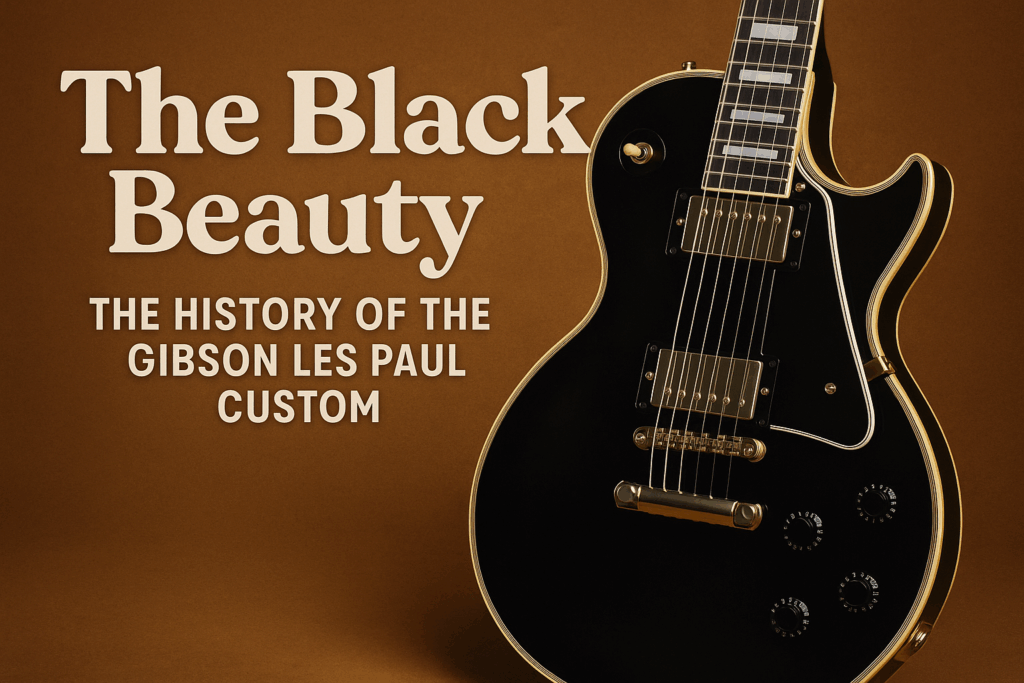
When it comes to legendary electric guitars, few models command the same respect, style, and sonic authority as the Gibson Les Paul Custom. Introduced in 1954 as a more upscale sibling to the original Les Paul Standard, the Les Paul Custom quickly carved its own identity in both sound and style. Nicknamed the “Black Beauty,” it became synonymous with elegance, sustain, and high-end craftsmanship—and has remained a staple in the arsenals of guitar heroes for decades.
A Brief History
The Gibson Les Paul Custom was originally designed as a premium version of the Les Paul model. While the original Les Paul Standard sported a gold finish and P-90 pickups, the Custom was envisioned as a formal, dressed-up alternative—hence the name “Custom.” It was initially only available in black, designed by Les Paul himself to look like a “tuxedo.”
Released in 1954, the first Les Paul Customs featured:
- Mahogany top (instead of maple) for a warmer, mellower tone
- Ebony fretboard, a first for Gibson electrics, offering a smooth and fast feel
- Alnico V “staple” neck pickup paired with a standard P-90 in the bridge
- Multi-ply binding, gold hardware, and mother-of-pearl block inlays
By 1957, the model evolved significantly:
- Humbucking pickups (the now-iconic PAF) replaced the P-90s, marking a major tonal shift
- Tonal clarity, sustain, and reduced hum helped shape the sound of blues, rock, and metal
Like the rest of the Les Paul line, the Custom was discontinued in 1961 in favor of the new SG-style body, but was reintroduced in 1968 with a return to its original carved-top single-cutaway shape, and has remained in production ever since.
Key Specs Through the Years
While there have been many variations, here are the core specs that have defined the Les Paul Custom across eras:
1954–1957 (Pre-Humbucker Era):
- Body: Mahogany body and carved mahogany top
- Neck: Mahogany, set neck
- Fretboard: Ebony, with block inlays
- Pickups: Alnico V staple neck / P-90 bridge
- Finish: Gloss black
- Hardware: Gold, with “waffle-back” tuners
1957–1960 (PAF Humbucker Era):
- Pickups: Dual PAF humbuckers
- Top: Switched to carved maple over mahogany for brighter attack
- Binding: 7-ply body binding, 5-ply headstock
1968 Reissue:
- Return of the single-cutaway body
- Modern wiring and potentiometer updates
- Slightly thinner neck profiles introduced in later years
Modern Les Paul Custom (Gibson USA / Custom Shop):
- Body: Mahogany with carved maple top (weight-relieved or solid)
- Neck: Mahogany or maple (depending on year), long neck tenon (Custom Shop)
- Fretboard: Ebony or Richlite on modern standards
- Pickups: 490R/498T or Burstbuckers (varies by year)
- Finish Options: Alpine White, Wine Red, Silverburst, and more
- Weight: Often heavy (9–11 lbs), adding to the sustain
Famous Players and Signature Moments
The Gibson Les Paul Custom has graced stages and studios in nearly every genre. Here are some of the most iconic players who’ve wielded one:
Randy Rhoads
Perhaps the most iconic Custom player, Rhoads’ white Les Paul Custom became part of his signature look and tone, combining classical precision with heavy metal intensity.
Peter Frampton
Frampton’s famed 1954 black three-pickup Custom (dubbed “Phenix”) was resurrected after being lost in a plane crash and remains his go-to guitar.
Zakk Wylde
The Ozzy Osbourne and Black Label Society shredder is synonymous with his bullseye Les Paul Custom, equipped with EMGs and towering gain.
James Hetfield
While better known for his Explorers, Hetfield frequently used a black Les Paul Custom in Metallica’s early years.
Steve Jones (Sex Pistols)
Jones’ snarling punk riffs were delivered through a well-worn white Les Paul Custom, helping define the gritty London punk sound.
Frédéric Leclercq (Kreator, ex-Dragonforce)
A modern metal player who continues the legacy with Custom Shop models built for power and clarity.
Why Players Love It
- Tone: Thick, creamy sustain with articulate highs and warm lows
- Feel: The ebony (or Richlite) board offers a fast, slick playing surface
- Looks: It’s simply one of the classiest-looking guitars ever built
- Versatility: Works just as well in jazz and blues as it does in hard rock and metal
Final Thoughts
Whether you’re drawn to its rich history, its unmistakable look, or its powerful tone, the Gibson Les Paul Custom is a guitar that commands respect. From jazz greats to metal gods, its legacy is carved into music history. And while it’s never been a cheap guitar, it’s always been worth it—for those who crave something truly custom.