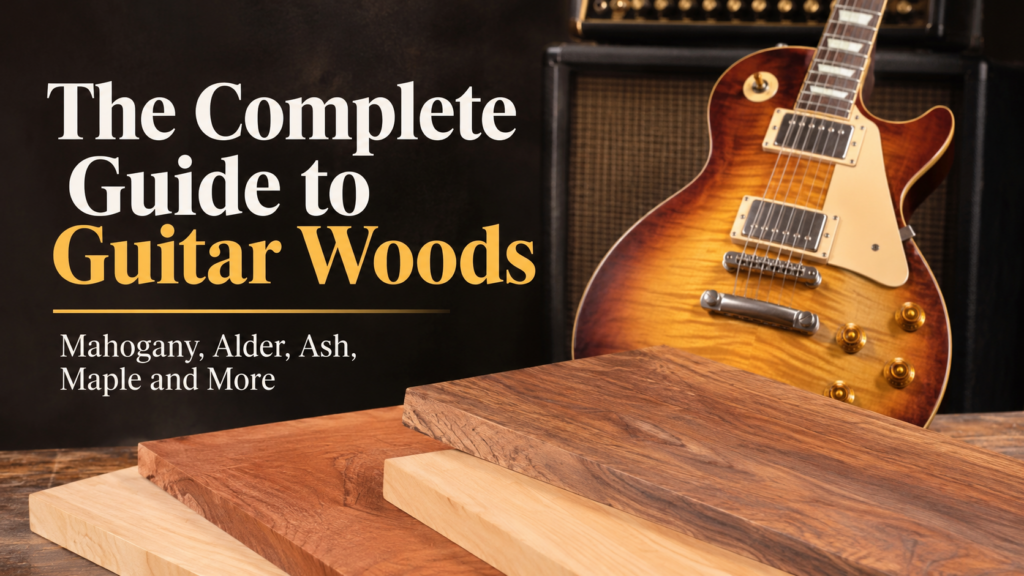
When choosing a guitar, there are plenty of things to consider. The shape of the body, the pickups, the neck profile, the finish and even the colour can all influence which instrument catches your eye. But there’s another important feature that often deserves a little more attention: the wood used to build it.
From the rich appearance of mahogany to the distinctive grain of ash, different woods have played an important part in guitar manufacturing for decades. Some have become closely associated with particular manufacturers, while others have earned a reputation for their appearance, weight, durability or tonal characteristics.
If you’ve ever wondered why a Gibson Les Paul is traditionally associated with mahogany, why Fender has used alder and ash on so many of its classic guitars, or why maple and rosewood are such popular fretboard materials, you’re certainly not alone.
So, what makes these woods different, where did their popularity come from, and does the type of wood really make a difference to the way a guitar sounds?
Let’s take a closer look at some of the most familiar woods used in guitar construction.
Why Does Wood Matter in Guitar Manufacturing?
Before looking at individual species, it’s worth understanding why manufacturers put so much thought into the materials they use.
Wood is one of the oldest and most important materials in musical instrument construction. It’s relatively strong, can be shaped into a huge variety of forms, and has natural properties that make it particularly useful for building guitars.
However, not all woods behave in the same way.
Some are relatively lightweight, while others are considerably denser. Some have attractive, pronounced grain patterns that look fantastic beneath a transparent finish, while others have a more subtle appearance that works particularly well with solid colours.
There are also differences in strength, stability, workability and availability. These characteristics all influence the way manufacturers choose materials for particular parts of an instrument.
It’s also important to distinguish between the different parts of a guitar. The wood used for the body doesn’t necessarily have to be the same as the wood used for the neck or fretboard.
A guitar might feature a mahogany body, a maple top, a mahogany neck and a rosewood fingerboard, for example. Each material has been selected for its own particular qualities.
And while guitarists have debated the tonal characteristics of different woods for years, it’s worth remembering that wood is just one part of a much bigger picture. Pickups, construction, strings, hardware, amplification and setup all play important roles in determining the final sound.
Mahogany: The Classic Gibson Favourite
Few woods are as closely associated with electric guitar manufacturing as mahogany.
Best known for its use in Gibson guitars, mahogany has been a popular choice for decades, particularly on instruments such as the Les Paul and SG.
It’s a relatively dense hardwood with a generally warm, reddish-brown appearance and an attractive grain pattern. Depending on the particular species and cut, it can range from fairly straight-grained to more visually pronounced.
One of mahogany’s biggest attractions is its combination of strength and workability. It can be shaped and finished beautifully, making it particularly suitable for guitar bodies and necks.
The traditional Gibson Les Paul Standard is perhaps the best-known example. Many models feature a mahogany body topped with a carved maple cap, creating a combination that has become one of the most recognisable designs in electric guitar history.
Mahogany is also widely used for guitar necks, where its stability and feel have made it a long-standing favourite.
In tonal discussions, mahogany is often described as warm, rich and full-bodied. It’s a sound commonly associated with the classic Les Paul, although the pickups, construction and electronics are equally important parts of the equation.
For many guitar enthusiasts, mahogany simply has that unmistakable association with traditional Gibson craftsmanship.
Alder: A Fender Classic
If mahogany is closely associated with Gibson, alder has a similarly important place in Fender’s history.
During the 1950s, Fender began using alder extensively on its solid-body electric guitars. It eventually became one of the company’s most familiar body woods, particularly on the Stratocaster and Telecaster.
Alder is relatively lightweight, easy to work with and has a fairly subtle grain pattern. This makes it particularly suitable for guitars finished in solid colours, where the natural appearance of the wood isn’t necessarily intended to be visible.
It also has a fairly consistent appearance, making it a practical choice for manufacturers producing guitars in large numbers.
You’ll find alder bodies on countless Fender instruments, including many iconic Stratocasters and Telecasters produced over the decades.
It’s traditionally associated with a balanced tonal character, with players often describing it as clear, responsive and versatile. This reputation has helped make it a popular choice across a wide range of musical styles.
Of course, alder isn’t exclusive to Fender. Plenty of other manufacturers have used it over the years, particularly when producing instruments inspired by traditional American electric guitar designs.
For anyone who appreciates the classic Fender sound and appearance, alder remains one of the most recognisable guitar woods around.
Ash: Beautiful Grain and Distinctive Character
Another wood with strong Fender connections is ash.
Particularly popular on vintage Telecasters and Stratocasters, ash is often appreciated as much for its appearance as its practical qualities.
One of its most attractive features is its grain. Depending on the particular type of ash, it can display beautiful patterns that look fantastic beneath transparent finishes.
This is one reason why natural-finish Telecasters have become so popular over the years. The combination of a simple body shape and attractive wood grain gives these instruments a distinctive appearance.
There are different varieties of ash, and they don’t all have identical properties.
Swamp ash, for example, has traditionally been prized for its relatively low weight and attractive grain. Northern ash is generally denser and heavier, offering a rather different set of characteristics.
Some players associate ash with a bright, lively and articulate sound, although these descriptions are subjective and shouldn’t be treated as guaranteed tonal results.
Ash has appeared on plenty of famous instruments, particularly Fender models from the 1950s and 1960s. Its visual appeal has also made it a popular choice for modern guitars that want to capture a little of that vintage character.
For guitarists who love natural finishes and distinctive grain patterns, ash is certainly a wood worth appreciating.
Maple: Strength, Stability and a Beautiful Appearance
Maple is another hugely important material in guitar construction.
It’s a dense, strong hardwood that has been used for guitar necks, fretboards, body tops and even complete guitar bodies.
One of the most recognisable examples is the carved maple top found on many Gibson Les Paul models. These tops can feature spectacular grain patterns, particularly on figured maple varieties such as flame maple and quilted maple.
When finished with a transparent sunburst or coloured stain, the natural figuring can create some truly beautiful results.
Maple is also extremely popular for guitar necks. Fender Stratocasters and Telecasters have featured maple necks throughout much of their history, and the familiar combination of a maple neck and fretboard has become a classic design feature.
There are several different varieties of maple used in guitar manufacturing, including hard maple and softer species such as bigleaf maple.
Figured maple is particularly desirable from an aesthetic perspective. Birdseye, flame and quilted patterns can all add considerable visual interest to an instrument.
In tonal discussions, maple is often associated with a bright, clear and articulate character. Its density and stiffness are also part of the reason why it’s such a popular choice for neck construction.
Whether it’s a beautifully figured Les Paul top or a classic Fender maple neck, maple has certainly earned its place among the most important woods in guitar history.
Rosewood: A Favourite for Fretboards
Rosewood is perhaps best known for its use on guitar fretboards.
Its darker appearance, attractive grain and comfortable playing surface have made it a popular choice across both electric and acoustic guitar manufacturing.
Fender and Gibson have both used rosewood extensively over the years. The classic Fender Stratocaster with a rosewood fingerboard is one of the most recognisable combinations in electric guitar design.
Rosewood is also frequently found on acoustic guitar bridges, backs and sides, although the particular species used can vary considerably.
There are several types of rosewood, including Indian rosewood and Brazilian rosewood. Brazilian rosewood has historically been particularly desirable due to its appearance, acoustic properties and association with high-end vintage instruments.
However, its availability is now heavily restricted by international conservation regulations, making original Brazilian rosewood instruments especially interesting to collectors.
Rosewood is often described as warm and smooth in tonal discussions, but its popularity also comes down to its feel and appearance.
It’s a material that has become so familiar in guitar manufacturing that many players simply associate it with the traditional look and feel of a quality instrument.
Ebony: The Premium Fretboard Choice
While rosewood is extremely common, ebony has a reputation as a particularly luxurious fretboard material.
It’s a very dense, hard wood that traditionally features a dark appearance and a smooth, refined surface.
Ebony fretboards have appeared on many high-end Gibson guitars, particularly certain Les Paul Custom models, as well as a variety of acoustic and classical instruments.
One of ebony’s most attractive qualities is its density and durability. It can provide a very smooth playing surface and is particularly well suited to the repeated contact and wear associated with regular playing.
Although many people picture ebony as completely black, it can actually display brown streaks and variations in colour. These natural markings are part of the wood’s character.
In the past, ebony was sometimes treated as a premium alternative to rosewood, particularly on more expensive instruments.
Today, manufacturers continue to use it on selected models, although responsible sourcing and availability remain important considerations.
For guitarists who appreciate a sleek, understated appearance, an ebony fretboard can be a particularly attractive feature.
Basswood: A Favourite Among Modern Guitarists
Basswood might not have the same traditional reputation as mahogany or maple, but it has become an important material in modern electric guitar manufacturing.
It’s a relatively lightweight hardwood with a fairly plain, even appearance. Unlike ash or figured maple, it doesn’t generally have particularly dramatic grain patterns.
This makes it especially suitable for guitars finished in solid colours.
Basswood became particularly popular during the 1980s and 1990s, when manufacturers were producing more guitars aimed at high-performance players.
Ibanez, in particular, has used basswood extensively across a number of its electric guitar ranges.
It’s often associated with a balanced, relatively even tonal response, although, as with other woods, the final sound depends on much more than the body material alone.
Basswood also offers practical advantages for manufacturers. It’s relatively easy to work with and can help keep instrument weight manageable.
For players interested in modern superstrat-style guitars, basswood is a material they’ll encounter quite frequently.
Poplar: An Affordable Alternative
Poplar is another wood that has found its way into a huge number of electric guitars.
It’s generally lightweight, reasonably easy to work with and relatively affordable compared with some of the more traditional guitar woods.
One of its main advantages is its availability and consistency, making it a practical choice for manufacturers producing instruments at accessible price points.
Poplar has been used on a variety of guitars, including some Fender models and instruments from other manufacturers.
It’s not usually selected for its spectacular grain patterns, as it tends to have a fairly plain appearance. However, that isn’t necessarily a disadvantage when the guitar is going to receive an opaque finish.
In terms of tonal descriptions, poplar is often considered fairly balanced and versatile.
Although it might not have the same collector appeal as vintage mahogany or beautifully figured ash, it’s a perfectly practical material for building a quality guitar.
Spruce: One of the Most Important Acoustic Guitar Woods
So far, we’ve concentrated largely on woods associated with electric guitars. But when it comes to acoustic instruments, spruce deserves a place of its own.
Spruce has been one of the most widely used woods for acoustic guitar soundboards for generations.
The soundboard is the large front surface of an acoustic guitar, and it plays an important role in producing and projecting sound. Its ability to vibrate efficiently makes spruce particularly well suited to this job.
Sitka spruce is one of the most common varieties, appearing on countless acoustic guitars from manufacturers such as Martin and Taylor.
It’s valued for its strength, relatively low weight and ability to respond to a wide range of playing styles.
Other varieties, including Engelmann spruce and Adirondack spruce, are also used in acoustic guitar construction.
Different types can offer slightly different physical and acoustic characteristics, which is one reason why manufacturers and players sometimes have strong preferences.
Spruce is often paired with mahogany or rosewood backs and sides, creating combinations that have become particularly familiar in the acoustic guitar world.
For anyone interested in acoustic instruments, understanding spruce is just as important as understanding mahogany or maple in the electric guitar market.
Does Guitar Wood Really Affect the Sound?
This is where things get particularly interesting.
Ask a group of guitarists whether different woods affect the sound of an instrument, and you’re likely to hear plenty of different opinions.
Traditional guitar design has always placed considerable importance on wood selection. Certain combinations have become closely associated with particular sounds, and manufacturers continue to use familiar materials on many of their most popular models.
However, the influence of wood depends heavily on the type of guitar being discussed.
On acoustic guitars, the choice of wood can have a meaningful influence on the instrument’s resonance, projection and overall tonal character. The soundboard, in particular, plays an important role in determining how the guitar responds.
The back and sides also contribute to the instrument’s acoustic behaviour, although their influence varies depending on the guitar’s construction.
Electric guitars are a little more complicated.
With a solid-body electric guitar, the pickups are responsible for converting string vibrations into an electrical signal. Their design, position and interaction with the strings have a substantial influence on the sound that eventually comes out of the amplifier.
The bridge, neck construction, strings, electronics and amplification all contribute too.
Some players believe that different body woods produce noticeably different tones, while others argue that their influence is relatively subtle compared with other components.
There is certainly room for debate, and it’s difficult to separate individual variables when comparing two complete instruments.
The important thing is not to assume that a particular wood will automatically make a guitar sound better. A well-designed instrument can sound fantastic regardless of whether its body is made from mahogany, alder, ash or another suitable material.
Which Guitar Wood Is Best?
With so many different materials available, is there really one type of wood that stands above the rest?
Not particularly.
Each has its own advantages, and the best choice ultimately depends on the instrument, the player’s preferences and what they’re looking for.
If you love traditional Gibson-style guitars, mahogany and maple are likely to be familiar favourites. If you’re more interested in classic Fender designs, alder and ash might be more appealing.
For acoustic guitar players, spruce, mahogany and rosewood are all materials worth understanding, particularly when comparing different models.
And if you’re choosing an electric guitar, it’s worth looking beyond the body wood alone. The neck profile, fretboard, pickups, bridge and overall construction can all have a much greater influence on whether an instrument feels and sounds right for you.
It’s also important to remember that different woods can vary considerably within the same species. Two guitars made from mahogany won’t necessarily have identical weights, grain patterns or physical characteristics.
Sometimes, the best approach is simply to try a few different instruments and see which one feels right.
More Than Just a Piece of Wood
It’s easy to overlook the materials used to build a guitar when there are so many other features competing for attention. But as we’ve seen, wood has played an important role in shaping the instruments we know and love today.
From the mahogany bodies of classic Gibson Les Pauls to the alder and ash designs that helped define Fender’s golden era, certain woods have become permanently associated with some of the most iconic guitars ever produced.
Others, such as basswood and poplar, have helped manufacturers create practical, affordable instruments for modern players, while spruce, rosewood and mahogany continue to play an important role in acoustic guitar construction.
There will probably always be debate about exactly how much different woods influence the sound of an electric guitar. And that’s part of the fun of being a guitar enthusiast.
Some players will swear by a particular combination of materials, while others are far more interested in the way an instrument feels, looks and responds when they pick it up.
Ultimately, there’s no single perfect wood for every guitar.
The most important thing is finding an instrument that inspires you to play. Whether it’s a beautifully figured maple-topped Les Paul, a well-worn alder Stratocaster or a spruce-topped acoustic guitar, the materials are just one part of what makes each instrument special.
And sometimes, that’s what makes the world of guitars so fascinating. Two instruments can look completely different, use entirely different materials and still have the ability to make wonderful music.