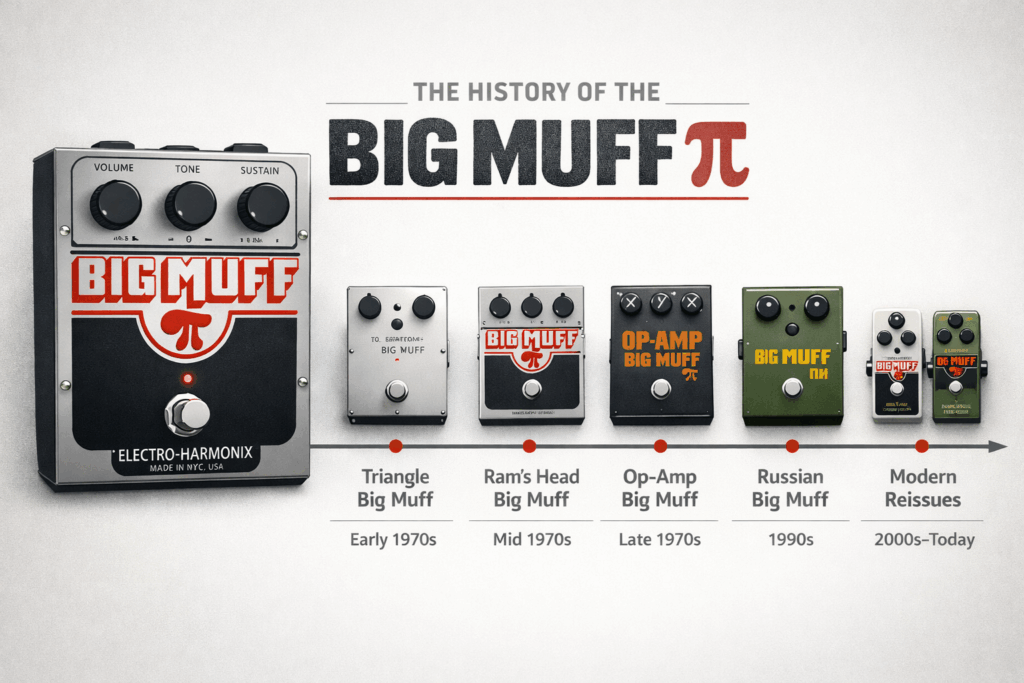
Few pedals have managed to be both instantly recognisable and endlessly variable quite like the Electro-Harmonix Big Muff Pi. It’s fuzz, it’s sustain, it’s a wall of harmonics… and depending on which version you plug into, it can be smooth and violin-like, gnarly and mid-forward, or scooped and enormous.
From cramped New York workshops in the late ’60s/early ’70s to stadium stages and bedroom boards worldwide, the Big Muff’s story is really the story of guitarists (and bassists) chasing a bigger, more dramatic version of themselves.
What is a Big Muff, really?
At its core, the Big Muff Pi is a four-stage, transistor-based fuzz/sustain circuit with a simple but powerful tone control. The magic is the way it stacks gain: rather than a spitty, gated fuzz, the Muff tends to deliver thick sustain, a compressed feel, and a harmonic “bloom” that can make single notes feel huge and chords feel like a storm front moving in.
That said, one Big Muff is rarely the same as another. Small component changes—transistors, clipping diodes, cap values—shift the EQ, saturation character, noise level, and how it sits in a mix. This is why guitarists argue about “the best” Muff the way vintage nerds argue about pre-CBS neck shapes.
The early days: New York fuzz fever
Electro-Harmonix (EHX) came out of the New York effects boom, when innovators were moving fast and building bold circuits for players who wanted more than “clean boost” or “a bit of grit.” The Big Muff Pi emerged as a more sustaining, more dramatic fuzz—perfect for the era’s louder amps, bigger stages, and increasingly expressive lead playing.
Early Big Muffs quickly became a favourite because they could do two things at once:
- Make leads sing (almost synth-like sustain)
- Make rhythm parts feel massive (thick, chewy chord textures)
This dual personality is a big reason it became a timeless tool rather than a period-correct curiosity.
The classic Big Muff eras (and why players obsess over them)
1) “Triangle” Big Muff (early 1970s)
Named for the physical layout of its components, the Triangle-era Muff is often described as:
- smoother and more “open”
- articulate for a Muff
- rich sustain without getting too woolly
Players who love the Triangle vibe usually want a Muff that’s big, but still retains note definition—great for expressive leads and layered studio parts.
2) “Ram’s Head” Big Muff (mid 1970s)
If the Triangle is smooth and open, the Ram’s Head is often associated with:
- slightly more aggressive saturation
- a singing top end
- that iconic, creamy sustain that feels made for soaring lead lines
This is the era many people think of when they picture the “classic” Muff lead tone.
3) The “Tall Font / NYC” and later 1970s variants
As production evolved, tolerances and parts choices created more variation unit-to-unit. Some later ’70s Muffs lean darker and thicker, some brighter and raspier. This is where the Big Muff mythology really begins: two pedals that look the same can feel wildly different.
4) The Op-Amp Big Muff (late 1970s)
A major design shift: instead of an all-transistor gain structure, certain versions used op-amps, resulting in a distinct voice—often described as:
- more aggressive, more immediate
- tighter attack
- slightly different mid character compared to the classic transistor versions
This flavour has become its own cult favourite because it cuts differently and can feel more “in your face.”
5) The Russian/Sovtek era (1990s)
When Big Muff production shifted, players discovered a new personality—often described as:
- thicker low end
- a growlier, sometimes darker character
- a more “industrial” roar that works brilliantly for heavy rhythm
These are beloved by players who want a Muff that feels huge and physical—particularly in rock and stoner/doom contexts, and often on bass too.
Famous Big Muff users (and what they used it for)
The Big Muff’s reputation isn’t just about specs—it’s about the way artists used it as a signature colour.
- David Gilmour – perhaps the most famous “singing sustain” Muff voice. The Big Muff became central to those soaring, vocal lead lines where the guitar feels like it’s breathing.
- J Mascis – a Big Muff poster child for loud alt rock: thick, woolly, unapologetically huge fuzz that turns riffs into earthquakes.
- The Smashing Pumpkins (Billy Corgan era tones) – the Big Muff is deeply connected to layered, saturated fuzz tones that still feel melodic and controlled when stacked in the studio.
- Jack White – fuzz as a personality trait. While he’s used plenty of fuzz flavours, the Muff-style approach (huge saturation + sustain) is part of that “larger than life” garage-rock vocabulary.
- Queens of the Stone Age / stoner & desert rock circles – the Muff’s ability to make riffs feel like a moving wall is basically a genre feature.
(And beyond guitar: countless bassists use Big Muff variants for thick, synthy grind—especially versions voiced with bigger low end.)
Modern Big Muff Pi models: the family tree gets a revival
One of the coolest parts of the Big Muff story is that EHX didn’t just leave it in the past—they’ve kept reissuing and refining it, often nodding directly to those classic eras.
Here are some of the most common Big Muff flavours you’ll see on modern boards:
Big Muff Pi (NYC reissue)
The classic “default” Muff voice: big sustain, scooped-ish tone control behaviour, and that instantly familiar fuzz blanket. Great if you want the archetype.
Nano Big Muff
Same general personality in a smaller enclosure—perfect for players who want Muff tones without sacrificing pedalboard real estate.
Triangle Big Muff reissue
A nod to those early, smoother units—often favoured by players who want the Muff to feel a little more articulate and less congested.
Ram’s Head reissue
Built to chase that creamy, singing lead tone. If your head says “Gilmour sustain,” this is usually the branch people point to.
Op-Amp Big Muff reissue
A more aggressive, punchy Muff variant with a different attack and cut. Great for thick riff tones that need a bit more bite.
Bass Big Muff / Deluxe Bass Big Muff
Voiced and featured for bass players (often including blend/DI-friendly ideas depending on version), designed to keep low end intact while adding fuzz.
Big Muff with Tone Wicker
Adds options that can open up the top end and alter the tone stack behaviour—useful if you love the Muff sustain but want more flexibility in how it sits in a mix.
Green Russian reissue
That thick, chewy, low-heavy roar—massive rhythm sounds, great on bass, and a favourite for heavy rock textures.
Why the Big Muff still matters
The Big Muff Pi isn’t a “transparent” pedal. It’s not subtle, and it doesn’t politely step out of the way. It’s a statement—a texture you build songs around.
And yet, it has lasted because it’s unbelievably musical:
- It can make leads feel orchestral and vocal
- It can make riffs feel like architecture
- It can turn simple parts into a wall of emotion
Whether you’re chasing vintage correctness, building a modern shoegaze board, or just want a fuzz that makes you play differently, the Big Muff remains a rite of passage.