Carlos Santana’s tone is instantly recognizable — a singing, sustaining, violin-like voice that dances between Latin rhythms, blues phrasing, and rock intensity. Over the decades, Santana has carved out a sound so distinct that even a single note seems to carry his spiritual fingerprint. But behind that tone lies an evolving collection of guitars, amps, and effects that have helped shape his sonic identity from Abraxas to Supernatural and beyond.
The Early Days: Gibson SG & Les Paul Customs (Late ’60s – Early ’70s)
In his early career — particularly during his breakthrough performance at Woodstock in 1969 — Santana was playing a Gibson SG Special loaded with P-90 pickups. This guitar delivered the raw, gritty midrange that cut through the mix of his Latin-rock band’s percussive grooves.
- Notable Guitar: 1961 Gibson SG Special
- Pickups: Gibson P-90s
- Amp of choice: Fender Twin Reverb or Silvertone amps in early performances
By the early ’70s, he transitioned to Gibson Les Paul Customs, seeking a thicker tone and better sustain. Albums like Abraxas feature these humbucker-loaded beasts paired with cranked tube amps.
The Mesa/Boogie Revolution (Mid ’70s – ’80s)
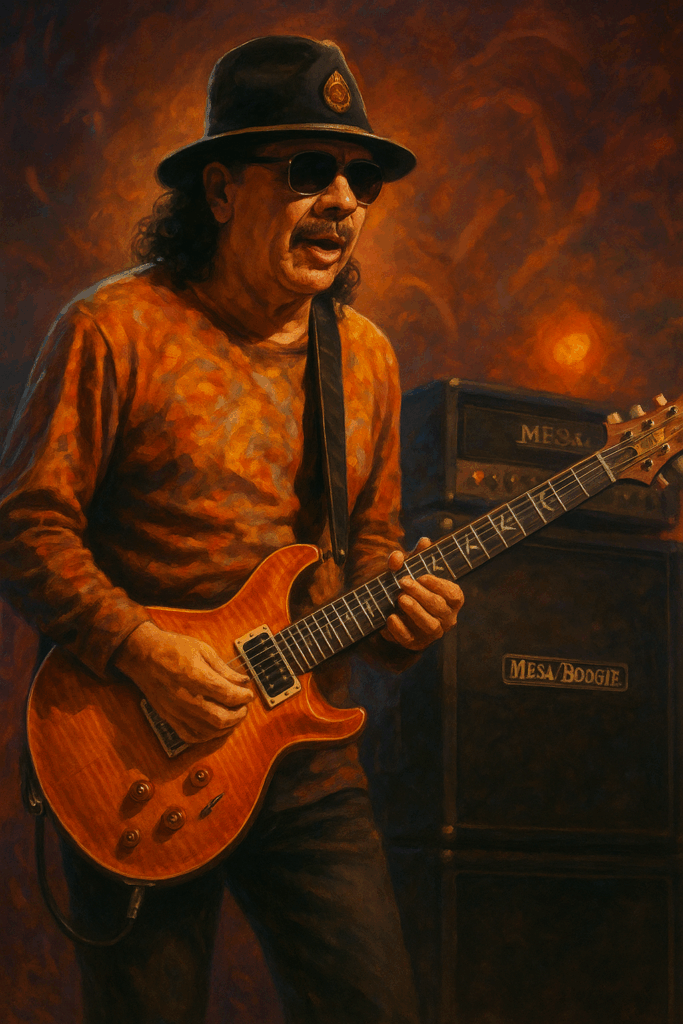
Santana played a key role in the birth of Mesa/Boogie amps. Randall Smith modified a Fender Princeton for Carlos, adding more gain and a closed-back cabinet. The result was a powerful amp with creamy sustain and focused mids — exactly the tone Carlos had been chasing.
- Key Amp: Mesa/Boogie Mark I
- Guitars used: Gibson L-6S, Les Pauls, and briefly some Yamaha SG models
- Tone goals: Singing sustain, rich mids, and warm top-end
This amp became his go-to for the next few decades. Santana’s close relationship with Mesa/Boogie helped launch the company into the upper echelon of boutique amp builders.
Enter PRS: A Match Made in Mahogany (Early ’80s – Present)
In the early 1980s, Carlos met a young Paul Reed Smith and quickly fell in love with his custom-built guitars. Santana became the first major artist to endorse PRS, and he’s remained a loyal user ever since.
Signature PRS Santana Models:
- PRS Santana I (1988) – based on his original Custom 24
- PRS Santana II & III – feature wider necks, Brazilian rosewood, and signature inlays
- PRS Santana MD (Modern Eagle variant) – with more versatile electronics
- PRS Santana Retro / Core Series – modern refinements of his vintage models
Key Features:
- Scale Length: 24.5”
- Pickups: PRS Santana humbuckers
- Tone: Thick, fluid sustain with articulate note separation
Carlos’s PRS guitars, especially those with Brazilian rosewood necks and mahogany bodies, became integral to his vocal-like tone.
Effects & Pedals
Carlos Santana isn’t a heavy pedal user — preferring to let his hands, guitar, and amp do the talking — but he’s used a few select effects to shape his tone:
- T-Rex Replica Delay – for subtle ambient repeats
- Mu-Tron III Envelope Filter – occasionally used for funk-inspired passages
- Ibanez Tube Screamer (TS9) – very rarely used for added midrange
- Boss CE-1 Chorus Ensemble – sometimes used live for depth
Overall, he keeps his signal chain simple and prefers amp-based drive and dynamics over extensive pedalboards.
Live & Studio Setup
Live, Santana often runs his PRS guitars into Mesa/Boogie Mark I, Mark IIB, or custom Santana models, sometimes blending in Dumble or Bludotone amps for extra nuance.
Cabinets: Santana has used custom 1×12 or 2×12 cabinets loaded with Electro-Voice (EV) speakers, known for their clarity and headroom.
Strings: D’Addario .009–.042 gauge
Picks: Herco Flex 75 or custom Dunlop picks
Wireless: Shure systems in recent tours
Carlos Santana’s Signature Sound: The Essentials
To recap, here’s what defines Santana’s tone:
- Sustain-rich humbuckers (especially PRS Santana pickups)
- High-gain, mid-focused tube amps (Mesa/Boogie Mark series)
- Minimal effects – with delay used sparingly for space
- Melodic phrasing, soft attack, and expressive vibrato
- Latin-inspired rhythms, blended with blues scales and modal phrasing
Legacy and Influence
Carlos Santana’s tone has inspired generations of guitarists seeking that mythical “singing sustain.” His embrace of Paul Reed Smith guitars and Mesa/Boogie amps reshaped both companies and helped define a whole era of boutique tone.
Whether he’s playing “Black Magic Woman,” “Europa,” or “Smooth,” the combination of soulful phrasing, rich sustain, and spiritual intent makes his sound unmistakable.