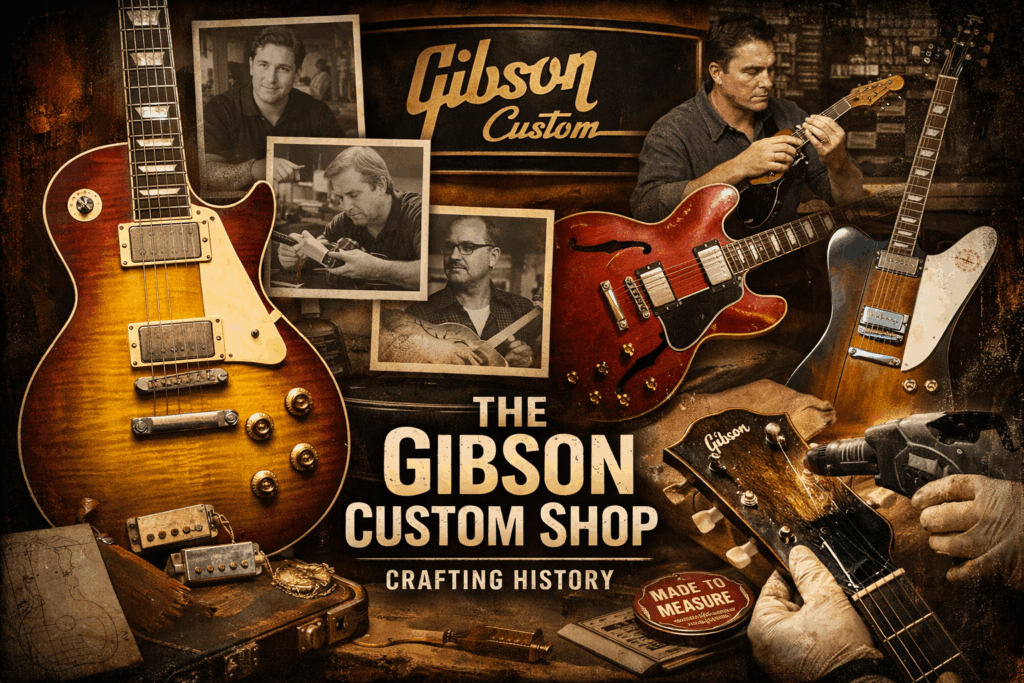
When Gibson launched its Custom Shop in the early 1990s, it wasn’t just creating a high-end product line — it was making a statement about heritage, craftsmanship, and the importance of historical accuracy in an era of mass production. Three decades later, the Gibson Custom Shop stands as one of the most influential and respected boutique operations within a major guitar manufacturer, responsible for some of the most faithful recreations of vintage instruments ever produced, as well as bold modern interpretations and artist-driven designs.
From painstaking ’59 Les Paul recreations to limited-run Firebirds, Explorers, and archtops, the Custom Shop has helped define how vintage-inspired guitars are built, marketed, and valued in the modern era.
The Origins: Gibson in the Late 1980s and Early 1990s
By the late 1980s, Gibson was in the middle of a major transition. After years of uneven quality control during the Norlin era (1969–1986), the company was acquired in 1986 by Henry Juszkiewicz, David Berryman, and Gary Zebrowski. One of their first priorities was restoring Gibson’s reputation for craftsmanship and historical authenticity.
At the same time, the vintage guitar market was exploding. Original 1950s Les Pauls, early ES-335s, and pre-CBS Fenders were commanding serious money, and players were becoming increasingly educated about period-correct specs: neck profiles, fret wire, pickup construction, finishes, plastics, and even tooling marks.
Gibson’s response was the creation of a dedicated Custom Shop division, officially launched in 1993 in Nashville. Its mission was twofold:
• Build historically accurate recreations of Gibson’s most revered instruments
• Create a small-batch, high-end workshop capable of bespoke orders and limited editions
This wasn’t just a premium trim level — it was a separate manufacturing philosophy.
Early Cornerstones: The Historic Reissue Program
The backbone of the Custom Shop has always been the Historic Reissue series, introduced in the early 1990s and refined continuously ever since.
The Les Paul Reissues
No guitars define the Gibson Custom Shop more than the Les Paul Historic Reissues:
• 1957 Les Paul Goldtop Reissue (R7)
• 1958 Les Paul Standard Reissue (R8)
• 1959 Les Paul Standard Reissue (R9)
• 1960 Les Paul Standard Reissue (R0)
These models aimed to replicate original late-’50s Les Pauls in construction, feel, tone, and appearance. Over the years, Gibson continually updated specs as more vintage examples were studied:
• One-piece mahogany backs
• Long neck tenons
• Correct neck carves
• Hide glue construction (introduced later)
• Aniline dye back finishes
• Correct top dish carve geometry
• Custombucker and Burstbucker pickups
• Period-accurate plastics and hardware
By the 2000s, the R9 in particular had become the industry benchmark for vintage-style single-cut guitars, influencing not just Gibson’s own production line but also boutique builders worldwide.
Beyond Les Pauls: Expanding the Historic Line
While the Les Pauls drew the headlines, the Custom Shop quickly expanded into other historically important models:
ES Series
• ES-335 ’59 and ’63 Reissues
• ES-345 and ES-355 Reissues
• ES-330 Reissues
• Limited-run block-neck and dot-neck variants
These guitars recreated classic semi-hollow construction methods, including correct maple/poplar laminates, long tenon neck joints, and period-correct neck profiles.
SG and Firebird Reissues
• 1961 SG Standard Reissue
• SG Custom Reissues
• Firebird I, III, V, and VII Reissues
Firebirds in particular became a Custom Shop specialty, featuring original-style mini-humbuckers, banjo tuners, and reverse-body construction.
Archtops and Acoustics
• L-5 and Super 400 Reissues
• SJ-200 and J-45 Historic Acoustics
• Advanced Jumbo Reissues
These models helped re-establish Gibson’s reputation in the archtop and acoustic worlds, where hand-carving and traditional bracing techniques were still highly valued.
The Murphy Lab and the Rise of Vintage Aging
One of the most influential developments in Custom Shop history was the rise of artificial aging — or “relicing.”
In the late 1990s, Tom Murphy began experimenting with aging techniques to replicate the look of genuine vintage guitars: finish checking, lacquer wear, tarnished hardware, and subtle neck wear.
What began as an in-house experiment became a defining feature of the Custom Shop:
• Murphy-aged Les Pauls
• Murphy-aged Firebirds and SGs
• Ultra-accurate vintage patina replication
By the 2010s, Murphy’s techniques had become so respected that Gibson formally launched the Murphy Lab in 2021, offering factory-aged finishes in several levels:
• Ultra Light Aged
• Light Aged
• Heavy Aged
• Ultra Heavy Aged
These finishes allowed players to experience the feel and look of a decades-old guitar straight out of the case.
Artist Models and Signature Instruments
The Gibson Custom Shop has also served as the home for high-end artist models, often combining historical detail with player-specific modifications.
Notable examples include:
• Jimmy Page No. 1 and No. 2 Les Pauls
• Eric Clapton “Beano” Les Paul
• Joe Bonamassa “Skinnerburst” Les Paul
• Slash Les Paul Standards
• Peter Green Les Paul (out-of-phase pickup recreation)
• Zakk Wylde Les Paul Customs
• Gary Moore Les Pauls
• Warren Haynes ES-335
• Alex Lifeson Les Paul Axcess
These instruments often involved deep forensic study of the original guitars, including:
• Pickup winding patterns
• Magnet types
• Neck carve replication
• Weight matching
• Finish coloration
They blurred the line between museum-grade replicas and touring-ready professional instruments.
The Custom Shop as a True “Custom” Operation
Despite its reputation for reissues, the Gibson Custom Shop has always maintained a genuine one-off and small-batch capability.
Through the Made 2 Measure program and dealer-specific runs, Gibson has produced:
• Custom color Les Pauls
• Unique neck profiles
• Non-standard hardware combinations
• Limited-run Firebirds, Explorers, and Flying Vs
• Historic-spec mashups never offered in the standard line
This flexibility allowed Gibson to cater to boutique dealers, collectors, and touring artists alike.
Key Figures Behind the Gibson Custom Shop
Several individuals have been central to shaping the Custom Shop’s identity:
Henry Juszkiewicz
As CEO from 1986 until his passing in 2019, Juszkiewicz was instrumental in re-establishing Gibson’s quality focus and launching the Custom Shop. His vision emphasized historical authenticity and premium craftsmanship.
Tom Murphy
The pioneer of Gibson’s aging techniques, Murphy’s work defined the look and feel of modern relic guitars and later evolved into the Murphy Lab.
Edwin Wilson
As a long-time Custom Shop executive and historian, Wilson helped guide Gibson’s archival research and reissue accuracy.
Cesar Gueikian
Now Gibson’s CEO, Gueikian has overseen a renewed focus on vintage correctness, streamlined model ranges, and the expansion of Custom Shop offerings since the company’s post-bankruptcy restructuring.
Rick Gembar
Former head of the Custom Shop, Gembar was deeply involved in shaping Gibson’s reissue strategy and artist collaborations during the 2000s and 2010s.
The Modern Era: Refinement and Renaissance
After Gibson’s bankruptcy in 2018, the company underwent a cultural and strategic reset. The Custom Shop emerged leaner, more historically focused, and more quality-driven than ever.
Recent refinements include:
• More consistent neck carves
• Improved pickup accuracy (Custombuckers)
• Hide glue neck joints
• Period-correct top carves
• Refined finish formulas
• Expanded Murphy Lab offerings
Modern Historic Reissues are now widely regarded as the most accurate vintage recreations Gibson has ever produced.
Legacy and Influence
The Gibson Custom Shop hasn’t just preserved Gibson’s past — it has shaped the entire high-end guitar market.
Its impact includes:
• Setting industry standards for vintage reissues
• Popularising relic finishes
• Driving historical research into guitar construction
• Influencing boutique builders worldwide
• Creating a collector-grade modern guitar market
For players and collectors alike, the Custom Shop represents the point where craftsmanship, history, and tone converge.
Final Thoughts
From its 1993 launch to today’s Murphy Lab-aged masterpieces, the Gibson Custom Shop has evolved into one of the most respected premium guitar operations in the world.
By combining deep historical research, elite craftsmanship, and genuine innovation, it has ensured that Gibson’s most iconic designs don’t just live on — they continue to evolve, inspire, and define what a modern vintage guitar should be.
For anyone passionate about Gibson’s legacy, the Custom Shop isn’t just a product line.
It’s the custodian of an American musical heritage.