When guitarists think of towering rock anthems and dazzling stage presence, few instruments loom as large in the imagination as the Gibson EDS-1275. With its distinctive dual necks — one standard six-string and one jangly 12-string — this guitar has become an enduring symbol of versatility, innovation, and sheer rock-and-roll spectacle. But how did this remarkable guitar come to be? Let’s dive into the history and legacy of the EDS-1275.
Origins: From Experimental Beginnings to Solid-Body Double Neck
Gibson’s exploration of multi-neck guitars stretches back to the late 1950s, with early custom-order instruments featuring two six-string necks. These were produced between 1958 and the early 1960s but were far from the design we recognize today.
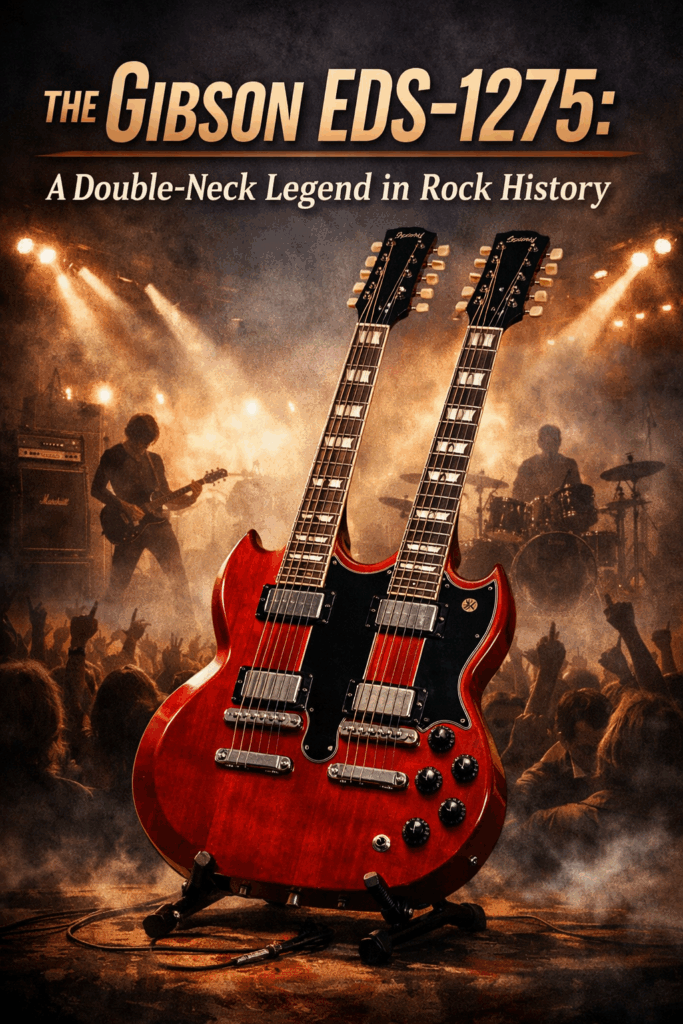
In 1963, Gibson introduced the solid-body EDS-1275, the version that would go on to capture global attention. Inspired by the company’s SG platform, this model paired a 12-string neck above a 6-string neck, enabling players to shift instantly between rich 12-string rhythms and powerful six-string leads.
Design and Playability: Two Guitars in One
At its heart, the EDS-1275 is about musical flexibility. The upper neck delivers the signature shimmer and harmonic complexity associated with 12-string guitars, perfect for rhythm and texture. The lower six-string neck lets players dig into solos and riffs without changing instruments mid-set.
Inside, the guitar features a solid mahogany body with set necks and rosewood fingerboards, giving both necks excellent sustain and clarity. While the instrument’s substantial size and weight demand stamina from the player, its sonic rewards are unmistakable.
Iconic Players: From Jazz to Rock Royalty
Though the EDS-1275 was not originally conceived as a rock staple, its impact on popular music cannot be overstated. Early adopters experimented with its possibilities, but it was Jimmy Page of Led Zeppelin who elevated the guitar to legendary status. Page’s use of the doubleneck during live performances of Stairway to Heaven — switching between the 12-string intro and six-string sections without missing a beat — made the EDS-1275 a symbol of rock virtuosity.
Other notable players have embraced the model as well. Don Felder famously used an EDS-1275 while performing the Eagles’ Hotel California, seamlessly navigating complex arrangements that would otherwise require multiple guitars.
Even Pete Townshend of The Who was briefly seen with a 1275 in the late 1960s, adding to the guitar’s storied presence on stage.
Production History and Rarity
The EDS-1275 has seen several production runs over the decades. After its initial run from 1963 to 1968, Gibson revived the model in the 1970s and produced variations into the late 1990s. Today, it’s most often available through the Gibson Custom Shop, where models like the Jimmy Page Replica are crafted for collectors and players alike.
Early examples — especially those from the 1958-62 period when Gibson’s first experiments with double necks were underway — are extremely rare and highly sought after by collectors.
Legacy: Why the EDS-1275 Matters
Beyond specifications and famous owners, the Gibson EDS-1275 stands as a testament to innovation in electric guitar design. It pushed the boundaries of what a guitar could be — not just a tool for soloing or rhythm, but a multi-faceted instrument capable of shaping entire arrangements in real time.
For many players and fans, it represents a moment when technical ambition and artistic expression converged on stages around the world. From Zeppelin amphitheaters to Eagles arenas, the EDS-1275’s image is etched into the visual language of rock history.
Conclusion
The Gibson EDS-1275 is more than just a double-neck guitar — it’s a cultural icon. Its bold design has challenged players, thrilled audiences, and inspired generations of guitarists. Whether you’re chasing the chime of a 12-string or the punch of a six-string solo, the EDS-1275 remains one of the most captivating instruments ever made.