Origins: A Step Above the Junior
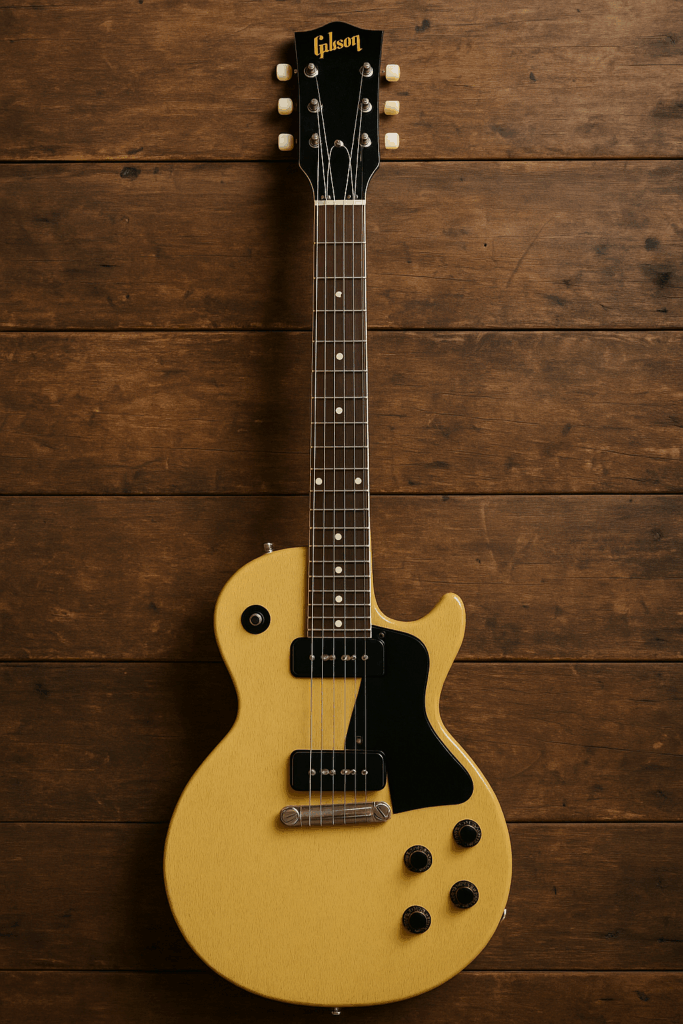
In 1955, Gibson expanded its Les Paul lineup with the Les Paul Special — a more refined version of the popular Les Paul Junior. While the Junior had a single P-90 pickup and was aimed squarely at beginners, the Special featured:
- A second P-90 pickup (neck and bridge positions),
- A 3-way pickup selector,
- Individual tone and volume controls,
- A bound neck,
- A “TV Yellow” finish option that resisted glare on black-and-white TV.
It was still part of Gibson’s “student” line but offered enough tonal flexibility and upgraded features to appeal to intermediate and professional players looking for simplicity and bite.
Design Features and Evolution
1955–1958: Single Cutaway TV Model
The first Les Paul Specials were single-cutaway models with a slab mahogany body and neck, no maple cap, and a wraparound bridge/tailpiece combo. The now-iconic “TV Yellow” finish was both practical and stylistically unique. These guitars are prized today for their resonance, raw tone, and vintage mojo.
1959–1961: The Double Cutaway Era
In 1959, Gibson updated the Special to a double-cutaway body — providing better access to higher frets. The controls remained the same, but the visual and ergonomic changes divided purists and modernists. By 1961, the Les Paul body style was replaced with the SG design, and the Special followed suit, transitioning into the SG Special.
1960s–1970s: The Name Lives On
Though the traditional Les Paul Special design was discontinued for a time, it lived on in SG form and sporadic reissues. During the Norlin era (1970s), Gibson occasionally revisited the Special with variations in specs, finishes, and hardware.
Revival and Reissues
By the 1980s and 1990s, interest in vintage-styled, minimalist guitars surged, thanks to punk and garage rock bands. Gibson began producing faithful reissues of both single- and double-cutaway Les Paul Specials. These models featured:
- Mahogany slab bodies,
- P-90 pickups,
- Vintage-style necks,
- Wraparound or Tune-o-Matic bridges (depending on the year/model).
The Special also became part of Gibson’s Historic and Custom Shop lines, offering collectors high-quality recreations of the original mid-’50s instruments.
Famous Players
Despite its modest roots, the Les Paul Special has been embraced by a variety of influential players:
- Leslie West (Mountain): Known for his ferocious tone, often credited to his use of a single-cutaway Special.
- Bob Marley: Played a 1970s Special that became one of his most recognized instruments.
- Johnny Thunders (New York Dolls): Helped define the punk aesthetic with a TV Yellow Special.
- Joan Jett: Often associated with a Melody Maker, but also a longtime Special user.
- Billie Joe Armstrong (Green Day): Sparked renewed interest in the model with his signature editions.
Legacy
The Les Paul Special remains one of Gibson’s most enduring and beloved designs. It offers a middle ground between the raw simplicity of the Junior and the upscale appointments of the Standard. Its P-90 pickups deliver a sound that’s aggressive, articulate, and loaded with midrange character — ideal for everything from blues and punk to indie and rock.
Whether as a vintage collectible or a modern reissue, the Gibson Les Paul Special continues to attract players who value tone, simplicity, and timeless style.