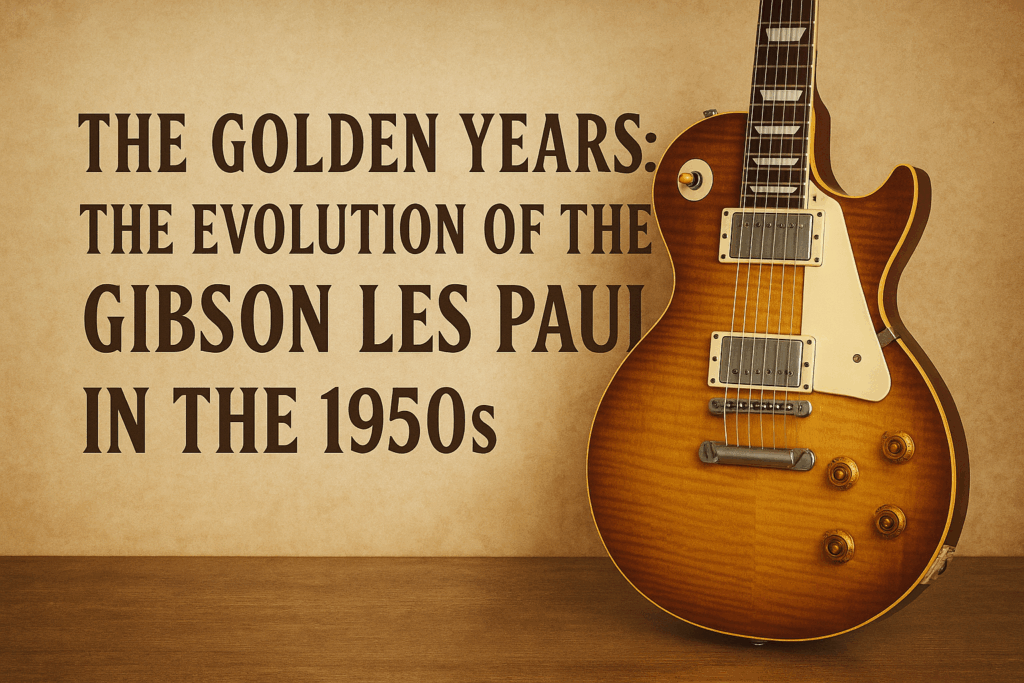
The Gibson Les Paul stands as one of the most iconic electric guitars in history, but its now-revered status was hard-earned through a decade of experimentation, innovation, and refinement. The 1950s were the formative years for this legendary model, shaping the foundation for what would become the standard by which all other single-cut electrics are measured.
Let’s take a detailed look at how the Gibson Les Paul evolved throughout the 1950s — the decade that defined it.
1952: The Birth of a Legend
The first Gibson Les Paul rolled off the production line in 1952, named after guitarist and inventor Les Paul, who had long been experimenting with solid-body guitar designs. The debut model featured:
- A gold finish — later dubbed the “Goldtop”
- A carved maple top on a mahogany body
- A set mahogany neck with rosewood fingerboard
- Two P-90 single-coil pickups
- The now-infamous trapeze tailpiece, with strings wrapped under the bar
While visually striking, the trapeze bridge limited sustain and tuning stability — issues Gibson would soon address.
1953: The Wraparound Compromise
By mid-1953, Gibson replaced the trapeze tailpiece with a wraparound stop tailpiece, offering better intonation and sustain. This small but vital change marked the beginning of the Les Paul’s performance evolution.
1954: Subtle Refinements
In 1954, while the Goldtop model remained visually similar, Gibson made important updates:
- Neck angle increased for better bridge alignment
- The wraparound tailpiece was refined further
- Small changes in pickup output and knob layout improved tone and usability
The Les Paul was now more playable, but it still hadn’t reached its full sonic potential — yet.
1955: The Wraparound’s Last Stand
1955 was the final full year for the wraparound tailpiece before the advent of Gibson’s next big leap. These guitars are prized today for their raw P-90 tone, favored by many blues and early rock ’n’ roll players.
1956: The Tune-O-Matic Arrives
The introduction of the ABR-1 Tune-O-Matic bridge with a separate stopbar tailpiece in 1956 marked a turning point. This setup gave players greater control over intonation and sustain, and would become a defining feature of the Les Paul line moving forward.
The 1956 Goldtop is often seen as the ultimate P-90 Les Paul, combining vintage tone with modern performance.
1957: Humbuckers Change Everything
In 1957, Gibson revolutionized the electric guitar world again by introducing the PAF (Patent Applied For) humbucking pickups, designed by Seth Lover. These pickups:
- Cancelled hum and noise
- Offered smoother mids and greater output
- Defined the classic Les Paul tone we know today
The ’57 Goldtop with dual PAFs is now one of the most sought-after vintage guitars on the market.
1958: The Burst Begins
1958 brought the end of the Goldtop era and the dawn of the sunburst Les Paul Standard — often simply called a “Burst.” Key changes included:
- Figured maple tops, though not all were highly flamed
- Cherry sunburst finish
- Continued use of PAF pickups, ABR-1 bridge, and stop tailpiece
These guitars had limited commercial success at the time, but their rarity and tone have made them the Holy Grail for collectors and players alike.
1959: The Peak of Perfection
Many consider the 1959 Les Paul Standard the pinnacle of the model’s evolution. Why?
- Beautifully flamed maple tops (on select models)
- Matured PAF pickup designs with varying winds
- Perfectly rounded neck profile
- Aged nitro finishes that faded uniquely over time
The ’59 Burst is the guitar of legends — played by Jimmy Page, Duane Allman, Billy Gibbons, and Joe Perry, among many others.
1960: Slimmer Necks and the Beginning of the End
In 1960, Gibson made further refinements, most notably:
- A slimmer neck profile, catering to faster players
- Slight aesthetic tweaks
However, sales were still underwhelming, and by 1961 the single-cut Les Paul was phased out in favor of what we now know as the SG.
Conclusion: A Decade of Timeless Innovation
Though it took time for the Les Paul to be fully appreciated, the 1950s saw it grow from an ambitious idea into one of the most iconic instruments ever built. Each year brought changes that shaped the sound of blues, rock, and beyond. From Goldtops to Bursts, the 1950s Les Pauls are not just guitars — they’re milestones in musical history.