Few guitarists have shaped the sound of rock ‘n’ roll like Keith Richards. As the rhythmic heartbeat of The Rolling Stones, Richards developed a unique, riff-heavy style that fused blues grit with rock swagger. Over the decades, his guitar choices have been as distinctive as his playing, spanning battered classics to highly customised oddballs. Let’s take a tour through some of the most iconic instruments in his arsenal.
1. Harmony Meteor H70
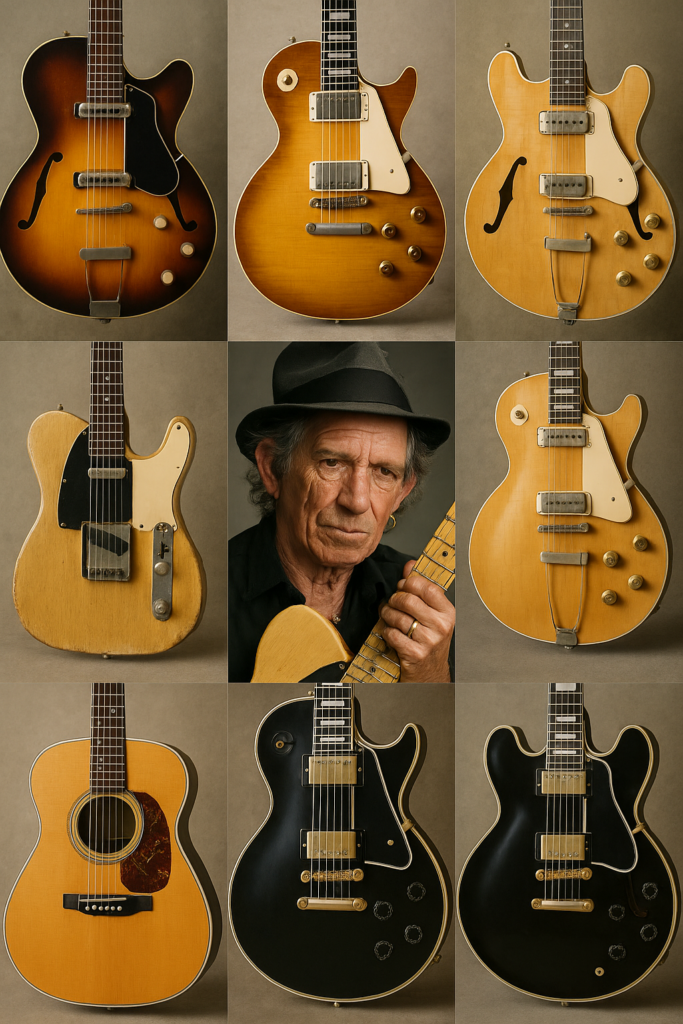
Keith’s first notable electric guitar, the Harmony Meteor, was a budget hollow-body made in the USA. He used it during the early Stones years (1962–64), including their first U.S. tour. Despite its modest price, the Meteor produced a warm, punchy tone suited to early R&B covers and proto-Stones originals.
2. Gibson Les Paul Standard (1959)
In 1964, Richards acquired a sunburst 1959 Gibson Les Paul Standard—one of the most coveted guitars in history. It was one of the first seen on British stages and helped usher in the Les Paul revival. He used it extensively during the Stones’ mid-60s peak, including on The Ed Sullivan Show. This guitar was later stolen during the 1967 Redlands bust.
3. Gibson Firebird VII
Seen during the Aftermath and Between the Buttons era, Keith used a reverse-body Gibson Firebird VII with three mini-humbuckers. It gave him a biting, clear tone, perfect for complex studio work and the band’s brief psychedelic period.
4. Epiphone Casino
Richards briefly used an Epiphone Casino in 1966, a model also favored by The Beatles. Its fully hollow body and P-90 pickups provided a jangly, resonant tone, notably heard during the Stones’ flirtation with psychedelic rock.
5. Ampeg Dan Armstrong Plexi
Introduced around 1969, this clear-bodied guitar became a Richards favorite for live shows, especially during the Let It Bleed and Sticky Fingers era. Its removable pickups and futuristic look made it a standout. He often played open G tuning on this guitar, a cornerstone of his riffing style.
6. Fender Telecaster “Micawber”
Perhaps his most famous guitar, “Micawber” is a 1953 Fender Telecaster given to him by Eric Clapton for his 27th birthday. It’s been heavily modified, including a Gibson PAF humbucker in the neck and five-string open G tuning (he removed the low E string). Micawber has been a cornerstone of his sound since the Exile on Main St. era and is still a mainstay on tour.
7. Fender Telecaster “Malcolm”
Another Telecaster in open G, “Malcolm” is a 1954 model named after Malcolm, a former Stones roadie. It’s used interchangeably with Micawber, and both guitars are frequently seen in concert.
8. Gibson ES-355
Keith used this semi-hollow model—fitted with a Bigsby—for slide parts and bluesy lead playing. It appeared during the Some Girls and Tattoo You sessions. Its mellow tone complements Ronnie Wood’s sharper attack.
9. Gibson Les Paul Custom “Black Beauty”
In the late ’60s and early ’70s, Richards occasionally played a black three-pickup Les Paul Custom. This elegant and powerful guitar was part of his live rig during the Get Yer Ya-Ya’s Out! tour.
10. Various Acoustic Guitars
Keith has always had a deep love for acoustic guitar. His preferred models include:
- Gibson Hummingbird – heard on “Wild Horses.”
- Martin D-18/D-28 – classic dreadnoughts used for songwriting and studio tracking.
- Guild 12-strings – used for layering and textures in the late ’60s and ’70s.
Keith’s Tuning Legacy
Perhaps more important than any single guitar is Richards’ use of open G tuning (D–G–D–G–B–D)—a technique that powers riffs like “Brown Sugar,” “Start Me Up,” and “Honky Tonk Women.” Removing the low E string gave him a percussive, rhythmic freedom that helped define his signature style.
Conclusion:
Keith Richards’ guitar history isn’t about pristine instruments—it’s about tools of expression, scarred by decades of road wear and attitude. Whether it’s a vintage Telecaster, a Plexiglas oddity, or a hollow-body Gibson, Richards coaxes swagger and soul from every string. His gear reflects his mantra: “Five strings, three chords, two hands, and one attitude.”