Eric Clapton’s tone is as legendary as his playing—and both owe a great deal to the guitars he’s used over the decades. From British blues beginnings to solo superstardom, here’s a look at the key instruments that shaped Slowhand’s sound.
1. Early Blues Roots – Gibson Les Paul Standard (1965–1966)
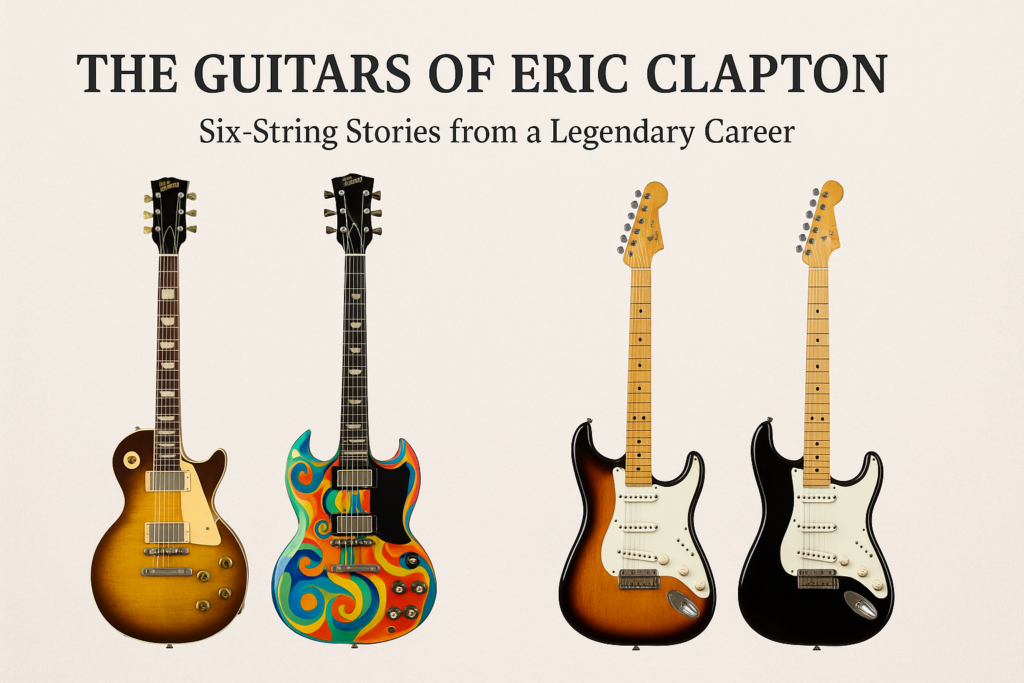
During his time with John Mayall & the Bluesbreakers, Clapton played a 1960 Gibson Les Paul Standard (though often mistaken for a 1959), plugged into a Marshall combo. This pairing helped define the thick, creamy overdrive of British blues rock.
Notable recording: “Blues Breakers with Eric Clapton” (1966) — often referred to as the “Beano album.”
2. Psychedelic Power – Gibson SG “The Fool” (1967–1968)
In Cream, Clapton switched to a hand-painted Gibson SG Standard, known as “The Fool” for the art collective that decorated it. It featured a psychedelic finish and thick humbucker tone, contributing to his fiery, expressive leads.
Notable track: “Sunshine of Your Love”
3. The ES Era – Gibson ES-335 (1968–1970)
Clapton also used a cherry red Gibson ES-335, particularly during Cream’s farewell tour and with Blind Faith. It returned in his hands for the 2005 Cream reunion.
Notable performance: Cream’s Farewell Concert at Royal Albert Hall (1968)
4. The “Layla” Strat – Fender Stratocaster Brownie (1970–1971)
With Derek and the Dominos, Clapton shifted to Fender Stratocasters. “Brownie,” a 1956 Strat with a two-tone sunburst finish, was used for the iconic “Layla.”
Notable album: “Layla and Other Assorted Love Songs” (1970)
5. The Icon – Fender Stratocaster Blackie (1970s–1985)
Perhaps Clapton’s most famous guitar, “Blackie” was a hybrid built from parts of three vintage Strats from the 1950s. He used it extensively during the 1970s and early 1980s for both studio and live work.
Notable track: “Wonderful Tonight”
6. Signature Sound – Fender Eric Clapton Stratocaster (1988–Present)
In the late 1980s, Clapton helped Fender design the Eric Clapton Signature Stratocaster. It featured a mid-boost circuit and noiseless pickups, providing a thick, compressed tone ideal for his later blues-pop material.
Notable track: “Tears in Heaven”
7. Acoustic Moments – Martin 000-28EC
Clapton also embraced acoustic playing, particularly in his Unplugged era. He partnered with Martin to release the 000-28EC, a smaller-bodied guitar ideal for fingerstyle blues.
Notable album: “Unplugged” (1992)
Conclusion
Clapton’s guitar choices weren’t just aesthetic—they helped shape his evolving sound through each musical chapter. From the raw Les Paul crunch of the ’60s to the refined Strat tones of his solo years, each guitar tells part of the Slowhand story.