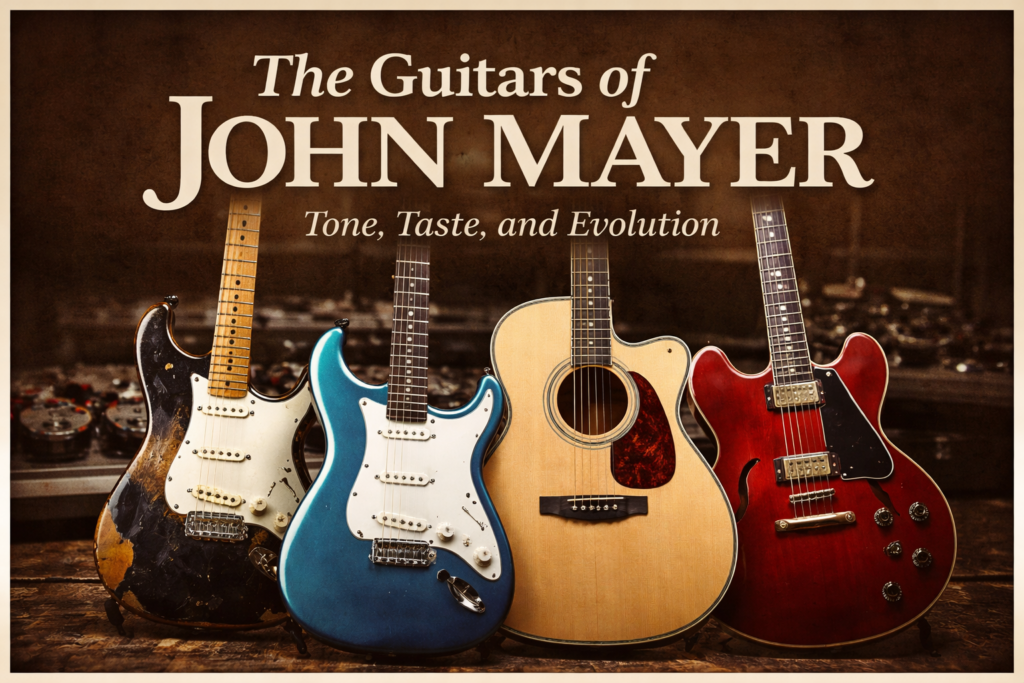
Few modern players have shaped contemporary guitar culture quite like John Mayer. Straddling the line between blues traditionalist and pop innovator, Mayer’s tone has always been central to his identity as a musician. Over the years, his guitar choices have reflected not just his influences—but his constant evolution as a player. From vintage-inspired Fender Strats to boutique builds and signature models, Mayer’s journey is as much about refinement as it is about expression.
Early Years: The Stratocaster Foundation
In the early 2000s, Mayer emerged as a Stratocaster devotee, heavily influenced by players like Stevie Ray Vaughan and Jimi Hendrix. His primary guitars during this era were Fender American Standard Stratocasters and Custom Shop models, often in classic finishes like sunburst and black.
What set Mayer apart wasn’t just the guitar—it was how he used it. He leaned heavily on the neck and middle pickup positions, crafting warm, glassy tones that became the backbone of albums like Room for Squares and Continuum. His touch—dynamic, expressive, and deeply rooted in blues phrasing—allowed these relatively traditional instruments to sound unmistakably modern.
During this period, Mayer also collaborated with Fender to release the John Mayer Signature Stratocaster in 2005. Featuring Big Dipper pickups and a slightly thicker neck profile, it quickly became a favourite among fans chasing his signature tone.
Expanding the Palette: Custom Shop and Beyond
As Mayer’s career progressed, so did his appetite for nuance. One of his most famous instruments—the “Black1” Stratocaster—became a defining part of his sound. Built by the Fender Custom Shop, it was heavily relic’d and featured unique tonal characteristics that Mayer leaned on throughout his work with the John Mayer Trio and live performances like Where The Light Is.
This era marked a shift toward more expressive blues playing, with Mayer pushing his Strat tones into grittier, more dynamic territory. Subtle variations between guitars—pickup output, neck feel, and resonance—became increasingly important to his sound.
The PRS Era: A New Chapter
In 2018, Mayer made headlines by leaving Fender and partnering with PRS. The result was the PRS Silver Sky—a guitar that pays homage to vintage Stratocasters while refining many of their quirks.
At first glance, the Silver Sky feels familiar: three single-coils, a tremolo bridge, and a bolt-on neck. But closer inspection reveals thoughtful changes—most notably the reversed headstock, refined pickup voicing, and meticulous attention to feel and tuning stability.
For Mayer, the Silver Sky wasn’t about reinventing the wheel—it was about perfecting it. It became his primary instrument for both solo work and his role in Dead & Company, delivering clarity, consistency, and a slightly more hi-fi take on classic Strat tones.
Acoustic Foundations: Martin & Beyond
While Mayer is best known for his electric work, his acoustic playing is just as integral to his artistry. His long-standing relationship with Martin resulted in the OMJM signature model, based on the OM-28 platform.
This guitar is perfectly suited to Mayer’s percussive fingerstyle approach—offering clarity, balance, and responsiveness. Tracks like Stop This Train and Neon showcase how central the acoustic guitar is to his songwriting and technical identity.
Beyond the Strat: Other Notable Guitars
Although synonymous with Strat-style guitars, Mayer’s collection is far broader. He has frequently used Gibson ES-335s, particularly for warmer, jazz-influenced tones, and has worked closely with PRS on more experimental designs like the Super Eagle series.
His gear choices often align with specific musical contexts—whether it’s blues, pop, or his work with Dead & Company—demonstrating a deep understanding of how different guitars shape feel and tone.
Tone Is in the Details
What makes John Mayer’s guitar journey so compelling isn’t just the instruments themselves—it’s the intent behind them. From vintage-inspired Fenders to meticulously designed PRS models, every choice reflects a player chasing feel, response, and connection.
Mayer’s evolution shows that great tone isn’t about constant change—it’s about refinement. Subtle shifts in pickups, neck profiles, and construction can unlock entirely new creative possibilities. And in Mayer’s hands, those details become the difference between good and unforgettable.
Final Thoughts
John Mayer’s guitars tell the story of a musician in constant pursuit of expression. Whether it’s the snap of a Stratocaster, the polish of a PRS Silver Sky, or the warmth of a Martin acoustic, each instrument represents a chapter in his tonal evolution.
For players and collectors alike, Mayer’s journey offers a valuable lesson: the right guitar doesn’t just shape your sound—it shapes your voice.