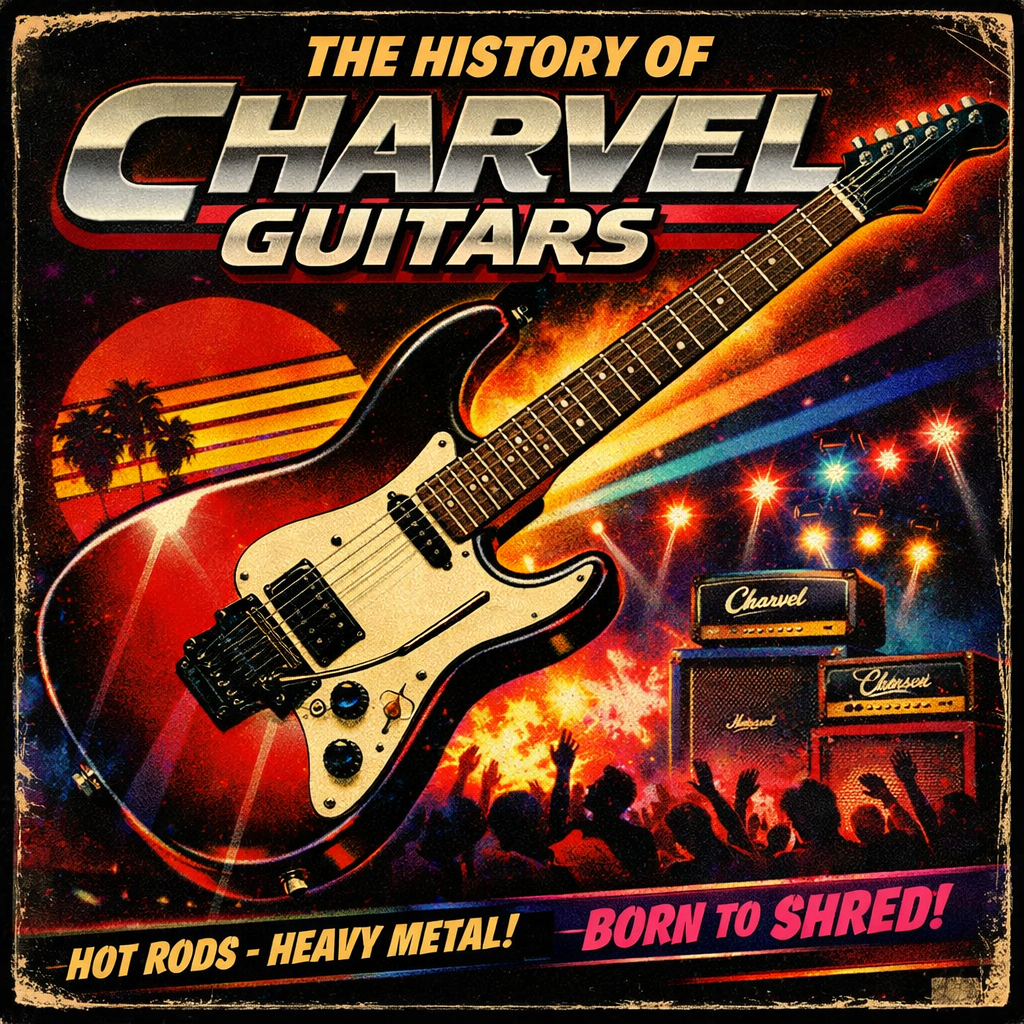
Few guitar brands are as closely tied to the rise of high-performance electric guitars as Charvel. Known for sleek finishes, fast necks, and hot-rodded hardware, Charvel became one of the defining brands of the 1980s shred era. But the company’s roots go back much further — beginning not with flashy guitars, but with a small repair shop in Southern California.
The Early Days: Wayne Charvel’s Repair Shop
Charvel was founded in the early 1970s by Wayne Charvel, a guitar repair specialist working out of Glendora, California.
Wayne Charvel built a reputation repairing and refinishing guitars, particularly those made by Fender and Gibson. At the time, many musicians wanted their instruments modified — hotter pickups, new finishes, better hardware, and improved playability.
Charvel’s shop quickly became known for:
- Custom refinishes
- Replacement bodies and necks
- High-performance hardware upgrades
- Repair work for touring musicians
Eventually the business began producing replacement guitar bodies and necks, allowing players to build their own customised instruments — something that was still relatively uncommon at the time.
This parts business quietly helped spark the aftermarket guitar mod culture that would explode in the late 1970s and 1980s.
Enter Grover Jackson
In 1978, Wayne Charvel sold the company to his employee Grover Jackson.
This marked the turning point that would define the Charvel brand.
Jackson shifted the focus from parts and repairs toward building complete guitars, particularly instruments inspired by the popularity of heavily modified Fender Stratocaster guitars used by rock players.
These early guitars — often called San Dimas Charvels — featured:
- Strat-style bodies
- High-output humbuckers
- Floyd Rose tremolos
- Bright custom finishes
- Slim, fast necks
The result was the birth of the “Superstrat.”
These guitars were built for speed, aggressive playing styles, and the emerging world of high-gain rock and metal.
The Jackson Connection
In the early 1980s, Grover Jackson was approached by guitarist Randy Rhoads, who wanted a radical new guitar design.
The resulting instrument — a sharp, offset V-shaped guitar — became the first Jackson guitar.
Because it differed so much from traditional Charvel designs, Jackson decided to launch Jackson as a separate brand.
During the early 1980s:
- Charvel focused on hot-rodded Strat-style guitars
- Jackson handled the more radical metal designs
Together the two brands became dominant in the growing shred and metal guitar scene.
The Rise of the Superstrat
By the mid-1980s, Charvel guitars were everywhere.
The company introduced the Charvel Model Series, a line of Japanese-made instruments that brought Charvel’s high-performance features to a wider audience.
Typical specs included:
- Floyd Rose locking tremolos
- Jackson-style pointy headstocks
- Slim maple necks
- High-output pickups
- Bright, graphic finishes
These guitars became synonymous with the MTV metal era.
Artists associated with Charvel during this period included:
The Charvel aesthetic — fast, flashy, and built for virtuoso playing — defined an entire generation of guitars.
Fender Acquisition and a Changing Market
In 2002, Fender Musical Instruments Corporation acquired the Charvel brand.
By this point the guitar market had shifted significantly from the shred-dominated 1980s. Fender repositioned Charvel as a brand focused on modern high-performance instruments while still honouring its heritage.
Production expanded to include:
- USA Custom Shop models
- Japanese production guitars
- Mexican-made instruments
Many models paid tribute to the classic San Dimas era designs that helped make the brand famous.
Modern Charvel Guitars
Today, Charvel remains a favourite among players who want speed, precision, and modern performance.
Popular modern series include:
- Pro-Mod Series
- USA Select
- MJ (Made in Japan) Series
Common modern Charvel features include:
- Compound-radius fretboards
- Graphite-reinforced necks
- High-output pickups (often Seymour Duncan)
- Floyd Rose tremolos
- Lightweight alder or basswood bodies
While the aesthetic still nods to the 1980s, the guitars are now used across many genres — from metal to fusion to modern rock.
Charvel’s Lasting Legacy
Charvel helped shape what a performance electric guitar could be.
Long before boutique builders popularised hot-rodded designs, Charvel was already building guitars that prioritised:
- Speed
- Stability
- Aggressive tone
- Player-focused ergonomics
The Superstrat concept that Charvel helped popularise would go on to influence countless brands — including Ibanez, ESP, and many modern boutique builders.
Today, whether you pick up a vintage San Dimas model or a modern Pro-Mod, Charvel guitars still carry the DNA of their original mission: high-performance instruments built for serious players.