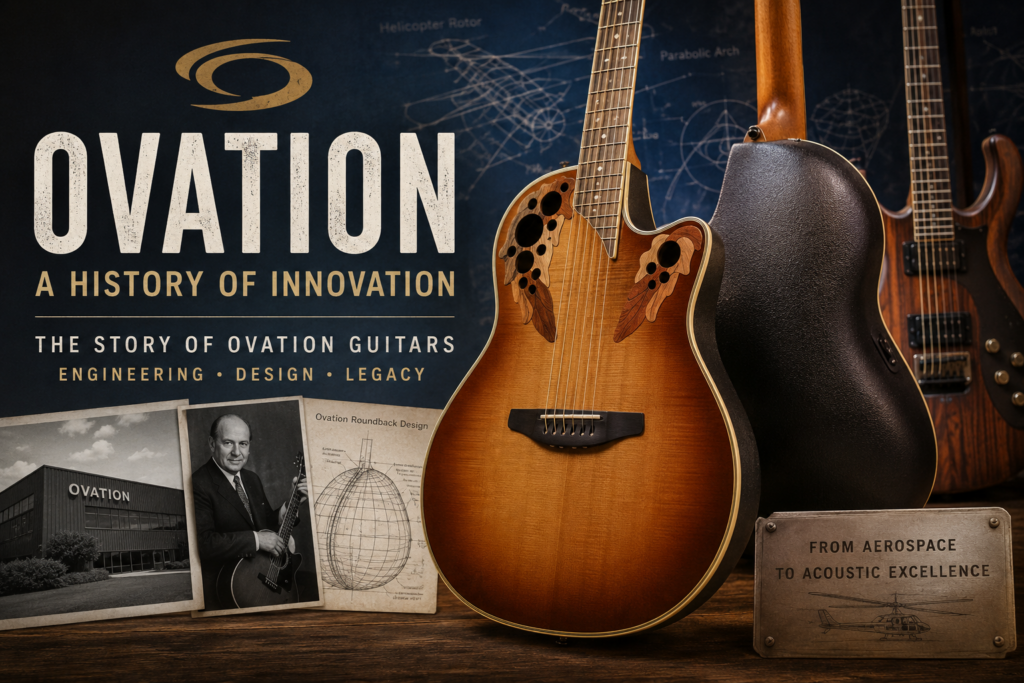
Few guitar companies have divided opinion quite like Ovation Guitar Company. To some players, Ovation guitars represent one of the most innovative leaps in acoustic guitar design during the twentieth century. To others, they remain a bold but unconventional departure from the traditions established by Martin and Gibson. Regardless of where players stand, Ovation changed the acoustic guitar industry forever.
From their instantly recognisable round backs to pioneering onboard electronics, Ovation guitars helped redefine what an acoustic guitar could be on stage and in the studio. Their story is one of experimentation, aerospace engineering, and a willingness to challenge centuries of guitar-building tradition.
Charles Kaman and the Birth of Ovation
The story begins with Charles Kaman, an aeronautical engineer and founder of Kaman Aircraft. During the 1960s, Kaman’s aerospace company sought to diversify into new industries, and Kaman himself was an enthusiastic guitarist who believed modern engineering could improve upon traditional acoustic guitar construction.
Rather than relying solely on traditional luthiery methods, Kaman approached guitar design like an engineering problem. His team applied knowledge gained from helicopter rotor technology, vibration analysis, and advanced composite materials to create a guitar that would project more efficiently and resist many of the structural issues associated with wooden instruments.
After extensive research and prototype development between 1965 and 1966, Ovation introduced its first production model, the Balladeer, in 1967.
The Revolutionary Roundback Design
The defining feature of an Ovation guitar was its rounded composite back, which became known as the “roundback” design. Instead of using traditional wooden backs and sides, Ovation employed a synthetic material called Lyrachord — a strong fiberglass composite developed using aerospace manufacturing techniques.
Kaman’s engineers believed the semi-parabolic bowl shape offered superior sound projection and structural consistency compared to flat-backed wooden guitars. The rounded body was intended to reflect sound more evenly while also reducing dead spots and internal damping.
The design also solved practical problems. Traditional acoustic guitars were vulnerable to temperature and humidity changes, while Ovation’s composite construction offered greater durability and stability for touring musicians.
Of course, the design came with compromises. Some players found the rounded backs uncomfortable when seated, while traditionalists disliked the synthetic construction. Yet the distinctive appearance and sound of Ovation guitars quickly earned attention during a period when amplification and live performance were becoming increasingly important.
Ovation and the Rise of the Acoustic-Electric Guitar
Perhaps Ovation’s greatest contribution to guitar history was its pioneering work in acoustic-electric technology.
During the late 1960s and early 1970s, amplified acoustic guitars were notoriously difficult to use live. Microphones created feedback issues, and many early pickups sounded harsh or unnatural. Ovation helped solve these problems by developing piezo pickup systems and onboard preamps that allowed acoustic guitars to perform reliably at stage volume.
This innovation transformed live acoustic performance. By the 1970s and 1980s, Ovation guitars became hugely popular among touring musicians because they could be plugged directly into PA systems with far less feedback than traditional acoustics.
For many working musicians, especially those performing in large venues, Ovation became the practical choice rather than simply an aesthetic one.
Glen Campbell and Celebrity Endorsement
No artist became more closely associated with Ovation than Glen Campbell. Campbell’s television appearances throughout the 1970s exposed millions of viewers to Ovation guitars, helping establish the brand as one of the most recognisable acoustic manufacturers in the world.
Other notable Ovation users included:
- Cat Stevens
- John Lennon
- Jimmy Page
- Melissa Etheridge
- Al Di Meola
- Brian May
- David Gilmour
- Roger Waters
- Freddie Mercury
The brand became particularly associated with professional stage use, television performances, and arena touring.
The Adamas: Ovation Pushes Innovation Further
In 1976, Ovation introduced one of its most ambitious models: the Adamas. Rather than simply refining traditional guitar construction, the Adamas pushed futuristic design even further.
The Adamas featured:
- A carbon fibre composite top
- Multiple offset soundholes instead of a central soundhole
- Advanced bracing systems
- Lightweight synthetic materials
- Improved structural stability
At a time when most manufacturers still relied heavily on traditional methods, the Adamas looked almost futuristic. While expensive and unconventional, it demonstrated Ovation’s commitment to innovation and engineering-led design.
Today, vintage Adamas guitars remain highly collectible and are viewed by many as among the most technically ambitious acoustic guitars ever produced.
Ovation Electric Guitars
Although primarily known for acoustics, Ovation also entered the electric guitar market during the 1970s.
Models like the Breadwinner and Deacon featured radical body shapes, active electronics, and ergonomic contours that were decades ahead of their time.
The Breadwinner in particular has since become something of a cult classic. Its unusual styling divided opinion, but the guitar’s balance, playability, and electronics were remarkably advanced for the era.
While Ovation’s electric models never achieved the commercial success of Fender or Gibson designs, they reflected the company’s willingness to rethink every aspect of guitar construction.
Changes in Ownership and Production
Ovation remained under the Kaman umbrella for decades before major corporate changes reshaped the company.
In 2008, Kaman Music Corporation was sold to Fender Musical Instruments Corporation.
By 2014, Fender closed Ovation’s historic New Hartford, Connecticut factory, shifting production overseas. The decision caused concern among Ovation enthusiasts and collectors who feared the end of American-made Ovation instruments.
Fortunately, the story did not end there. In 2015, Drum Workshop acquired the Ovation brand and reopened portions of the New Hartford operation. More recently, European distributor GEWA Music took ownership and has continued producing both American-made and imported Ovation models.
Ovation’s Legacy Today
Modern acoustic guitar design owes far more to Ovation than many players realise.
Features now considered standard on stage acoustics — onboard preamps, piezo systems, feedback resistance, and reliable plug-and-play performance — were areas where Ovation led the industry decades earlier.
Even though traditional wooden acoustics remain dominant, Ovation guitars still occupy a unique place in guitar culture. Vintage American-made models from the 1970s and 1980s continue to attract collectors, while many professional musicians still value Ovations for their dependable amplified sound.
Perhaps most importantly, Ovation proved that guitar building did not have to remain trapped in tradition. By combining aerospace engineering with musical instrument design, Charles Kaman and his team created one of the most distinctive and innovative guitar brands ever produced.
Love them or hate them, Ovation guitars changed the acoustic guitar world forever.