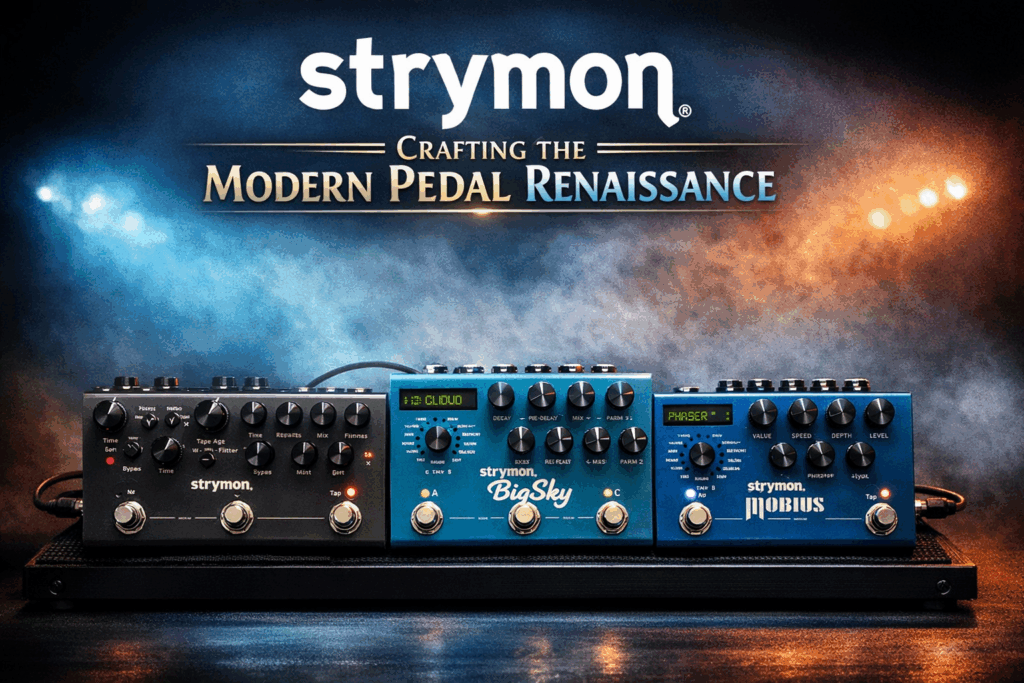
When it comes to boutique effects pedals that blend studio‑grade sound with cutting‑edge digital wizardry, Strymon sits at the pinnacle of modern pedal innovation. Revered by guitarists, producers, and sound designers alike, Strymon has carved a legacy that reshaped expectations for what pedals can do — not just sonically, but in terms of depth, versatility, and sonic purity. This isn’t just about making effects louder or flashier — it’s about reimagining them.
In this deep dive, we’ll explore how Strymon started, the famous pedals that defined its journey, and the indelible influence the company has had on the pedal industry as a whole.
From Boutique Roots to Sonic Vanguard
Strymon was founded in the mid‑2000s by Ola Strandberg and a team of engineers passionate about high‑fidelity digital effects. The name “Strymon” is inspired by Strymon River in Greece — a nod to the idea of flowing, organic sound.
While many pedal companies of the era were focusing on analog circuits or simple digital recreations of classic effects, Strymon approached effects with a studio mentality: high sampling rates, rich algorithmic design, and user interfaces that gave musicians unprecedented control. Early on, Strymon made a clear choice to prioritize audio quality over cost savings, which meant using premium components, robust hardware, and powerful DSP chips.
The result? Pedals that didn’t sound like approximations — they sounded like high‑end studio processors in stompbox form.
Iconic Pedals That Made History
🌪️
Strymon Timeline — A Delay Revolution
Released in the late 2000s, the Timeline quickly became a benchmark for digital delay pedals. At a time when many delays struggled with digital harshness or limited controls, Timeline delivered:
- 12 distinct delay engines
- Tap tempo and rhythmic subdivision options
- Stereo I/O and MIDI compatibility
- Deep editing via preset storage
Players could find everything from pristine echo to warped, modulated, and glitchy textures — all with exceptional clarity. This was more than a delay pedal; it was a delay workstation.
Why it matters: Timeline didn’t just offer versatility — it demonstrated that digital pedals could outshine many rackmount units in tone, flexibility, and performance.
☁️
Strymon BigSky — The Reverb Redefined
Following the success of Timeline, Strymon upped the ante with BigSky, a reverb pedal that became an instant classic.
BigSky offered:
- Multiple reverb algorithms (Plateaux, Spring Tank, Cloud, and more)
- Shimmer and modulated reverb options
- Extensive control over pre‑delay, decay, and diffusion
- True stereo operation
This wasn’t your typical room or hall reverb — BigSky painted vast sonic landscapes. Ambient guitarists, shoegazers, and studio producers embraced it for its lush textures and immersive capabilities.
Why it matters: BigSky helped transform reverb from a background effect into a frontline creative tool, influencing countless players to think bigger about spatial sound.
♻️
Strymon Mobius — Modulation Mastery
Strymon took on modulation with Mobius, a pedal packed with classic and contemporary effects:
- Chorus
- Flanger
- Phaser
- Tremolo
- Vibrato
- Rotatory speaker emulations
Each engine delivered nuanced tone and expression, far surpassing the typical “chorus pedal” stereotype. The sound quality was rich and organic, with controls that invited experimentation rather than restriction.
Why it matters: Mobius set a new expectation for modulation pedals: diverse character, deep control, and studio‑like performance.
🕰️
Strymon El Capistan — Tape Delay Charm
While Timeline offered digital versatility, El Capistan embraced the warmth and unpredictability of tape. This analog‑modeled tape delay emulated:
- Saturation and wavelength instability
- Tape age coloration
- Wow & flutter controls
- Multi‑head delay textures
El Capistan became a favorite for those craving vintage vibe without the maintenance headaches of actual tape machines.
Why it matters: It proved that digital pedals could authentically emulate analog character, not just approximate it.
What Sets Strymon Apart
So what makes Strymon pedals more than just another boutique brand?
🔊 1.
Studio‑Grade Sound Quality
Strymon pedals often use 96 kHz (or higher) processing and 24‑bit audio paths — far beyond the 44.1 kHz / 16‑bit norm found in many stompboxes. The result is clarity, low noise, and headroom that rival studio gear.
📡 2.
Deep Yet Intuitive Control
Unlike many digital pedals where menus hide layers of parameters, Strymon interfaces are designed for hands‑on exploration. Knobs, switches, and instant feedback mean you play the effect, not just set it.
📦 3.
Presets + MIDI Integration
From the early Timeline to later models, Strymon embraced preset storage and MIDI control, making their pedals viable in professional rigs and studio environments.
⚙️ 4.
Build Quality That Lasts
Robust metal enclosures, high‑quality footswitches, and thoughtful I/O options make Strymon units reliable for stage and studio alike.
Strymon’s Ripple Effect on the Pedal Industry
Strymon didn’t just make great pedals — it raised the bar for what players expect from digital effects:
- Higher fidelity — Players began demanding cleaner, more musical digital tone.
- Expanded creativity — Reverbs and delays stopped being “add‑ons” and became sound‑design tools.
- Digital respectability — Once derided in some circles, digital pedals gained legitimacy alongside analog classics.
- Boutique inspiration — Other companies started innovating more boldly, exploring modular control, deep editing, and hybrid designs.
Manufacturers such as Eventide, Meris, Walrus Audio, Chase Bliss Audio, and Empress Effects — among others — followed similar paths, focusing on depth of sound and expressive control.
Even players who prefer analog over digital acknowledge how Strymon’s rigorous design philosophy influenced modern pedal expectations — particularly in terms of noise floor, transparency, and dynamic response.
Strymon Beyond Guitar
While guitarists were early adopters, Strymon pedals found homes in many creative contexts:
- Keys and synths
- Studio processing
- Ambient soundscapes
- Experimental and electronic music
This versatility reflects a broader truth: Strymon pedals aren’t just for guitarists — they’re tools for sonic exploration across instruments and genres.
Notable Pedals and Milestones
Here’s a quick look at some of Strymon’s most influential models:
| Pedal | Primary Effect | Why It Matters |
|---|---|---|
| Timeline | Delay | Redefined digital delay with studio‑grade tones |
| BigSky | Reverb | Expanded reverb into a creative realm |
| Mobius | Modulation | Brought depth & variety to classic modulation |
| El Capistan | Tape Delay | Authentic tape vibe in a pedalboard‑friendly format |
| Volante | Echo Machine | Experimental multi‑tape delays |
| Lex | Tremolo/Filter | Expressive control with vintage vibes |
| Iridium | Amp Modeling | High‑quality amp tones in a compact unit |
Each of these units carries the Strymon ethos: no compromises, maximum musicality.
The Legacy Continues
More than a decade after its founding, Strymon continues pushing boundaries. Their pedals aren’t mere effects — they’re platforms for creativity. Whether you’re crafting ambient soundscapes, stacking trails of delay, or dialing in lush reverb for your next record, Strymon pedals offer both precision and personality.
For the modern guitarist, Strymon isn’t just a brand — it’s a milestone in the evolution of effects pedals.
Final Thoughts
Strymon pedals represent a turning point in the history of effects: where innovation meets expression, and technology serves the musician first. From landmark pedals like Timeline and BigSky to their influence on the broader boutique landscape, Strymon has redefined what’s possible on pedalboards everywhere.