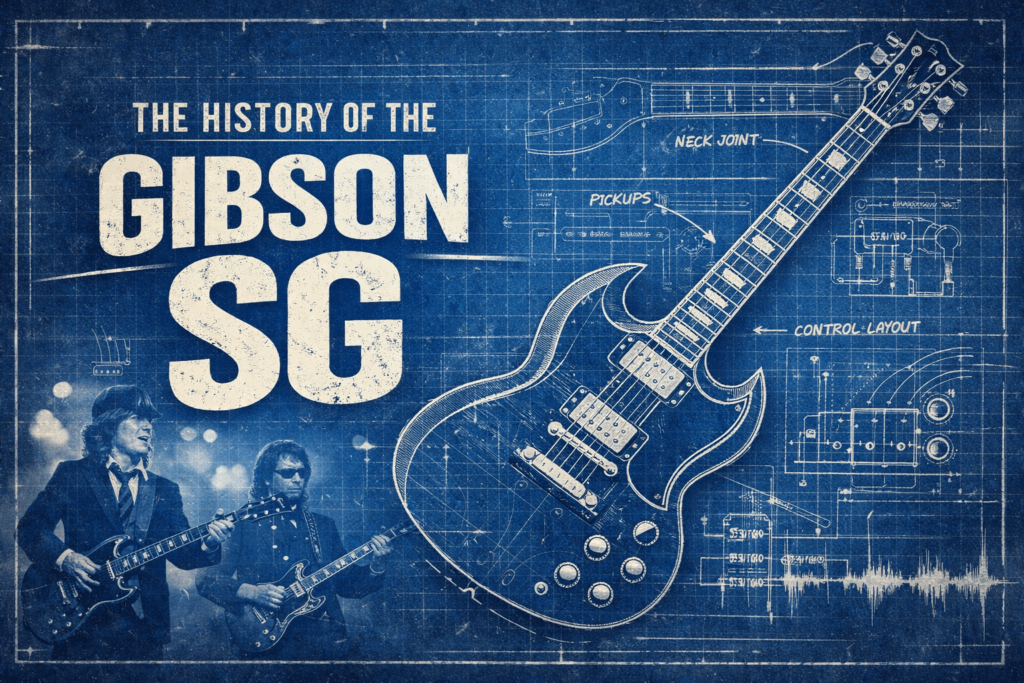
When you think of Gibson guitars, the Les Paul might come to mind first—but it’s the SG that truly defined a new generation of sound. Sleek, aggressive, and unmistakably stylish, the Gibson SG has carved its place into music history as the go-to guitar for heavy rock, blues, and everything in between.
But the SG’s story begins with a surprising twist—it was originally never meant to be a model of its own.
A New Direction: 1961 – The “New” Les Paul
By 1960, Gibson was facing increasing pressure from Fender’s rising popularity with the Stratocaster and Telecaster. The original Les Paul design—solid, heavy, with a carved top—was beginning to feel outdated to some players. In an effort to modernize, Gibson unveiled a new, lightweight, double-cutaway design in 1961 with sharper horns, improved upper fret access, and a slim, fast neck profile.
This radical redesign was still branded the Gibson Les Paul, but Les Paul himself hated it. He disapproved of the new shape, the thin body, and didn’t want his name on the headstock. By 1963, Gibson quietly removed his name and began marketing the guitar under a new title: the Gibson SG, short for Solid Guitar.
Core Design: What Makes an SG?
The SG was—and still is—built for comfort and speed:
- Mahogany body and neck: Lightweight with rich, resonant tones.
- Set neck construction: Enhances sustain and stability.
- Twin humbuckers: Usually PAF-style or later, more aggressive options.
- Slim profile: Both in neck and body, for ease of playability.
- Distinctive “devil horn” double cutaway: A rock ‘n’ roll silhouette like no other.
While early SGs had some stability issues (notably with the neck joint and tremolo system), these were gradually improved over the years.
Notable Variants and Specs
- SG Standard: The classic model—chrome hardware, dual humbuckers, trapezoid inlays, and bound neck.
- SG Special: Stripped-back model, often with P-90 pickups and dot inlays.
- SG Custom: Deluxe edition with three pickups, gold hardware, and ornate binding.
- SG Junior: Student model with a single P-90 and minimal appointments.
Rock Legends and the SG
The SG’s popularity skyrocketed in the late ’60s and ’70s as it became the axe of choice for many legendary guitarists:
- Angus Young (AC/DC): Possibly the most iconic SG player of all time, known for wielding a red SG Standard like a weapon on stage.
- Tony Iommi (Black Sabbath): Used a left-handed SG with custom pickups to invent the sound of heavy metal.
- Frank Zappa: Modified SGs with onboard electronics and wild tonal possibilities.
- Eric Clapton: Famously played an SG during his time with Cream—most notably his hand-painted “Fool” SG.
From progressive rock to doom metal, punk to grunge, the SG proved itself versatile, comfortable, and capable of serious tone.
The SG Today
Still in production more than 60 years later, the Gibson SG remains one of Gibson’s best-selling and most recognizable guitars. From Custom Shop reissues to affordable Epiphone versions, the SG’s legacy is alive and well.
Whether you’re into blazing solos, sludgy riffs, or vintage blues licks, the SG offers a unique combination of feel, tone, and attitude. It may have started life as a controversial Les Paul substitute—but today, it stands proudly on its own as a genuine classic.