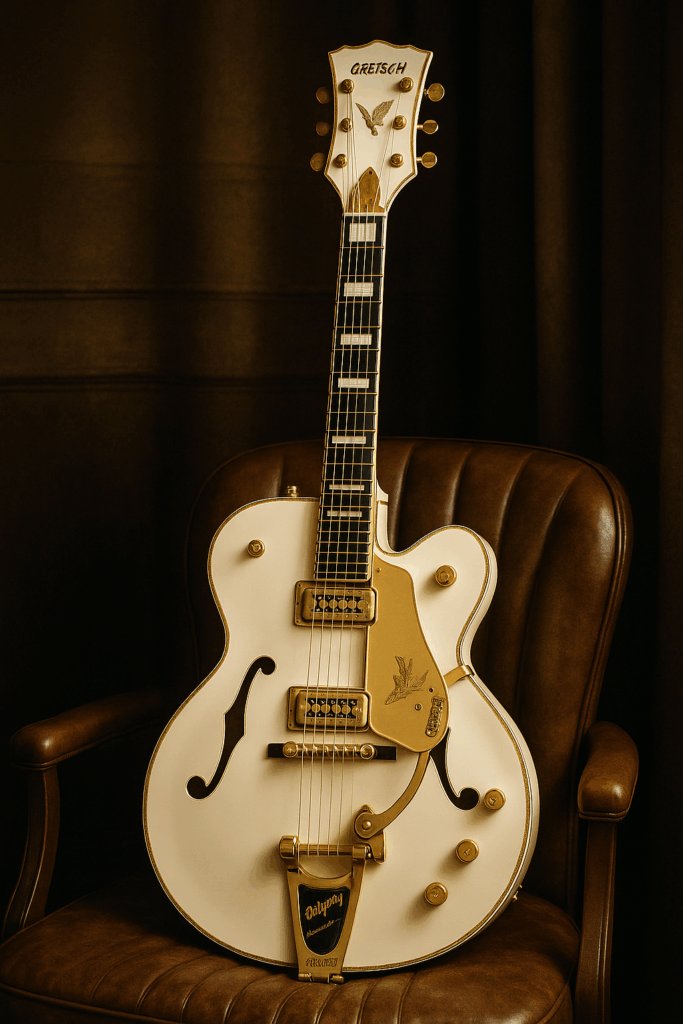
When it comes to iconic guitars that blend visual opulence with tonal character, few can rival the Gretsch White Falcon. Dubbed “the Cadillac of guitars,” the White Falcon is as much a statement piece as it is a finely crafted instrument. From its extravagant debut in the 1950s to its continued legacy today, the White Falcon remains a symbol of class, excess, and innovation in guitar design.
Origins: A Vision from Jimmie Webster
The story of the White Falcon begins in 1954, when Gretsch’s designer and guitar promoter Jimmie Webster set out to create a showpiece unlike anything else on the market. Inspired by Gretsch’s drum and banjo designs, Webster incorporated lavish aesthetic elements—sparkling gold-sparkle bindings, engraved pearl inlays, and a gleaming white finish—into a hollow-body guitar intended solely for display at that year’s NAMM show. But the reaction was immediate and overwhelming. Dealers and players demanded it be put into production.
Gretsch responded quickly, releasing the first production White Falcon in 1955 under the model name 6136. With a price tag of $600, it was positioned as one of the most expensive electric guitars of its day, second only to the Gibson Super 400CES. Gretsch marketing dubbed it “the finest guitar we know how to make,” and it lived up to the title in both form and function.
The 1950s: Birth of a Classic
The early White Falcons were archtop hollow-body guitars with a 17-inch-wide body, solid spruce tops, and laminated maple backs and sides. The neck was maple with an ebony fingerboard and mother-of-pearl block inlays. Early models were fitted with dual DeArmond Dynasonic single-coil pickups and a Melita bridge, delivering a bright, clear tone well-suited to jazz and country styles.
Visually, the White Falcon was an art-deco dream: triple-layered white and gold sparkle bindings on nearly every edge, large “G” brand f-holes, a winged headstock logo, and a gold-plated Cadillac-style tailpiece. It was less a guitar and more a sculpture—one meant to be seen as much as heard.
Late ’50s to Early ’60s: Refinement and Innovation
In 1957, Gretsch introduced several significant changes that would shape the White Falcon’s identity for decades to come. Block inlays were replaced by the signature neo-classical “thumbnail” inlays, and the pickups were upgraded to Gretsch’s own Filter’Tron humbuckers—designed in collaboration with Ray Butts—offering a warmer, fuller sound with reduced hum. These pickups became integral to the Gretsch sound, loved for their chime and articulation.
In 1958, the Melita bridge was replaced by the Space Control roller bridge, which improved tuning stability, especially when used with the Bigsby vibrato system. By the early 1960s, the White Falcon saw the introduction of a double-cutaway version, giving players easier access to higher frets and increasing its appeal to rock and pop musicians.
Perhaps one of the most ambitious designs from this era was the introduction of the stereo model—the 6137 White Falcon Stereo—featuring independent outputs for each pickup, allowing for wide tonal experimentation. Though not widely adopted, it highlighted Gretsch’s willingness to innovate beyond aesthetics.
The Baldwin Era: Decline and Change
In 1967, the Baldwin Piano Company acquired Gretsch, marking the beginning of a troubled period for the brand. Under Baldwin’s management, production shifted and quality control declined. While the White Falcon remained in the catalog, many players and collectors consider Baldwin-era Falcons—especially those from the 1970s—to be inferior to their predecessors. Pickups changed, wiring schemes became more complex, and some models lost the visual flair that made the guitar famous.
During this time, the Falcon adopted smaller f-holes, a more “modern” aesthetic, and alterations to neck profiles and body construction. While some appreciated the tweaks, many viewed them as a dilution of what made the White Falcon special.
Revival and Rebirth: The Modern Era
The 1980s and ’90s saw a resurgence of interest in Gretsch guitars, thanks in part to players like Brian Setzer, who used vintage Gretsches to fuel the neo-rockabilly movement. In 1989, Fred Gretsch III—great-grandson of the company founder—reacquired the brand and began restoring its reputation.
By 1996, Gretsch reintroduced the White Falcon as part of a refined and expanded lineup, emphasizing vintage-correct specs and build quality. These new Falcons, produced in Japan by Terada Gakki, were faithful recreations of the classic 1950s and 1960s models, complete with gold hardware, Filter’Tron pickups, Bigsby vibratos, and that unmistakable white finish. Modern versions also benefited from improved playability and reliability while retaining the vintage charm.
In the years since, Gretsch has expanded the Falcon line to include a variety of finishes—Black Falcon, Silver Falcon, and even the limited-edition Irish Falcon used by Bono of U2. Signature models have been released for Billy Duffy of The Cult, Stephen Stills, and others, allowing fans to own variations based on the exact specs of their idols’ instruments.
Famous Players and Iconic Moments
The White Falcon’s grandeur and tone have made it a favorite of some of music’s most eclectic and revered players. Brian Setzer’s use of Gretsch guitars, including the White Falcon, helped revive interest in the brand during the 1980s, and his own signature models remain top sellers.
Billy Duffy of The Cult became closely associated with the Falcon during the band’s early years, favoring the guitar for its cutting sound and dramatic stage presence. His signature model, with chrome hardware and stripped-back controls, is based on his original 1970s Baldwin-era Falcon.
Stephen Stills frequently used a 1958 Falcon during his solo work and Crosby, Stills, Nash & Young tours, and Neil Young has also been spotted with vintage White Falcons in the studio. Chris Cheney of The Living End brought the Falcon into the punkabilly world, while players like Martin Gore of Depeche Mode and John Frusciante of the Red Hot Chili Peppers have used the guitar in more alternative contexts.
Others who’ve embraced the Falcon include Chet Atkins, Elvis Presley, Eddie Cochran, Mike McCready, Robert Charlebois, and even Dave Grohl, underscoring the guitar’s broad appeal across genres and generations.
A Timeless Symbol of Style and Sound
Nearly 70 years after its debut, the Gretsch White Falcon remains one of the most coveted guitars in the world. Its blend of striking aesthetics, rich history, and unmistakable tone has cemented its status as a true classic. Whether as a showpiece, a sonic workhorse, or a bridge between musical worlds, the White Falcon continues to soar—just as Jimmie Webster dreamed it would back in 1954.