When it comes to defining the sound of rock and roll, few amplifier brands have left as indelible a mark as Vox. With a rich legacy that stretches back to the 1950s, Vox amplifiers have become synonymous with the jangly, chime-like tone that helped shape the British Invasion—and continues to inspire musicians to this day. From The Beatles to Brian May, Vox has been a key player in some of music’s most iconic moments.
The Birth of Vox: A British Original
Vox was founded by Thomas Walter Jennings, who originally ran the Jennings Organ Company. In 1957, he formed Jennings Musical Instruments (JMI) in Dartford, Kent, England. That same year, Vox launched its first guitar amplifier—the AC1/15, quickly followed by the amp that would change everything: the Vox AC15.
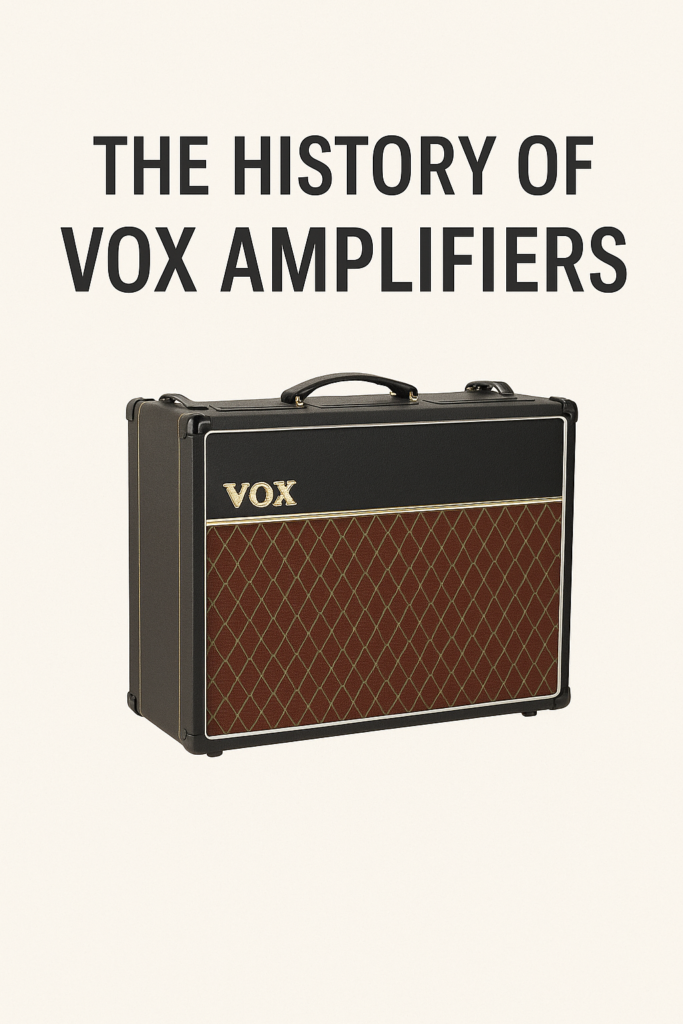
The Vox AC15
Released in 1958, the AC15 was a 15-watt tube amp that delivered a smooth, warm tone with natural overdrive when pushed. Designed by Dick Denney, a guitarist and engineer, the AC15 was revolutionary for its time, allowing players to get a richer tone at lower volumes. It quickly caught the attention of professional musicians looking for something different from the dominant American amp sounds.
The Game-Changer: Vox AC30
In response to bands needing more power for larger venues, Vox introduced the AC30 in 1959. Essentially a beefed-up AC15 with 30 watts and two 12” Celestion speakers, the AC30 became the flagship amp of the brand—and a cornerstone of 1960s rock.
Its distinctive sound—bright, punchy, and rich with harmonic complexity—was perfectly suited to the era’s new breed of electric guitarists.
Vox and the British Invasion
The Vox AC30 became the amp of choice for The Beatles, who helped catapult it into legendary status. In fact, Vox’s relationship with The Beatles was so integral that Vox often supplied amps custom-built for the Fab Four’s growing needs.
Other notable users from the 1960s included:
- The Rolling Stones – Early in their career, the Stones used Vox amps on stage and in the studio.
- The Kinks – Dave Davies famously used an AC30 combined with speaker distortion to create the raw, fuzzy tone on “You Really Got Me.”
- The Yardbirds – With guitarists like Eric Clapton, Jeff Beck, and Jimmy Page, the Vox tone became a staple of British blues-rock.
Beyond the ’60s: Reinvention and Legacy
While the 1970s saw the rise of new amp brands like Marshall and Mesa/Boogie, Vox remained a respected name. In the 1980s and ’90s, artists like U2’s The Edge and Queen’s Brian May brought Vox back into the spotlight. May’s towering guitar sound—created through a homemade guitar and a wall of AC30s—became one of the most recognizable tones in rock history.
Modern Classics and Reissues
Today, Vox continues to produce both vintage-inspired and modern amplifiers. Key modern offerings include:
- AC15C1 and AC30C2 – Modern versions of the classics with added features like reverb and master volume.
- Vox Night Train and MV Series – Compact tube and hybrid amps for bedroom players and pros alike.
- Vox Valvetronix Series – Modeling amps that combine digital flexibility with analog warmth.
Famous Vox Users (Past and Present)
- The Beatles – Particularly George Harrison and John Lennon
- Brian May (Queen) – Known for stacking multiple AC30s live
- The Edge (U2) – Uses AC30s alongside a vast pedalboard
- Tom Petty – A consistent Vox user for clean, jangly tones
- Radiohead – Jonny Greenwood and Ed O’Brien often use Vox amps for their dynamic sonic textures
Conclusion
From smoky jazz clubs in the ’50s to festival main stages in the 21st century, Vox amplifiers have helped shape the sound of modern music. Whether you’re chasing the chime of the ’60s or looking for a versatile tone for contemporary styles, Vox remains a top choice among discerning musicians.
If tone could talk, a Vox amp would have a lot of stories to tell—and you’d recognise its voice instantly.