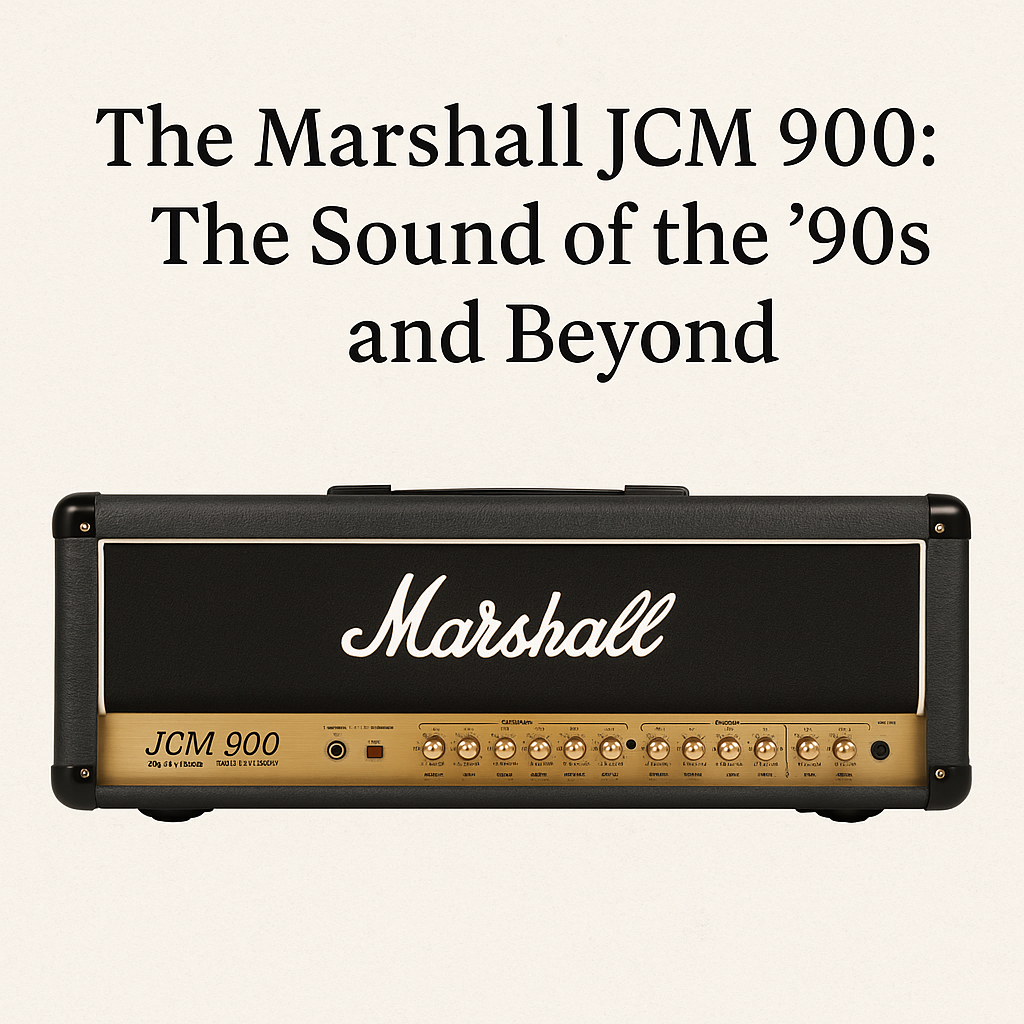
When Marshall introduced the JCM 900 series in 1990, it was stepping boldly into a new decade of heavier, more aggressive guitar tones. Building on the legacy of its predecessors—the JTM, JMP, and JCM 800 lines—the JCM 900 aimed to offer modern features and the versatility that contemporary guitarists demanded. The result was an amp that became synonymous with early ’90s alternative rock, punk revival, and metal, and one that remains a staple on stages and in studios today.
From JTM to JCM: The Road to the 900
Marshall’s story began in the early 1960s with the JTM45, a British twist on the American Fender Bassman. The JTM line, particularly the Bluesbreaker combo, quickly gained favor with players seeking more punch and sustain—qualities that would help define the British rock sound. This lineage evolved into the JMP series in the late ’60s and ’70s, introducing more powerful amps like the 1959 Super Lead, which helped launch the careers of legends like Jimi Hendrix, Pete Townshend, and Eric Clapton.
By the 1980s, Marshall released what would become one of its most iconic lines: the JCM 800. Known for its raw power, midrange bark, and tight low end, the JCM 800 became a favorite among heavy metal and hard rock bands, including Slayer, Guns N’ Roses, and Iron Maiden. It was a single-channel beast, often used in combination with distortion pedals or overdriven to brutal levels. As the ’80s progressed, however, players wanted more: more gain, more flexibility, and more features. That desire led directly to the birth of the JCM 900.
The JCM 900: A Modern Workhorse
Launched in 1990, the Marshall JCM 900 represented a significant step forward in terms of functionality. Models like the 4100 Dual Reverb offered two independent channels, allowing guitarists to switch between clean and distorted tones without additional pedals. This dual-channel setup, along with built-in reverb, a true-bypass effects loop, and increased gain stages, gave players the flexibility that previous models lacked.
Most notably, the JCM 900 embraced high-gain design in a way earlier Marshalls had not. Where the JCM 800 delivered a searing crunch, the 900 pushed into saturated territory, better suiting the sounds of grunge, punk-pop, and heavier metal genres emerging at the time. While purists often criticize the JCM 900 for relying too much on diode clipping rather than pure tube overdrive, many musicians found its punchy tone and reliability perfect for touring and recording.
Who Played the JCM 900?
Despite the debate surrounding its tone, the JCM 900 found favor with a wide array of influential players, particularly in the alternative and punk scenes of the ’90s.
Billie Joe Armstrong of Green Day used a JCM 900 during the recording and touring of Kerplunk and Dookie, helping define the crunchy, tight rhythm tone that became a pop-punk benchmark. Josh Homme, in his Kyuss days, also relied on a JCM 900 to deliver massive desert rock riffs, particularly during the Blues for the Red Sun era. Noel Gallagher of Oasis ran two JCM 900 heads for a wall of Britpop guitar during the band’s explosive rise.
Other notable users include Thom Yorke of Radiohead, who incorporated the JCM 900 into the band’s early tours, and Frank Iero of My Chemical Romance, whose live rig included a JCM 900 during their Three Cheers for Sweet Revenge era. Even Alex Lifeson of Rush explored the amp’s capabilities on albums like Counterparts and Test for Echo, proving its adaptability across genres.
Reception and Legacy
The JCM 900’s reception has always been somewhat polarizing. Tone purists often dismiss it for its reliance on solid-state clipping for its distortion, favoring the all-tube tone of the JCM 800. Others celebrate it as a reliable, versatile amp that delivered exactly what many players needed in the studio and on stage—especially in an era where stylistic demands were shifting rapidly.
Nevertheless, the amp’s influence is undeniable. It served as a bridge between the vintage-voiced JCM 800 and the more modern JCM 2000 DSL series that followed in 1998. In many ways, the 900 anticipated the future of Marshall amps: channel-switching, built-in reverb, and a balance between vintage tone and modern versatility.
Conclusion: A True Marshall Milestone
The Marshall JCM 900 may not have the cult mystique of the Plexi or the raw power of the JCM 800, but it played a crucial role in Marshall’s evolution and in the music of the 1990s. It offered a new kind of sonic flexibility, making it possible for guitarists to adapt to the changing demands of modern music without abandoning the core Marshall sound. Whether you see it as a misunderstood gem or a utilitarian workhorse, the JCM 900 remains a landmark in amplifier design—and a powerful symbol of a new generation of rock.