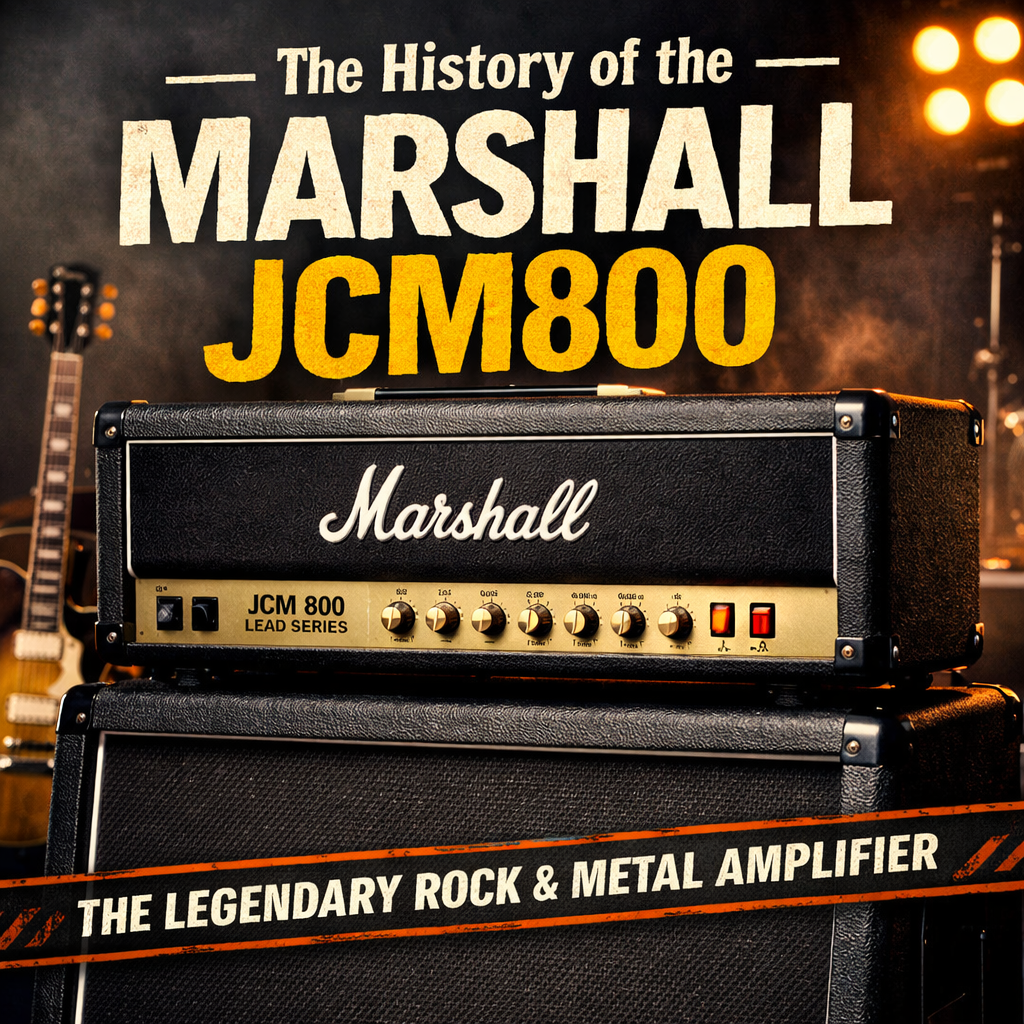
Few guitar amplifiers have left a mark on rock music as deep and unmistakable as the Marshall JCM800. Introduced at the dawn of the 1980s, the JCM800 didn’t just continue Marshall’s legacy—it redefined it. Stripped-back, aggressive, and unapologetically loud, the JCM800 became the sound of hard rock, punk, and heavy metal for an entire generation.
Origins: Marshall Enters the 1980s
By the late 1970s, Marshall amplifiers were already legendary. The Plexi and JMP-era amps had powered the explosion of British blues-rock and early hard rock, but musical tastes were shifting. Players wanted more gain, more consistency, and more reliability on loud stages.
In 1981, Marshall launched the JCM800 series—named after Jim Marshall’s initials and the new product numbering system (“JCM” followed by the 800 series). While visually modernised with a sleeker panel and bold logo, the real evolution was under the hood.
The Core Models: 2203 and 2204
At the heart of the JCM800 story are two amplifiers:
- 2203 – 100-watt head
- 2204 – 50-watt head
Both featured a single-channel master volume design, allowing players to push the preamp into overdrive without fully diming the power section. This was a crucial step toward the modern high-gain amp.
Key characteristics:
- EL34 power tubes (UK models)
- Aggressive upper-midrange
- Tight low end
- Raw, cutting distortion when pushed
Unlike later multi-channel designs, the JCM800 rewarded player dynamics—volume knob changes, picking attack, and pedal interaction mattered.
The Sound: Brutal, Focused, Iconic
The JCM800 sound is often described as:
- Dry
- Immediate
- Punchy
- Unforgiving
It lacked the spongy sag of earlier Marshalls but made up for it with clarity and attack. For punk, NWOBHM, and early thrash metal, this was exactly what players wanted.
Famous Players Who Defined the JCM800 Era
The JCM800 didn’t just appear on records—it defined them. Notable users include:
- Slash – Although famous for earlier Marshalls, JCM800s were central to his late-’80s touring rigs
- Zakk Wylde – Crushing pinch harmonics and searing gain
- Kerry King – Thrash metal aggression personified
- Dave Murray – Articulate metal leads with classic British bite
- Steve Jones – Punk rock ferocity and simplicity
From stadium rock to underground metal, the JCM800 was everywhere.
Beyond the Heads: Combos and Split Channels
As the decade progressed, Marshall expanded the JCM800 line:
- 4010 / 4011 combos (50w and 100w)
- 2210 / 2205 split-channel models, adding channel switching and diode clipping
While purists often prefer the earlier single-channel heads, these later variants hinted at where Marshall was heading next.
What Came After: The JCM800’s Descendants
The success of the JCM800 directly shaped Marshall’s future amplifiers:
JCM900 (1990s)
- More gain
- Diode-assisted clipping
- Dual channels
- Aimed at modern rock and metal, but more divisive among players
JCM2000 DSL & TSL
- True multi-channel designs
- Broader tonal range
- DSL models, in particular, are often seen as spiritual successors to the JCM800
JVM Series
- High-gain evolution taken to the extreme
- MIDI switching, multiple modes per channel
- A far cry from the simplicity of the 800, but built on its DNA
Even today, many modern Marshall circuits are still judged by how closely—or how intentionally—they depart from the JCM800 benchmark.
Legacy: Why the JCM800 Still Matters
Decades on, original JCM800s remain:
- Highly collectible
- Regularly gigged
- Frequently reissued and cloned
Boutique builders and pedal designers still chase that sound—tight, aggressive, and brutally honest. In an era of digital modelling and ultra-featured amps, the JCM800’s appeal lies in its simplicity and authority.
Final Thoughts
The Marshall JCM800 is more than just an amplifier—it’s a turning point in electric guitar history. It bridged the gap between vintage crunch and modern high-gain, powered some of the most iconic records ever made, and continues to influence how guitarists think about tone.
For players who believe great tone starts with volume, attitude, and a loud British stack, the JCM800 remains unbeatable.