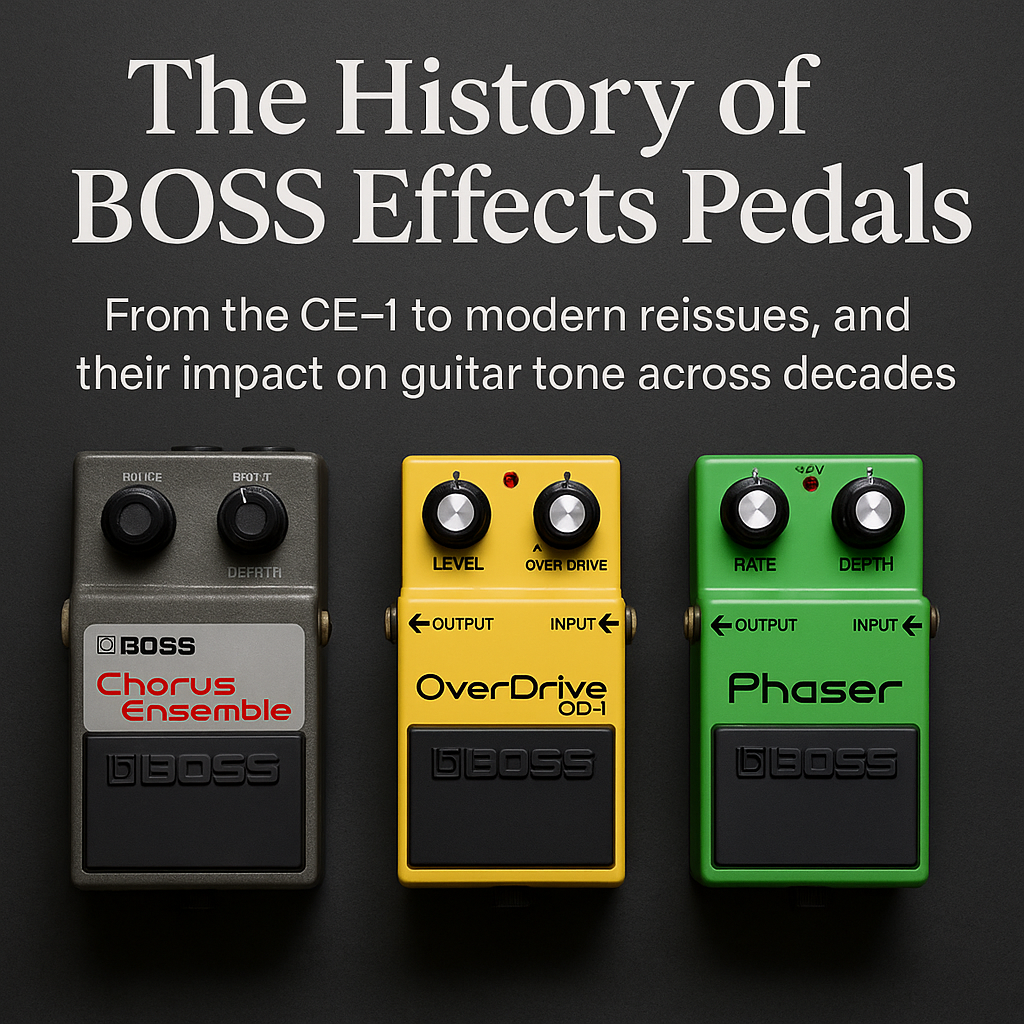
The story of BOSS begins as an off‑shoot of the Japanese musical instrument company Roland. BOSS was formed in 1973, specifically to design and manufacture effects pedals — a bold move considering that guitarists had long been working primarily with amplifiers and rack units.
Early Steps
- In 1974, Roland USA and Roland Japan released the “B‑100 The Boss Acoustic Preamp” — one of the first uses of the “Boss” name in their gear line.
- In 1976, the first pedal branded under BOSS proper was launched: the BOSS CE‑1 Chorus Ensemble. Among other things, it offered both chorus and vibrato and was one of the earliest serious attempts at bringing studio‑level modulation effects into a more compact, stage‑friendly format.
Compact Pedal Revolution
By 1977, BOSS introduced its “compact pedal” series (smaller enclosures, foot‑switch latching, battery compartments under the chassis) that would become the template for countless effects pedals. The first of these included:
- The CE‑1 successor series
- The OD‑1 OverDrive, PH‑1 Phaser and SP‑1 Spectrum were among the earliest in that compact format.
This compact housing, rugged build and distinctive colouring became hallmarks of the BOSS identity.
Growth Through the 1980s: Innovation & Expansion
In the 1980s, BOSS expanded both the variety of effects and the reach of their pedals.
Key Milestones
- The BOSS DS‑1 Distortion was introduced in 1978 — a landmark pedal that brought distortion into the mainstream of compact pedal operation.
- The CE‑2 and other modulation effects continued the legacy of the CE‑1, giving guitarists rich chorus and vibrato options in a stage‑friendly box.
- Delay took centre stage: the DM‑1 Delay Machine and subsequent digital delay pedals allowed more adventurous sounds.
- BOSS established a consistent colour‑coding system: green for phasers, white for delays, etc., making recognition and usage more intuitive.
Why This Era Mattered
- The compact pedal format made it feasible for guitarists to build pedalboards rather than relying solely on amp‑based effects or rack units.
- The durability and standardised format (3‑knob + footswitch + rugged chassis) meant reliability on stage. As one retrospective noted: “Over four decades, this Japanese behemoth’s pedal design has become the standard bearer for what a stompbox looks like.”
- The effect categories (overdrive, distortion, modulation, delay) proliferated, giving musicians many more options to shape their sound.
1990s to Early 2000s: Genre‑Defining Pedals & Cult Status
With the rise of different musical genres (metal, blues revival, alternative rock), BOSS responded with targeted pedals that became iconic in their own right.
Metal and Heavy Options
- The MT‑2 Metal Zone, released in 1991, was designed for high‑gain metal guitarists, with a dual‑stage gain circuit and semi‑parametric EQ controls to sculpt the midrange.
- The HM‑2 Heavy Metal (1983) though earlier, found a cult following in extreme metal (especially Swedish death metal) and was reissued later due to demand.
Blues & Overdrive
- The BD‑2 Blues Driver (mid‑1990s) aimed to give a tube‑like overdrive dirt for blues players, maintaining more of the amp’s voice while adding grit.
- Meanwhile, simpler overdrives like the SD‑1 Super Overdrive (1981) continued to remain popular due to tonal versatility.
Impact
- These pedals weren’t just options — they shaped the sound of entire genres. For example, the HM‑2 is sometimes described as “the holy grail of death metal.”
- They reinforced BOSS’s reputation not just as a manufacturer of reliable pedals, but as a tone‑maker whose designs were integral to the sound of modern guitar music.
Modern Era: Digital Technology & Legacy Reissues
As the 21st century progresses, BOSS has both preserved its heritage and adapted to new technologies.
Reissues & Special Editions
- Celebrating milestones: BOSS marked its anniversaries with limited edition colours and reissues of classic pedals.
- The “Waza Craft” line offers boutique‑grade versions of classic pedals (higher quality components, special modes). The HM‑2W reissue is one such example.
Digital & Modeling Integration
- BOSS has moved into digital modelling and multi‑effects territory, while still retaining the compact stompbox format.
- This shows the brand is adapting: offering the classic physical form factor yet embracing modern production and digital flexibility.
Why It Matters Today
- For players: There’s a vast ecosystem of BOSS pedals, old and new, giving huge tonal choices.
- For collectors: Early models, rare colours or limited editions are sought‑after.
- For the industry: BOSS helped standardise the stompbox format (size, controls, ruggedness) that many other companies followed.
Key Lessons from the BOSS Story
- Innovation + practicality: BOSS didn’t just invent effects — they packaged them in a way that worked for gigging guitarists (battery option, rugged feet, standard format).
- Durability leads to legacy: Many BOSS pedals from decades ago are still in use, proving the build quality.
- Tone shaping matters: The brand’s willingness to explore distinct circuits (asymmetrical clipping, digital delays, semi‑parametric EQ) meant it didn’t just repeat what others were doing.
- Adaptability: As music styles changed, BOSS adapted (metal, blues, ambient, digital); they didn’t rest on early successes.
- Recognition and branding: From the colourful compact pedals to the “traffic light” naming, BOSS built a recognisable aesthetic and a trusted name.
Conclusion
From the CE‑1 in the mid‑1970s to today’s digital and boutique reissues, BOSS has charted a remarkable journey. It began with a vision to bring professional‑grade effects into a stage‑friendly format, and that vision matured into a legacy of some of the most widely used and influential pedals in guitar history.
If you’re a guitarist, hobbyist or gear‑nerd, understanding this history provides not just appreciation for the gear, but insight into how technology, music styles and user demands shape the tools we use. BOSS is a prime example of effective evolution in music hardware.