Few guitarists have sculpted tones as unmistakable and emotionally resonant as David Gilmour. Known for his work with Pink Floyd and his solo career, Gilmour’s playing is not only about melody and feel—his gear choices have been instrumental in crafting that soaring, ambient sound. Let’s explore the amplifiers and effects that helped define his signature tone across the decades.
Amplifiers: Power Behind the Tone
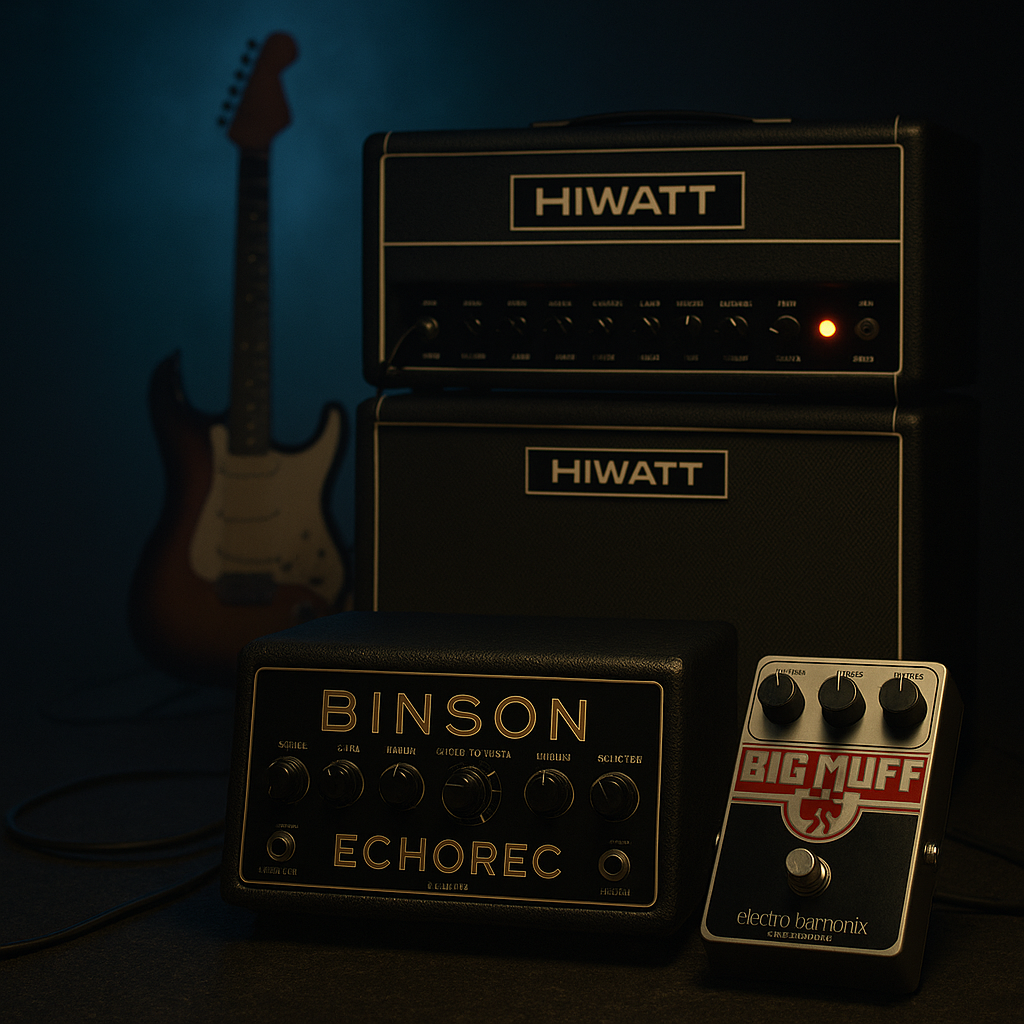
Hiwatt DR103
Arguably the backbone of Gilmour’s live and studio rig, the Hiwatt DR103 head paired with WEM or custom cabinets delivered a clean, powerful platform that let his pedals shine. Known for headroom and clarity, it’s been his go-to since the early ’70s, especially prominent during the “Dark Side of the Moon”, “Wish You Were Here”, and “Animals” eras.
Alembic F-2B Preamp
Used in studio setups during the “Wall” sessions, this tube preamp (inspired by vintage Fender circuits) gave Gilmour a warm, articulate tone when paired with solid-state power amps and studio gear.
Yamaha RA-200 Rotary Speaker
Rather than a traditional Leslie, Gilmour favored this rotary speaker for swirling modulation—listen to tracks like “Shine On You Crazy Diamond” to hear its lush movement.
Effects: The Heart of Gilmour’s Soundscapes
Electro-Harmonix Big Muff Pi
Gilmour’s go-to fuzz/distortion—especially during the “Animals” and “Wall” tours. The Ram’s Head version is particularly revered for its sustaining, violin-like overdrive that became central to solos like “Comfortably Numb.”
Binson Echorec
A tape-based delay unit used during the early Pink Floyd era. The Echorec’s rhythmic, multi-head delay defined tracks like “Time” and “Echoes,” giving his guitar an ethereal, hypnotic dimension.
MXR Phase 90 & Uni-Vibe
Both modulation effects saw use for swirling textures. The Uni-Vibe featured especially on “Breathe” and live renditions of “Echoes,” delivering a warm, throbbing pulse.
Custom Pete Cornish Pedalboards
Gilmour’s mid-to-late career pedalboards were built by Pete Cornish, known for their rugged reliability and pristine tone routing. These included a mix of custom overdrives, buffers, and switching systems that allowed for seamless live performance control.
Boss CE-2 Chorus
Used heavily during the “Final Cut” and “Momentary Lapse of Reason” periods, this analog chorus added width and shimmer to clean tones and solos alike.
Digital Delays (TC Electronic 2290, Boss DD-2)
Gilmour transitioned to digital delay units in the ’80s, favoring the TC 2290 and Boss DD-2 for precise, tap-tempo synced echoes—essential for songs like “Run Like Hell.”
Notable Tone Moments
- “Comfortably Numb” Solo – Big Muff into Hiwatt with delay and reverb.
- “Shine On You Crazy Diamond” – Clean Hiwatt tone, rotary speaker, and subtle delay.
- “Run Like Hell” – Delay-heavy, palm-muted rhythm soaked in modulation.
Final Thoughts
David Gilmour’s gear choices weren’t about novelty—they were about clarity, space, and emotion. Whether it’s the haunting echoes of “Echoes” or the epic peaks of “Comfortably Numb,” his blend of classic tube amps and atmospheric effects helped elevate the electric guitar to symphonic heights.
Whether you’re chasing his tone or just admiring his craft, one thing is clear: Gilmour proves that when used tastefully, gear becomes more than equipment—it becomes part of the voice.