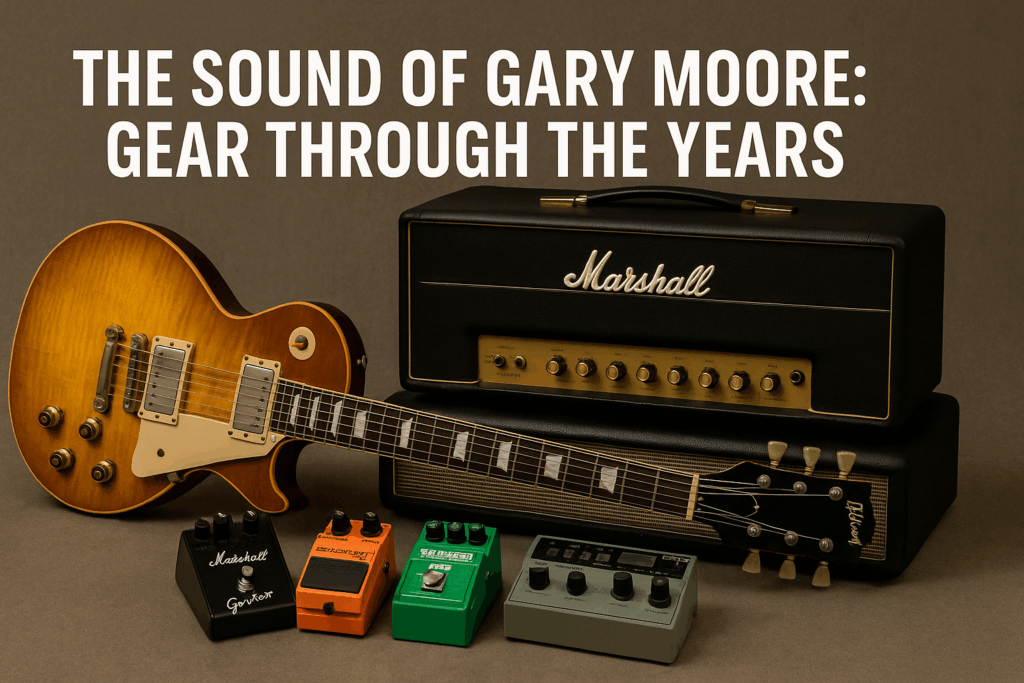
Gary Moore (1952–2011) remains one of the most admired guitarists for his emotive playing, tone, and ability to move between blues, rock, and fusion. Part of what made his guitar sound so compelling was his choice of gear and how he used it. Let’s walk through the most significant guitars, amplifiers, and effects that helped define his voice.
Guitars: From Strats to Legendary Les Pauls
Early period & Rock / Fusion era
- In his early years (e.g. with Skid Row, Colosseum II), Moore used various Gibson and semi‑hollow guitars.
- He was also photographed with a Gibson Melody Maker, sometimes modified (e.g. swapped pickups) during his Thin Lizzy era.
- In the early 1980s, he endorsed Ibanez and used models like the RS1000 (cherry sunburst, dual humbuckers)
- He also had a Hamer Special guitar (white finish, DiMarzio humbuckers) around 1985 era.
The Les Paul era (and the “Greeny” & “Stripe” story)
It’s in his later, more blues-oriented work that Moore made his most iconic gear choices.
- Perhaps the most famous guitar associated with him is the 1959 Gibson Les Paul Standard nicknamed “Greeny” (originally Peter Green’s). Moore adopted that guitar and used it for much of his career.
- Another 1959 Les Paul he used was nicknamed “Stripe”, which he acquired in 1988 and used across his solo output.
- Gibson later released a Gary Moore signature Les Paul (around 2000–2002), which he used alongside his vintage Les Pauls.
- Moore did not exclusively use Les Pauls; at times he used modified Fenders / Strats (e.g. a ’62 Reissue Strat) especially during his more rock / 80s‑style periods.
- In the 2000s and beyond, he sometimes used other models — e.g. a Gibson Explorer in concert settings, or a Gibson Firebird on certain tracks (he mentioned using a Firebird for “spring reverb twang” textures)
In short: while Moore explored many guitars, the Les Paul (particularly vintage late ’50s ones) became central to his signature sound.
Amplifiers & Power
Moore’s amplifier choices evolved with his musical direction. He often used clean or moderately driven settings and let pedals or boosters add coloration rather than relying purely on heavy amp distortion.
Key amplifiers
- Marshall JTM45 (reissue / early version) For his blues / tone productions (e.g. Still Got the Blues), Moore considered a Les Paul + JTM45 + Guv’nor pedal a foundational starting point.
- Marshall JMP 2022 20W (1971 model) This amp was part of his rig in the ’80s / later years; he reportedly used it across many of his albums from 1987 onward.
- Soldano SLO‑100 In the early 1990s, Moore used the Soldano SLO100 in his rigs. Interestingly, he often ran it on the clean channel (or with its crunch switch) and used external pedals (e.g. Guv’nor, Tube Screamers) for further drive.
- Vox AC‑30 In his Colosseum II period, Moore used a VOX AC‑30 (a hand‑wired 1974 model) before it went missing.
- Other/older amps In his early bands, he used amps like the Hiwatt Custom 100 (through Wem 4×12 cabinets) and an Orange Matamp OR200. He also used smaller amps or hybrid setups (e.g. Gallien-Krueger combos) early on.
Over time, his preferences leaned toward rigs that offered clean headroom and let effects and tonal control shape his overdrive and sustain.
Effects & Pedals: The Subtle Touches
Moore was not a pedal junkie; he preferred a lean but effective setup, using pedals more for boosting or coloration than as the primary source of distortion.
Notable pedals and effects in his setup
- Marshall Guv’nor (Mk I) Perhaps his most famous pedal — used especially during his blues era to push the clean amp into a sweet mid-gain overdrive. Moore himself cited it as part of his tone triad (Les Paul / Guv’nor / JTM45).
- Boss DS‑1 Distortion He used this, especially on his Stratocaster setups, to “give the Strat a real kick” without thinning it out.
- Ibanez TS10 (Tube Screamer) Often used to push into overdrive or as a mid-boost in the signal chain, particularly in conjunction with the Soldano.
- Roland / rack units & delays / echo
- Roland SDE‑3000: used from mid-1980s onward, as a programmable digital delay, replacing a cluster of pedals.
- Roland SRE‑555 Chorus Echo: used especially in the early-mid ’80s for echo, sometimes with chorus from other pedals.
- He reduced use of many small Boss pedals over time, consolidating into cleaner rack units or using just what was necessary.
- Other pedals / newer era Later in his career, Moore experimented with boutique pedals. For example, he used T-Rex pedals such as the Moller Overdrive and Twister (a chorus/flanger hybrid) and others like the Gristle Luxury Overdrive.
Overall, Moore’s approach to effects was relatively restrained — he favored clarity, dynamics, and letting the guitar and amp do their work, using pedals judiciously.
Signal Chain Philosophy & Tone Habits
A few recurring principles and insights in Moore’s rig and tone approach:
- Lean signal chains – Moore believed that the more effects and circuitry between guitar and amp, the more you lose fidelity. He often pared things down to the essentials.
- Boost rather than heavy distortion – He tended to use boosters (Guv’nor, TS10) to push an amp’s existing tone rather than stacking massive gain blocks.
- Choice of pickup / guitar / wiring mattered – His use of vintage Les Pauls, often with PAF / classic humbuckers, allowed the core tone to be rich, dynamic, and responsive to hand attack.
- Use of delay, echo, and subtle space – Rather than heavy modulation, he used delay/echo units (e.g. SDE‑3000, SRE‑555) to add depth, especially in solos and shimmering phrasing.
- Versatility across genres – Moore’s gear allowed him to shift from searing rock leads to gentle, bluesy cleans without dramatic re-rigging.
Example Rig:
Still Got the Blues Era
To give a more concrete snapshot, the Still Got the Blues / early 1990s phase is often cited as his “definitive” tone:
- Guitar: 1959 Les Paul (often “Stripe” or the Greeny)
- Amplifier: JTM45 reissue (or similar Marshall)
- Pedal: Guv’nor as the primary overdrive
- Some use of TS10 to push gain further
- Subtle echo / delay (from rack unit) for solos
This stripped‑down but effective rig allowed him to get sustain, clarity, dynamics, and emotive phrasing without drowning the tone.