Few amplifiers in the history of music have had the cross-generational impact and unexpected legacy of the Fender Bassman. Originally designed in the early 1950s as a companion to Leo Fender’s new Precision Bass, the Bassman quickly found fans far beyond the bass-playing community. Its powerful tone, warm breakup, and innovative circuitry laid the groundwork for not just Fender’s future amplifiers, but entire families of amplifiers across the industry — including the mighty Marshall stack.
📜 Origins: Built for the Precision Bass
When Leo Fender released the Precision Bass in 1951 — the first mass-produced electric bass guitar — he knew players would need an amp capable of handling lower frequencies without breaking up or distorting too early. Enter the Fender Bassman, first introduced in 1952 as the 5B6 Bassman, a 26-watt, single-15” speaker combo that looked like a beefed-up guitar amp but with unique tone-shaping potential.
The Bassman’s original purpose was simple: deliver enough clean volume to support bass guitarists in live settings. However, in pursuit of this goal, Fender inadvertently created an amp that guitarists would fall in love with too.
🔧 The Tweed Era (1950s): 5E6 to 5F6-A
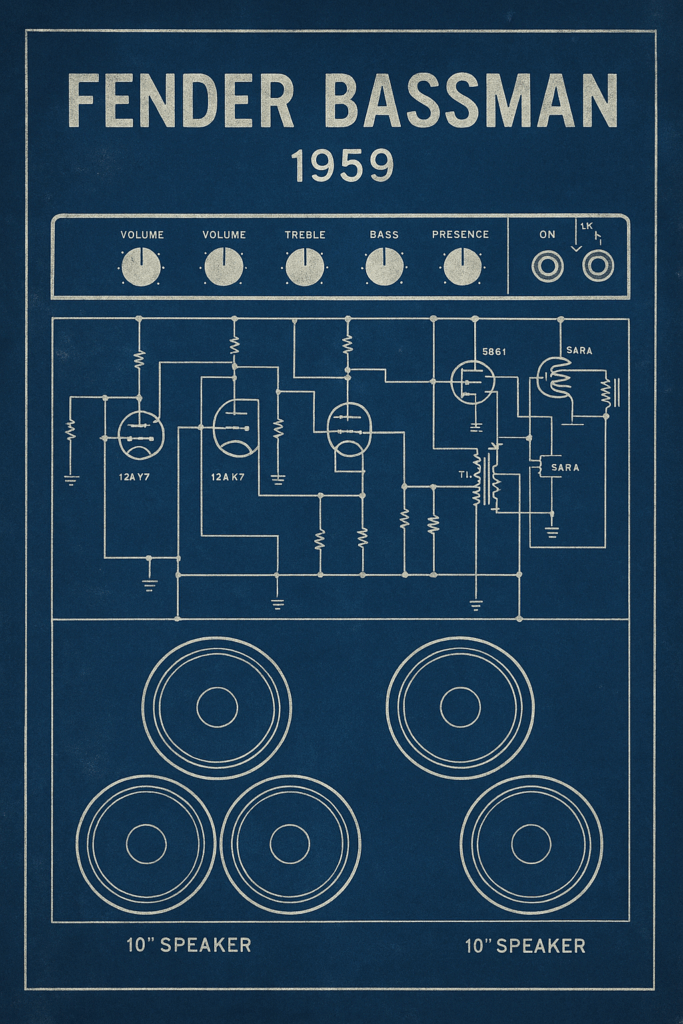
The most legendary of the early Bassman designs arrived in 1957 with the 5F6-A circuit, often referred to as the holy grail of Fender tone. Featuring:
- Four 10” Jensen speakers
- 50 watts of power
- A presence control
- Fixed-bias 6L6 power tubes
- Split cathode preamp stages
…the 5F6-A set the standard for what a guitar amplifier could be.
Though marketed to bassists, guitarists like Buddy Guy and Brian Setzer soon realized this amp’s sweet, rich breakup and touch sensitivity were ideal for blues, rockabilly, and early rock ‘n’ roll. Its tonal complexity made it an instant classic.
🇬🇧 A British Legacy: The Marshall Connection
In the early 1960s, Jim Marshall was searching for a robust amp for British guitarists — and when he couldn’t easily source Fender Bassmans, he decided to build his own. Using the 5F6-A as the blueprint, Marshall modified it with British-made components, different transformers, and EL34 tubes. The result? The Marshall JTM45 — the first in a long line of amps that would dominate rock stages in the coming decades.
In this way, the Fender Bassman didn’t just inspire players — it inspired whole amplifier brands.
🎛 The Black Panel & Silver Panel Era (1960s–1970s)
Fender continued to evolve the Bassman through the ’60s and ’70s. In 1963, the amp adopted the now-famous black panel aesthetic, along with new circuitry for improved headroom and clarity.
By the late 1960s, the Silver Panel Bassman arrived, with updated cosmetics and circuitry. The amp was now more oriented towards clean tones, appealing to a new era of funk, country, and soul players. Versions like the Bassman 50 and Bassman 70 were introduced, often seen in head-and-cab configurations.
Guitarists from Mike Campbell to Josh Homme would come to appreciate these versions for their clean pedal platforms and unique voicing.
⚡ Modern Reissues & Revival
By the late 1980s and 1990s, demand for vintage-style amps surged. Fender answered with a number of Bassman reissues, most notably:
- ’59 Bassman LTD — A faithful recreation of the 5F6-A tweed model, featuring tube rectification and four 10” speakers.
- Bassman ’70s silverface reissues in various circuits, sought after by pedal users for their massive clean headroom.
In recent years, boutique builders and modders have revived the Bassman circuit in countless custom designs, often tweaking it for extra gain or enhanced low-end response.
🎸 Notable Players Who’ve Used the Bassman (Guitarists & Bassists)
- Brian Setzer – His rockabilly tone is practically synonymous with a tweed Bassman.
- Jimi Hendrix – Early recordings include Bassman tracks.
- Mike Bloomfield – A heavy user of the ’59 Bassman.
- Josh Homme (Queens of the Stone Age) – Known to use Silver Panel Bassman heads.
- Steve Cropper – Clean tones on Stax records through Silver Panel models.
- Tom Petty & The Heartbreakers – Bassman tones feature across many albums.
- Justin Meldal-Johnsen – Modern bass tones via Bassman reissues.
🧪 Why Guitarists Love It
Despite its name, the Fender Bassman might be one of the most beloved guitar amps of all time. Why?
- Huge low-end and midrange warmth
- Smooth overdrive at higher volumes
- Great platform for fuzz, boost, and overdrive pedals
- Legacy of classic rock, blues, and roots music tones
🎤 Conclusion: The Amp That Transcended Its Role
The Fender Bassman is a perfect example of design unintentionally ahead of its time. Born to support bass guitar, it ended up shaping the sound of guitar-based music for decades — from American blues to British rock and beyond. Whether you’re a vintage purist chasing tweed tones, or a modern pedalboard aficionado seeking a clean canvas, the Bassman stands as one of the most enduring amp circuits in history.