Mention “Yamano” to Gibson fans and you’ll usually get the same reaction: a knowing nod, followed by some version of “the good ones went to Japan.” Like most guitar folklore, there’s a myth layer—but underneath it is a very real (and genuinely influential) business relationship between Yamano Music / Yamano Gakki and Gibson, spanning the late-’80s through the mid-2000s, with ripple effects that are still felt in the vintage and collector market today.
This is the story of how a Japanese distributor became tied to some of the most desirable modern-era Gibsons, why “Yamano paperwork” exists, and what it all means if you’re shopping for a Les Paul, ES-335, or Custom Shop Historic that’s wearing the Yamano badge.
Who (and what) was Yamano?
Yamano wasn’t a single person hand-picking flame tops in a warehouse—though that legend persists online. Yamano is a long-established Japanese musical-instrument retailer and distributor that grew from a Tokyo shop founded in the 1890s into a major national network.
In guitar terms, Yamano matters because it became deeply intertwined with US brands entering (and thriving in) Japan’s famously detail-oriented market.
The key shift: Yamano becomes Gibson’s Japanese dealer/distributor
By the late 1980s, Japan had matured into one of the world’s most important guitar markets: high-end buyers, serious players, and collectors with extremely high expectations around fit/finish, wood, and consistency.
Multiple historical summaries and brand histories place a major turning point in 1987, when Yamano Gakki obtained the Gibson and Epiphone dealership in Japan, and handled distribution of Gibson (and certain Epiphone lines) into the Japanese market.
From there, the Yamano–Gibson relationship became more than “just logistics”—because Yamano’s customer base (and reputation) rewarded consistency and quality, and that fed back into the kinds of instruments being ordered, specced, and accepted.
Orville by Gibson: the partnership gets a “Japan-only” brand
If you want the clearest proof that Yamano and Gibson were closely aligned, it’s this: Orville by Gibson.
In 1988, Gibson and Yamano elected to expand Japan-market offerings without simply slapping “Epiphone” on everything—so they used the Orville name (after Gibson founder Orville Gibson) for Japan-only instruments positioned between US Gibsons and lower-priced imports. Production ran through the 1990s, and the brand was discontinued in 1998.
Whether you’re an Orville devotee or not, its existence tells you something important: Yamano wasn’t merely shipping boxes. They were a strategic partner helping Gibson compete in a market crowded with extremely high-quality Japanese-built instruments.
So why do “Yamano Gibsons” have the reputation they do?
1) Japan’s market pressure (and Yamano’s standards)
Japan’s top-end buyers have long been picky (in the best way): tight tolerances, clean finishing, consistent neck carves, and tasteful tops—especially once Les Paul Standards and Historics became “flametop objects of desire.”
That pressure shaped ordering and selection culture. Even today, you’ll see dealers describe Yamano-bound stock as meeting especially high expectations for appearance and build—reflecting what Japanese customers demanded and what Yamano wanted to represent.
2) Special runs and Yamano paperwork
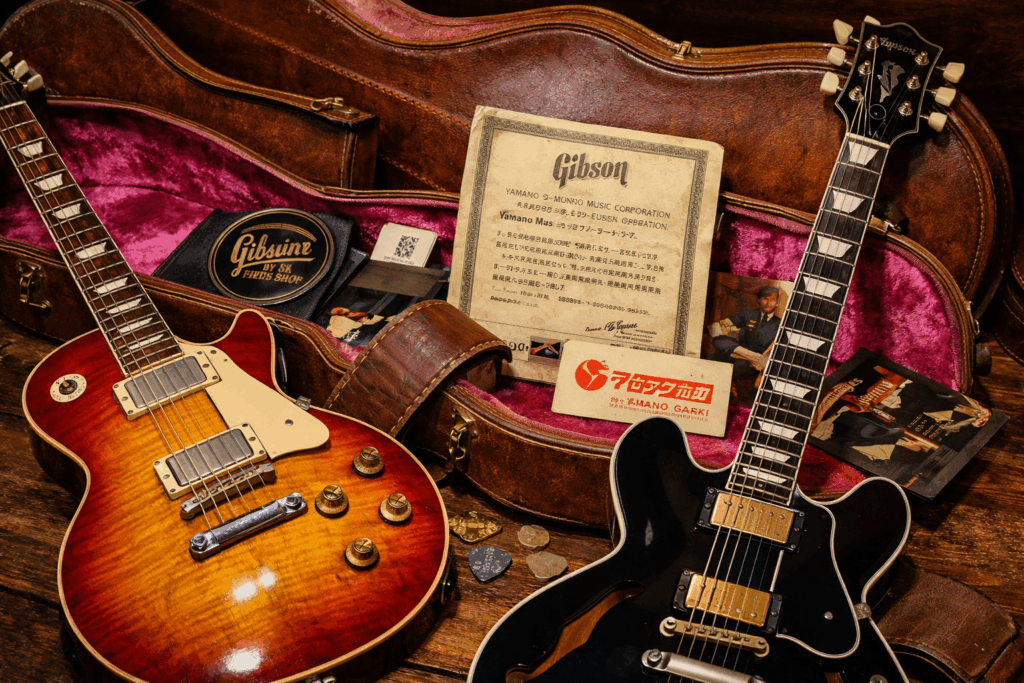
Many instruments that went through Yamano were accompanied by Yamano certificates / import documentation (often referenced in listings as “Yamano cert” or “Yamano import certificate”). That paperwork doesn’t automatically make a guitar “better”—but it does authenticate a Japan-distribution path that collectors recognize.
3) The timing: the ’90s into the mid-2000s
A lot of the Yamano mystique is tied to overlap with what many players consider a strong period for Gibson output—especially for certain USA and Custom Shop models—combined with Japan’s appetite for beautifully presented instruments (tops, bursts, lighter weights, tidy finishing).
That’s why “Yamano” often pops up in the same sentence as phrases like good wood, killer flametop, and exceptional build in sales descriptions and enthusiast discussions.
What actually counts as a “Yamano” Gibson?
In practical, buyer-friendly terms, a “Yamano” Gibson usually means:
- It was imported/distributed into Japan via Yamano during the years they handled Gibson distribution, or
- It was a Yamano-ordered / Yamano-bound run (sometimes with distinctive specs), or
- It includes Yamano documentation in the case candy (common in listings for Japan-market guitars).
And importantly: it’s not limited to Les Pauls—ES models, SGs, Custom Shop pieces, and other Gibson family brands show up with Yamano provenance too.
The breakup: Gibson ends Yamano distribution in Japan
By February 2007, reports circulating from the time describe Gibson announcing that Yamano Music was no longer the authorized distributor for Gibson brands in Japan, with Gibson moving toward selling directly to Japanese dealers.
That date matters for two reasons:
- It effectively puts bookends around the “classic” Yamano era, and
- It helps explain why Yamano-documented guitars—especially from the 1990s–mid-2000s—became a distinct collector category.
Why collectors still chase them
Let’s separate the romance from the reality:
The romance
- “Hand-picked tops”
- “Best examples sent to Japan”
- “Yamano = guaranteed masterpiece”
The reality (still compelling)
- Yamano’s position in the Japanese market helped shape what kinds of Gibsons were ordered, promoted, and accepted.
- Many Yamano-path guitars are beautifully presented examples (tops, finishes, consistency) because that’s what sold in Japan.
- The paper trail (certificates, tags, dealer history) adds confidence and resale value in a market that loves provenance.
In other words: Yamano isn’t magic dust—but it can be a meaningful clue that you’re looking at a guitar that was built and spec’d for an exacting audience.
Buying tips: how to shop “Yamano” intelligently
If you’re considering a Yamano-import Gibson (or a listing claims it), here’s the sensible checklist:
- Ask what the claim is based on Is it Yamano paperwork? A dealer story? A serial number trace? Case candy? Photos matter.
- Look for documentation Yamano certificates/import docs are commonly referenced in listings and can strengthen the provenance.
- Judge the guitar, not the myth Neck feel, fretwork, resonance, weight balance, acoustic volume—those win every time.
The legacy: Yamano’s quiet impact on modern Gibson culture
The Yamano–Gibson relationship sits at the crossroads of three big guitar-world truths:
- Japan helped force the global market to care about build quality and detail (especially when “copies” started rivaling originals).
- Distribution partners can shape what gets built, not just where it gets sold.
- Provenance matters—and Yamano provenance became a shorthand for a particular era, market, and expectation set.
So when you see “Yamano import” in a listing today, you’re not just seeing a sticker or a rumour—you’re seeing a chapter in Gibson history where Japan’s most influential dealer network helped define what “high-end” looked like, and what customers were willing to demand.