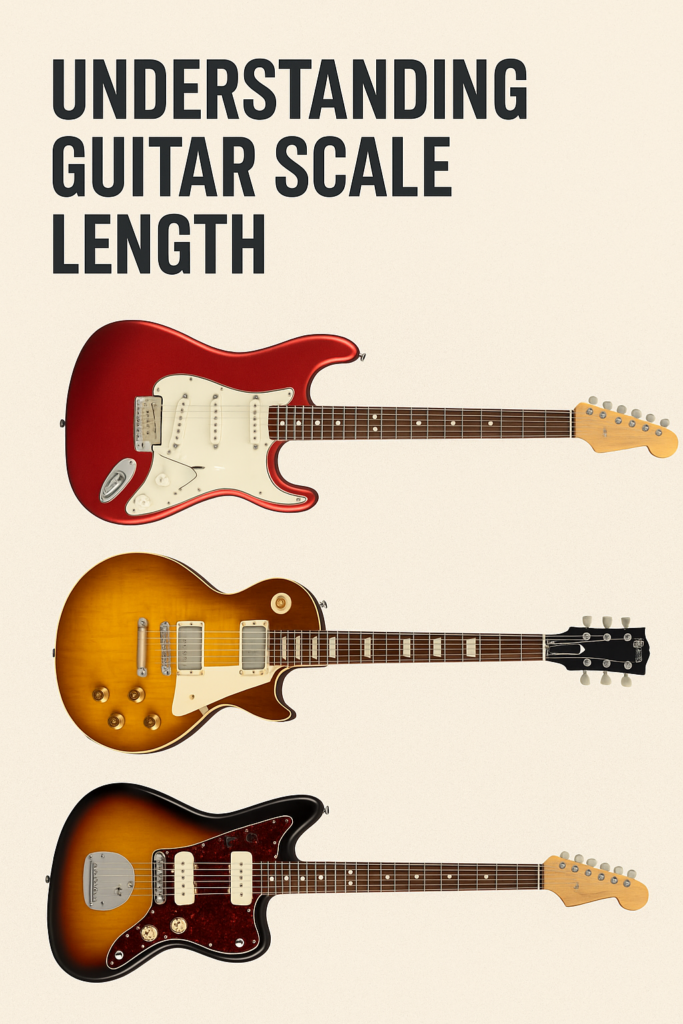
When choosing a guitar, players often focus on pickups, tonewoods, or body style—but one critical factor that profoundly impacts both tone and playability is scale length. In this post, we’ll explore how scale length affects your playing experience and tone, and we’ll look at some iconic guitar models to help you understand the differences.
What Is Scale Length?
Scale length is the distance between the nut and the bridge saddle—the vibrating length of the string. Common electric guitar scale lengths range from 24” to 25.5”, with some outliers going shorter or longer.
Even small changes in scale length can affect:
- String tension
- Fret spacing
- Tone and sustain
- Bendability and overall “feel”
Common Scale Lengths and Guitar Models
Here are three major scale lengths and the famous guitars that use them:
25.5” – Fender Stratocaster & Telecaster
This is the standard for many Fender guitars, including the iconic Stratocaster and Telecaster.
Feel:
- Strings feel tighter under the fingers.
- More spacing between frets.
- Crisper, more articulate tone with stronger attack.
Playability:
- Better for players who like clean picking and snappy response.
- May be slightly harder for bends and barre chords, especially for players with smaller hands.
24.75” – Gibson Les Paul & SG
Gibson popularized the shorter 24.75” scale with models like the Les Paul, SG, and ES-335.
Feel:
- Strings feel slinkier and easier to bend.
- Slightly warmer tone with more midrange emphasis.
Playability:
- Easier for legato playing, vibrato, and wide bends.
- Frets are slightly closer together—great for players with smaller hands or who prefer a more relaxed feel.
24” – Fender Jaguar & Jazzmaster (Modified Versions)
The Fender Jaguar and some offset models feature a short 24” scale.
Feel:
- Very low string tension, even with heavier gauge strings.
- Rich in harmonic overtones and quirky character.
Playability:
- Ultra-easy bending and expressive playing.
- Ideal for indie, surf, and shoegaze players looking for something more unconventional.
How Scale Length Affects Tone
- Longer scale (25.5”) = brighter, tighter, more articulate tone.
- Shorter scale (24.75” or less) = warmer, rounder, and slightly more compressed tone.
This means a Strat will naturally have more twang and chime, while a Les Paul delivers fat, creamy sustain.
Choosing the Right Scale Length for You
Try different guitars side by side. Ask yourself:
- Do you like a firm, snappy string feel, or something softer?
- Are you stretching for chords or flying through leads?
- Is brightness or warmth more important for your tone?
Also consider that string gauge can compensate for tension: heavier strings on a short-scale guitar, or lighter strings on a long-scale one, can help balance feel.
Final Thoughts
Scale length isn’t just a spec on a datasheet—it’s a foundational aspect of how a guitar feels and sounds. Understanding this helps you make better choices whether you’re buying your first guitar or customizing your dream build.
Whether you’re digging into blues on a Les Paul, twanging away on a Telecaster, or riding reverb waves on a Jaguar, the scale length is part of what shapes your voice.