If you’ve ever browsed vintage acoustics or modern reissues and wondered what separates a D-28 from a 000-18 — or what on earth a 00-45 actually means — you’re not alone.
C. F. Martin & Co. has one of the most logical and historically consistent model numbering systems in the guitar world. Once you understand it, you can decode a Martin model at a glance — identifying body size, trim level, tonewood choices, and even era-specific details.
For collectors and players browsing The Guitar Marketplace, this knowledge is invaluable.
1. The First Part: Body Size & Shape
The letters and numbers at the beginning of a Martin model name typically refer to the body size and shape.
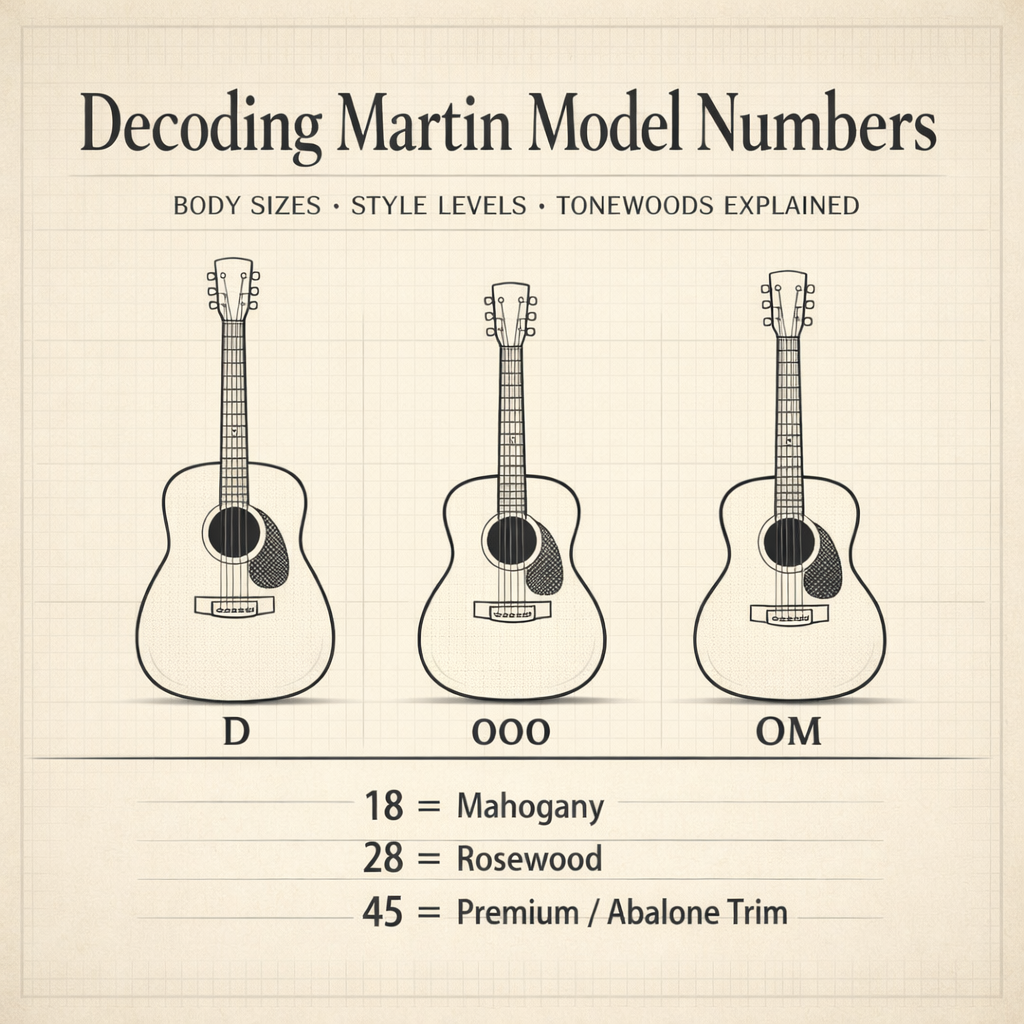
Common Martin Body Designations:
- 0 – Concert size
- 00 – Grand Concert
- 000 – Auditorium
- OM – Orchestra Model (000 body with longer 25.4” scale)
- D – Dreadnought
- M / 0000 – Grand Auditorium (wider lower bout)
- J – Jumbo
The Dreadnought (D)
The “D” stands for Dreadnought, a body shape introduced in the 1910s and popularised in the 1930s. Named after British battleships, the dreadnought was built for volume and projection.
Examples:
- Martin D-18
- Martin D-28
If you see a “D” at the start — you’re looking at a square-shouldered powerhouse.
2. The Second Number: Style (Trim & Tonewoods)
The number after the dash (e.g., 18, 28, 45) refers to the style level — which historically indicated ornamentation and wood choice.
Style 18
- Traditionally: Mahogany back & sides
- Minimal binding
- Simple appointments
Example: Martin 000-18
Style 18 is often considered the “working musician’s classic” — warm, woody and direct.
Style 28
- Traditionally: Rosewood back & sides
- Herringbone purfling (on vintage examples)
- More refined trim
Example: Martin OM-28
Style 28 is arguably the most iconic Martin configuration — balanced, piano-like, and rich.
Style 45
- Premium rosewood
- Abalone top, back, and fingerboard inlays
- Highest level of ornamentation
Example: Martin D-45
Style 45 models represent the pinnacle of traditional Martin craftsmanship.
3. Putting It Together
Once you understand the structure, decoding becomes simple:
D-28
- D = Dreadnought body
- 28 = Rosewood, mid-high trim level
000-18
- 000 = Auditorium body
- 18 = Mahogany, understated trim
OM-28
- OM = Orchestra Model body
- 28 = Rosewood trim level
The system is logical, consistent, and rooted in 19th-century tradition.
4. What About Extra Letters?
Modern Martins often include additional letters to indicate special features.
Common suffixes include:
- E – Electronics (e.g., D-28E)
- V – Vintage series
- GE – Golden Era
- MD – Modern Deluxe
- JR – Junior body size
Example:
Martin D-28 Modern Deluxe
This tells you it’s a Dreadnought, Style 28, from the premium Modern Deluxe series.
5. Historical Context Matters
While the numbering system is consistent, there are nuances:
- Pre-1934 000 models had short scale
- Herringbone trim disappeared during WWII and returned decades later
- Brazilian rosewood was standard on Style 28 pre-1969
- Style numbers once dictated exact spec combinations, whereas modern Martins allow more flexibility
Understanding era-specific changes is essential when evaluating vintage pieces.
6. Why It Matters for Buyers & Collectors
For those browsing vintage or modern acoustics on The Guitar Marketplace, knowing how to decode Martin model names helps you:
- Quickly identify tonewood combinations
- Understand trim level & collectibility
- Compare pricing tiers
- Spot historically significant variants
A D-18 and D-28 may look similar at a distance — but tonally and historically, they represent two distinct branches of Martin’s legacy.
Final Thoughts
Martin’s numbering system is a rare example of clarity in the guitar world. Once understood, it becomes a powerful shorthand — telling you nearly everything you need to know about a guitar before you even strum it.
For players seeking woody mahogany warmth, Style 18 awaits.
For lush overtones and rosewood depth, Style 28 remains king.
For ornate, heirloom-level craftsmanship — Style 45 stands alone.