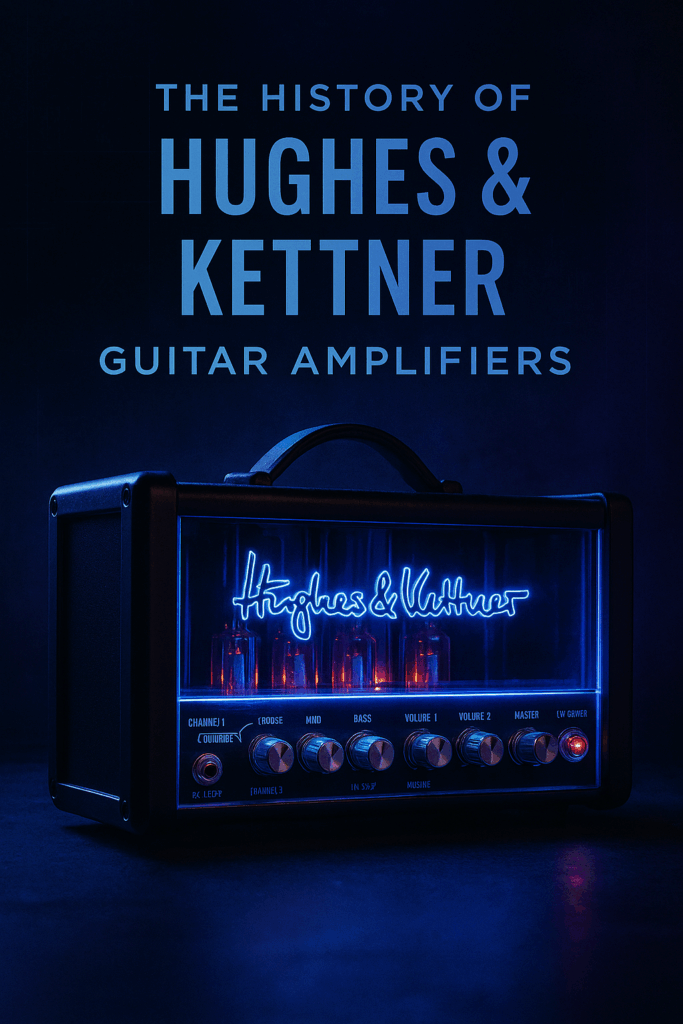
In the crowded world of guitar amplification, few names carry the kind of respect that Hughes & Kettner does. Over the decades, they’ve pushed forward ideas around programmability, tube/solid‑hybrid designs, and user flexibility, while also earning a following from high-profile guitarists and tone nerds. Their visual style (think illuminated plexiglass fronts) also gives them a distinctive presence on stage. But it’s not just about looks — their history reveals a company that repeatedly embraced technical risks and new ideas.
Origins: The Stamer brothers & early days (1984 onward)
Founding
- Hughes & Kettner was founded in 1984 in Neunkirchen, Germany, by brothers Hans and Lothar Stamer.
- In 1987, the business relocated to St. Wendel, where it remains based.
- Before making guitar amps, the Stamer family had experience in speaker and audio gear manufacturing (for example, in the HK Audio sphere).
From the beginning, the company combined “tone first” ambitions with engineering curiosity — aiming to not just replicate classic sounds, but to add flexibility and new functions.
Early innovations and landmark products
AS 64 — one of the first programmable amps
One of Hughes & Kettner’s earliest breakthroughs was the AS 64, released around 1985. It is often cited as one of the first guitar amps that allowed storing presets (in other words, selectable stored tones).
This gave guitarists the ability to switch between different tonal settings (gain, EQ, etc.) in a way that was unusual for the time.
Hybrid and tube/solid-state experiments
- In 1988, the ATS series was introduced, using hybrid designs (i.e. combining tube preamp stages with solid-state components) to push tonal flexibility.
- Hughes & Kettner also explored effects and speaker modeling. In 1989, they released the Red Box, a speaker‑emulation/DI device, letting an amp be recorded or sent to a PA without needing a microphone on a speaker cabinet.
- The Rotosphere (introduced ~1997) is another big one — a tube‑powered effect simulating a rotary speaker (like a Leslie), but in pedal form.
These early innovations foreshadowed Hughes & Kettner’s continuing interest in combining analog warmth with smart switching, modeling, and digital control.
The rise of flagship designs: TriAmp, Tube and Edition lines
The “TriAmp” concept
One of the landmark designs in the Hughes & Kettner catalogue is the TriAmp. First versions of TriAmp emerged in the 1990s, and later updates (TriAmp MK II, MK III) refined the concept.
The idea: build an all‑tube amp with three independent amplifier modules or “voices”, which can be blended or switched, giving a wide tonal palette in a single head. For many, the TriAmp line represents the “top end” Hughes & Kettner ethos.
Tube, Edition, and hybrid lines
- In the late 1990s and early 2000s, Hughes & Kettner expanded with Tube series amps (all-tube designs) and Edition series (combinations of transistor/solid-state/combo models). (French Wikipedia has a helpful list of “historic” models).
- Over time, they developed more compact tube heads (e.g. the TubeMeister series) that brought many of the flagship tonal options to smaller rigs.
- The GrandMeister line (a more feature-rich version of TubeMeister) added integrated digital/programmable effects, switching, and more versatility for live use.
Modern era, acquisition, and recent developments
Recent models and features
- In 2020, Hughes & Kettner released the Spirit Nano head, a compact 50W hybrid head combining solid-state amplification with features like their Red Box speaker simulation.
- Their “ERA” series (ERA 1, ERA 2) are designed for acoustic instruments and microphones, expanding the brand beyond strictly electric guitar use.
- On the effects front, the Red Box 5 is a current evolution of their original Red Box line (speaker simulator / DI) still sold today.
Acquisition by Thomann
A major milestone: In May 2025, Hughes & Kettner was acquired by Musikhaus Thomann (one of Europe’s largest musical instrument retailers).
This marks a new chapter: with Thomann’s resources behind the brand, there is both opportunity and risk — will Hughes & Kettner retain its boutique, innovative spirit, or become more mass-market? Early signals suggest Thomann aims to grow the brand further, not dilute it.
Legacy, reputation, and impact
What players like about H&K
- Versatility and switching: Many Hughes & Kettner amps can jump between channels and voicings easily, with built-in routing, effects, and programmability.
- Tone with flexibility: Although some purists prefer simpler designs, H&K strikes a balance between “classic tube tone” and modern features.
- Visual identity: Their illuminated plexiglass fronts (showing tubes) have become a signature aesthetic.
Artists and signature models
Some notable users and collaborations:
- Alex Lifeson of Rush has a signature amp in the H&K fold (TriAmp MKII Alex Lifeson).
- Tommy Thayer (KISS) also has a signature model (Duotone Tommy Thayer).
- Other users include Allan Holdsworth, Tony MacAlpine, Joe Bonamassa, Marillion’s Steve Rothery (especially fond of the Rotosphere), Nuno Bettencourt, and more.
These artist associations help cement the brand’s reputation among serious guitarists.
Challenges, criticisms, and future outlook
No brand is perfect. Some of the common critiques include:
- Complexity vs purity: Because many models are feature-rich or hybrid/programmable, there are some who argue the simplicity and “purist” tube-only designs get diluted.
- Cost and niche positioning: High-end H&K tube amps can be expensive, limiting accessibility for some players.
- Competition from modeling and digital amps: The rise of modeling amps and digital multi‑effects rigs presents a challenge; H&K has responded by integrating more digital/fx features.
Looking forward, with Thomann’s acquisition, Hughes & Kettner is well positioned to scale its presence, perhaps broaden distribution, and push new models that straddle analog and digital boundaries. Retaining its identity and commitment to tone will be key.
Conclusion
From its beginnings in a small German workshop in 1984, Hughes & Kettner has grown into a respected name in the amp world — one that repeatedly pushes its own boundaries of tone, technology, and usability. Their legacy is one of innovation (preset amps, speaker emulation, tube‑modeling hybrids), artist partnerships, and the balancing of heritage with forward thinking.