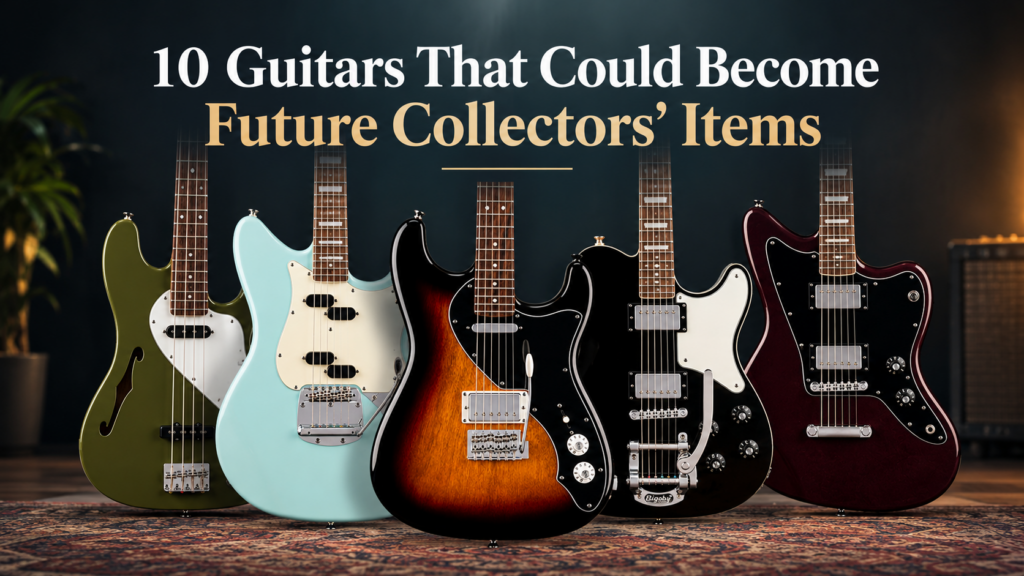
When it comes to collecting guitars, it’s easy to look backwards.
The original Fender Stratocasters. The legendary Gibson Les Paul Bursts. The rare Gretsch models that helped define the sound of rock and roll.
These are the instruments that have become synonymous with guitar collecting, commanding enormous interest from musicians, enthusiasts and collectors around the world.
But what about the guitars of today?
Could some of the instruments currently sitting in guitar shops, being played on stages and appearing in modern recording studios eventually become the vintage treasures of tomorrow?
It’s certainly possible.
Throughout guitar history, we’ve seen instruments that were once relatively affordable or overlooked become highly desirable years later. Sometimes it’s because of a famous musician. Sometimes it’s a limited production run. And sometimes it’s simply because a particular guitar represents an important moment in the evolution of the instrument.
With that in mind, we’re looking at ten guitars that could become future collectors’ items — and what makes each one particularly interesting.
1. Fender Parallel Universe Series: When Fender Broke Its Own Rules
Few guitar series have generated quite as much curiosity as Fender’s Parallel Universe collection.
Introduced in 2018, the series brought together some of Fender’s most recognisable designs and combined them in ways that weren’t necessarily expected.
Think Telecaster bodies with Stratocaster features, unusual pickup configurations, and combinations that would never normally appear in a standard Fender catalogue.
The original collection included models such as the Jazz-Tele, Strat-Tele Hybrid and Meteora, each offering a different interpretation of Fender’s familiar designs.
Rather than simply recreating the guitars of the 1950s and 1960s, Parallel Universe was about experimentation.
And that’s precisely what makes the series interesting from a collector’s perspective.
The guitars were produced in limited runs, with many models disappearing from the catalogue once their production period ended. That means anyone looking for a particular Parallel Universe guitar may eventually find themselves searching the second-hand market rather than visiting their local Fender dealer.
The series also represents a fascinating period in Fender’s history, when the company was willing to challenge its own established designs.
Could some of these unusual combinations become sought-after guitars in years to come?
It’s certainly a possibility.
2. Gibson Modern Collection: A Different Side of Gibson
When most people think of Gibson, they picture a Les Paul Standard, an SG or perhaps an ES-335.
But Gibson has always had a more experimental side.
The company’s modern designs have included instruments such as the Explorer, Flying V and Firebird — guitars that initially challenged conventional ideas about what an electric guitar should look like.
More recently, Gibson has continued exploring modern specifications and alternative designs through its contemporary collections.
For collectors, these instruments offer something different from the traditional vintage Gibson market.
Rather than looking for a particular year of a Les Paul Standard, some players are drawn to unusual finishes, distinctive specifications and models that represent a specific period of Gibson’s development.
The interesting thing about these guitars is that their appeal may change over time.
A model that initially attracts attention because of its unusual design could eventually become a reminder of an important period in the company’s history.
Of course, not every modern Gibson will become collectible.
But when a guitar combines an unusual design, limited availability and a distinctive place in the Gibson story, it’s certainly worth paying attention to.
3. PRS Silver Sky: The Modern Guitar With Vintage DNA
Few modern guitar designs have generated as much discussion as the PRS Silver Sky.
Developed in collaboration with John Mayer, the Silver Sky was introduced in 2018 and brought together elements of classic American electric guitar design with PRS’s own approach to construction and manufacturing.
Its familiar double-cutaway body, three single-coil pickups and vintage-inspired styling immediately made it recognisable.
But the Silver Sky wasn’t simply another Stratocaster-style guitar.
PRS approached the design with its own specifications, including a distinctive neck profile, pickup design and overall construction.
The result was an instrument that quickly developed a following among players looking for a modern alternative to the traditional Fender formula.
The Silver Sky also represents an interesting moment in guitar history.
For decades, the electric guitar market was dominated by designs that had barely changed since the 1950s. The arrival of a successful modern instrument inspired by those classics demonstrated that there was still room for new interpretations.
Could early Silver Sky models eventually attract collector interest?
The original production years, distinctive specifications and any genuinely limited editions could all become part of that story.
As with any modern guitar, however, desirability will depend on more than the name on the headstock.
4. Gibson Theodore: The Return of an Unusual Design
Gibson has produced plenty of unusual guitars over the years, but few modern releases have attracted as much curiosity as the Theodore.
Originally designed by Gibson’s Ted McCarty in the 1950s, the Theodore remained an obscure design for decades.
Its distinctive body shape was unlike the familiar Les Paul or SG, and it never entered regular production during McCarty’s original era.
That changed when Gibson introduced the Theodore as a modern production instrument.
The guitar immediately stood out.
Its unusual silhouette, offset-style body and vintage-inspired features made it one of the more distinctive additions to Gibson’s catalogue.
And that’s precisely why it deserves a place on this list.
Collectors have always been attracted to guitars that tell an interesting story. Instruments that represent an abandoned design, an unusual experiment or a previously unseen concept can develop a particular appeal over time.
Theodore has all the ingredients of an interesting guitar-history story.
Whether it eventually becomes a highly sought-after Gibson remains to be seen, but its unusual origins make it a model worth keeping an eye on.
5. Fender Tom DeLonge Starcaster: A Modern Signature With a Cult Following
Tom DeLonge has been associated with some of the most recognisable guitars of the alternative-rock era.
His earlier Fender Stratocaster signature models became particularly well known for their stripped-back specifications, single humbucker and simple controls.
But his later Starcaster designs represent a different chapter in that story.
The Starcaster itself has an interesting history. Originally introduced by Fender in the 1970s, the semi-hollow design struggled to achieve the same commercial success as the company’s more familiar solid-body instruments.
Over time, however, the Starcaster developed a cult following.
DeLonge’s association with the design brought it to a new generation of players, particularly those drawn to the guitar’s distinctive shape and alternative-rock identity.
In 2025, DeLonge also unveiled the highly unusual Ad Astra Ten collection, featuring ten Starcasters incorporating meteorite fragments.
These instruments demonstrate just how far a guitar can move beyond its original design concept.
The combination of a distinctive model, a recognisable musician and an unusual limited release makes the Starcaster an interesting candidate for future collector interest.
Of course, the standard production models and genuinely limited editions should be considered very differently.
But the Starcaster’s growing place in alternative-rock history makes it a fascinating guitar to watch.
6. Epiphone 1959 Les Paul Standard: The Affordable Classic
Not every potentially collectible guitar needs to carry a premium price tag.
In fact, some of the most interesting instruments in the modern guitar market are those that bring historic designs to a wider audience.
The Epiphone 1959 Les Paul Standard is a particularly good example.
Developed as an affordable interpretation of Gibson’s legendary late-1950s Les Paul Standard, the model combines familiar vintage-inspired styling with specifications aimed at players who want the classic Les Paul experience without the cost of a Gibson Custom Shop instrument.
The 1959 Les Paul has become one of the most recognisable guitars in history.
Its association with players such as Jimmy Page, Eric Clapton and Joe Bonamassa has helped establish the model as a cornerstone of electric guitar collecting.
Epiphone’s interpretation brings that history to a much wider audience.
But what could make it collectible?
Special finishes, limited runs, distinctive collaborations and particular production periods can all contribute to the appeal of an instrument over time.
The standard model may not necessarily become a rare collector’s piece, but certain versions could eventually develop a following of their own.
And that’s an important distinction.
Sometimes the interesting guitar isn’t the most expensive one in the catalogue.
It’s the one that represents a particular moment in the evolution of a famous design.
7. Ibanez AZ Series: The Modern Superstrat
The electric guitar has changed considerably since the 1950s.
While traditional designs remain hugely popular, many modern players want something that combines familiar styling with contemporary features.
That’s where the Ibanez AZ series comes in.
Introduced in 2018, the AZ range was developed around the idea of a versatile modern guitar.
The familiar double-cutaway body shape is there, but the specifications are designed for contemporary playing.
Depending on the model, features can include modern neck profiles, versatile pickup configurations, advanced switching systems and hardware designed for stability and performance.
The AZ series has also become closely associated with modern guitarists, including artists such as Tim Henson and Joe Satriani.
What makes the range interesting from a collector’s perspective is its place in the evolution of the modern electric guitar.
For decades, the Stratocaster-style design has been adapted and modified by manufacturers looking to improve its versatility.
The AZ represents one of Ibanez’s most significant interpretations of that concept.
Certain signature models, unusual specifications or limited production versions could eventually attract collector interest.
But the wider AZ range also highlights something important about modern guitar collecting.
The instruments that become desirable in the future may not necessarily be the ones that most closely resemble the guitars of the past.
8. Yamaha Revstar Professional: Japanese Craftsmanship With a Modern Identity
Yamaha has a long history of producing excellent guitars, but the Revstar range has become one of its most interesting modern electric guitar designs.
Inspired by the company’s Japanese heritage and the world of custom motorcycles, the Revstar combines a distinctive body shape with a range of contemporary features.
The Professional series takes that concept further.
Built in Japan, these guitars feature carefully selected materials, premium construction and specifications designed for serious players.
The Revstar is particularly interesting because it doesn’t simply copy an established American design.
Instead, it represents Yamaha’s own interpretation of the modern electric guitar.
That gives it a distinctive identity.
And when it comes to collecting guitars, identity matters.
The instruments that attract long-term interest are often those that represent something different — whether that’s a particular design, a manufacturing approach or a moment in a company’s history.
Certain Revstar models, especially unusual specifications or limited editions, could eventually develop a following among collectors.
The series is still relatively young, but its distinctive design and Japanese manufacturing heritage make it one worth watching.
9. Squier Paranormal Series: The Unexpected Collector’s Choice
Squier has traditionally been associated with affordable versions of Fender’s most famous designs.
But the Paranormal series has taken a rather different approach.
Rather than simply reproducing Stratocasters and Telecasters, the range has explored unusual combinations of familiar Fender and Squier designs.
Models have included instruments such as the Toronado, Cyclone, Cabronita and other guitars that combine features from different eras of the company’s history.
The result is a collection that feels both familiar and unusual.
And that makes the Paranormal series particularly interesting.
Many of the instruments are produced in specific runs, with certain models and finishes disappearing from the catalogue once their production period ends.
For players, that means the range offers an opportunity to own something a little different without necessarily spending a fortune.
For collectors, it raises an interesting question.
Could some of these unusual Squier designs eventually become more desirable than their original production prices might suggest?
It’s certainly possible.
The history of guitar collecting is full of examples where unusual designs, limited production and a strong following have helped an instrument develop a reputation over time.
The Paranormal series has many of those characteristics.
10. Gibson Custom Shop Limited Editions: The Modern Classics
If there’s one category of guitar that naturally attracts collector interest, it’s the Gibson Custom Shop.
The Custom Shop has spent decades producing historically accurate recreations, artist signature models and limited-edition instruments that celebrate some of the most important guitars in music history.
But its modern releases are also interesting in their own right.
From special Les Paul Standards to unusual artist collaborations, the Custom Shop regularly produces instruments that differ from the company’s standard production models.
Some are built in relatively small numbers.
Others feature specifications, finishes or construction details that are unlikely to appear again in exactly the same form.
That combination can make them particularly appealing to collectors.
However, it’s important to remember that a limited production run doesn’t automatically guarantee future demand.
The guitar still needs to offer something that players and collectors genuinely want.
A distinctive design, an interesting historical connection and excellent craftsmanship can all contribute to an instrument’s appeal.
And with Gibson’s long history of producing iconic guitars, its Custom Shop remains one of the most interesting places to look when considering which modern instruments might become tomorrow’s classics.
What Actually Makes a Guitar Collectible?
So, what separates a guitar that becomes a collector’s item from one that simply remains another instrument in a manufacturer’s catalogue?
There isn’t a single answer.
But throughout guitar history, a few recurring themes have helped certain instruments develop a lasting appeal.
1. Limited Production
Guitars produced in relatively small numbers can attract interest, particularly when they feature distinctive specifications or finishes.
However, rarity alone isn’t enough.
A guitar can be rare without being desirable.
2. Historical Significance
Some guitars become collectible because they represent an important moment in a manufacturer’s history.
That could be the introduction of a new design, a major change in production or the launch of a model that eventually becomes iconic.
3. Association With Famous Musicians
Few things influence guitar desirability quite like a famous player.
An instrument associated with an influential musician can become much more interesting to collectors, particularly if it represents an important period in that artist’s career.
4. Originality and Condition
For many collectors, originality is an important part of a guitar’s appeal.
Original pickups, hardware, finishes and electronics can all contribute to the historical interest of an instrument.
That doesn’t mean modified guitars are necessarily less desirable. Some modifications are historically significant in their own right.
But knowing what has been changed, and when, is an important part of understanding a guitar’s history.
5. A Strong Following
Perhaps the most important factor is simply whether people genuinely want the guitar.
A model might be limited, unusual and beautifully made, but without a strong following among players and collectors, its long-term desirability remains uncertain.
Ultimately, the guitar market is shaped by musicians and enthusiasts.
And their tastes can change considerably over time.
Could Today’s Guitars Become Tomorrow’s Vintage Treasures?
The history of guitar collecting is full of surprises.
Instruments that were once overlooked have become icons. Designs that initially struggled to find an audience have eventually developed a cult following. And guitars that were originally created as affordable alternatives have sometimes become highly desirable decades later.
The Fender Parallel Universe series, PRS Silver Sky, Gibson Theodore and Yamaha Revstar all represent different aspects of the modern guitar market.
Some are unusual interpretations of established designs.
Others represent new directions for manufacturers with decades of history behind them.
And some simply offer a fresh perspective on what an electric guitar can be.
Of course, nobody can predict exactly which instruments will become the next big collector’s items.
Production numbers, condition, originality, historical significance and changing musical tastes will all play a role.
But perhaps that’s part of what makes guitar collecting so interesting.
The guitar that seems ordinary today could become something special tomorrow.
And for anyone who loves guitars, there’s always another instrument waiting to be discovered.