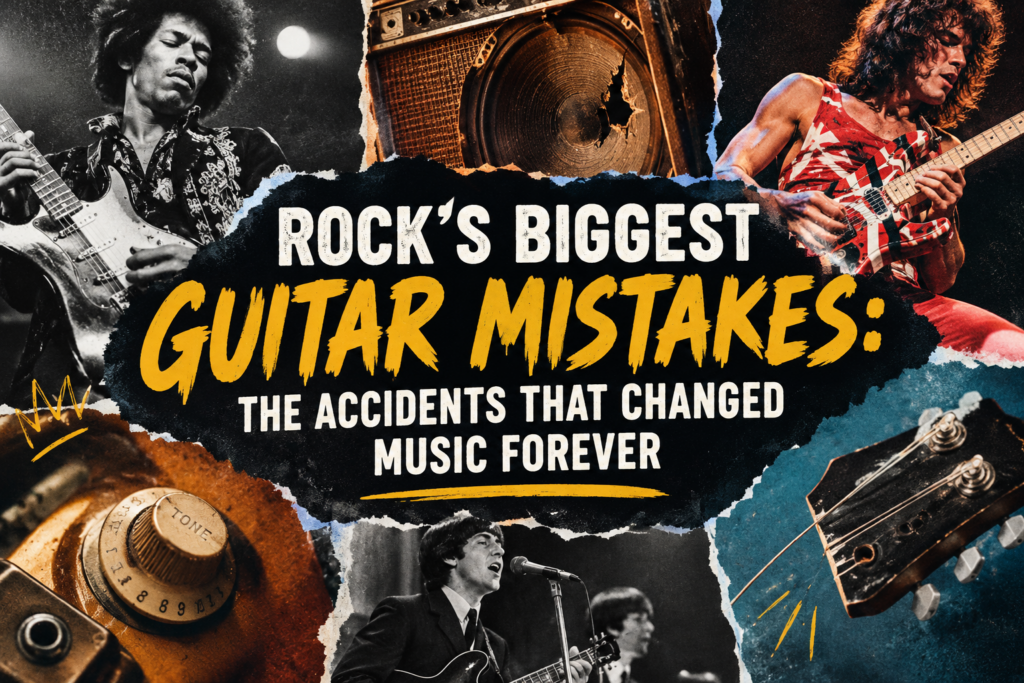
Some of the greatest sounds in rock history weren’t carefully planned. They came from broken equipment, unexpected feedback, experimental recording techniques and guitarists who weren’t afraid to do things differently.
From the fuzzy distortion that helped define rock music to the unconventional instruments and recording tricks that became legendary, the history of the electric guitar is full of happy accidents.
Of course, not every mistake turns into a musical breakthrough. But every so often, something goes wrong in the studio or on stage, and a guitarist discovers a sound that nobody has quite heard before.
Here are some of the most fascinating accidents, experiments and unexpected discoveries that helped change the sound of rock music forever.
1. The Distortion That Helped Create Rock’s Heaviest Sounds
Today, guitarists spend hundreds or even thousands of pounds on distortion pedals, overdrive units and amplifiers designed to produce the perfect dirty tone.
But in the early days of electric guitar, distortion wasn’t always something musicians wanted. It was often a sign that equipment was being pushed beyond its intended limits.
One of the most famous stories involves Link Wray, whose 1958 instrumental Rumble featured a raw, aggressive guitar sound that was unlike much of the clean, polished music of the time.
Wray experimented with his amplifier and deliberately damaged the speaker cone to create a rougher, more distorted tone. The result helped establish a sound that would influence generations of rock guitarists.
The story of early distortion isn’t quite as simple as one guitarist inventing it, of course. Guitarists and recording engineers had been experimenting with overdriven equipment for years. But Wray helped demonstrate just how powerful and exciting a deliberately rough guitar sound could be.
His approach helped pave the way for the heavier sounds of garage rock, punk, hard rock and heavy metal.
The takeaway: Sometimes, a sound that seems technically imperfect can become the very thing that makes a recording memorable.
2. Dave Davies and the Guitar Speaker That Changed Rock
Another legendary distortion story comes from Dave Davies of The Kinks.
In 1964, Davies wanted a more aggressive guitar sound for the band’s new single, You Really Got Me. According to the familiar story, he used a razor blade to cut the speaker cone of an amplifier, creating the rough, buzzing tone that became central to the recording.
The result was a landmark moment in British rock.
The song’s pounding power chords and raw guitar sound helped establish a blueprint for heavier rock music. Its influence can be heard in countless later styles, from hard rock to punk.
Although the precise details of how the sound was achieved have been debated, the broader point remains: Davies was searching for a guitar tone that conventional equipment wasn’t giving him.
Rather than settling for a clean sound, he embraced something much more aggressive.
It was a reminder that guitarists didn’t have to follow the manufacturer’s instructions to create something exciting.
The takeaway: Experimentation can be just as important as equipment. Sometimes, the most interesting sounds come from pushing familiar tools beyond their usual limits.
3. Jimi Hendrix and the Art of Making Feedback Musical
Feedback can be one of the most frustrating sounds a guitarist encounters.
Turn up the volume, move too close to an amplifier and suddenly your guitar starts producing a high-pitched squeal that seems to have a mind of its own.
But Jimi Hendrix helped transform feedback from an unwanted noise into an essential part of the electric guitar’s expressive vocabulary.
Hendrix experimented with amplifier volume, guitar position, distortion and effects to control the interaction between his instrument and the speakers.
Instead of treating feedback as something to eliminate, he used it to create sustained notes, dramatic transitions and sounds that seemed almost impossible to produce with a guitar alone.
His performances of songs such as The Star-Spangled Banner at Woodstock in 1969 demonstrated how feedback and other unconventional guitar sounds could become part of a musical performance.
It wasn’t simply a matter of turning the amplifier up and hoping for the best. Hendrix developed an extraordinary feel for how his guitar responded to the equipment around him.
What sounded like chaos in the wrong hands could become a deliberate musical statement.
The takeaway: Not every unusual sound needs to be corrected. With enough control and experimentation, even feedback can become part of the music.
4. The Fuzz Face and the Problem That Helped Create a Classic Effect
The fuzz pedal is now one of the most recognisable effects in rock music, but its development involved plenty of experimentation.
An early example of the sound appeared on the 1962 recording Don’t Worry by country guitarist Marty Robbins. The unusual distorted guitar sound was created using a faulty mixing console channel during the recording session.
Session guitarist Grady Martin’s bass guitar signal passed through the malfunctioning equipment, producing a fuzzy, distorted tone.
The unexpected sound caught the attention of musicians and equipment makers, helping inspire the development of dedicated fuzz devices.
Among the most famous was the Dallas Arbiter Fuzz Face, introduced in the 1960s and later associated with guitarists including Jimi Hendrix.
The Fuzz Face became known for its thick, saturated sound and its responsiveness to a guitarist’s playing dynamics and guitar volume control.
What began as an unwanted recording problem helped demonstrate that distorted sounds could be musically useful in their own right.
The takeaway: An accident can reveal a sound worth pursuing, even if recreating it intentionally takes a lot more work.
5. Eddie Van Halen and the Guitar Techniques That Broke the Rules
Not every musical breakthrough involves broken equipment. Sometimes, the unexpected discovery comes from a guitarist approaching the instrument in a completely different way.
Eddie Van Halen helped popularise two-handed tapping, a technique that allows guitarists to produce rapid sequences of notes by tapping the fretboard with the fingers of both hands.
The technique wasn’t entirely new. Guitarists had experimented with tapping long before Van Halen became famous. However, his playing brought it to a much wider audience.
His instrumental Eruption, released on Van Halen’s 1978 debut album, became one of the most influential guitar showcases in rock history.
The performance combined tapping with bends, vibrato, rapid runs and other techniques to create a sound that seemed almost impossible to many listeners at the time.
Van Halen’s approach challenged traditional ideas about how the guitar should be played. Instead of relying entirely on picking notes with the right hand, he used both hands to expand the instrument’s possibilities.
It was a reminder that sometimes the biggest breakthroughs happen when someone stops worrying about the conventional way of doing things.
The takeaway: You don’t always need to master every traditional technique before experimenting with new ways to play.
6. The Recording Mistakes That Became Part of the Song
Studio recordings are often carefully planned, with musicians repeating takes until everything sounds right.
But some of the most memorable moments in music have come from performances that weren’t perfectly polished.
A famous example is the opening guitar sound of The Beatles’ I Feel Fine, released in 1964.
The distinctive ringing noise heard at the beginning came from feedback produced by a guitar and amplifier setup in the studio. Rather than removing it, the band and producer George Martin incorporated the sound into the recording.
The result was an unusual opening that immediately grabbed the listener’s attention.
The Beatles were already experimenting with recording techniques, tape manipulation and unconventional sounds. Their willingness to explore new possibilities helped expand what audiences expected from popular music.
The feedback on I Feel Fine wasn’t simply a random noise left in by mistake. Once the sound had been discovered, it was deliberately used as part of the arrangement.
This is an important distinction in many stories of musical accidents: the original sound might be unexpected, but recognising its potential is a creative decision.
The takeaway: Sometimes, the best response to an unexpected sound is to ask whether it actually makes the song better.
7. Keith Richards and the Missing String
Keith Richards is famous for his stripped-back approach to rhythm guitar, and one of his best-known techniques involves removing the low E string from his guitar and playing in open G tuning.
The tuning is particularly associated with The Rolling Stones songs Brown Sugar, Start Me Up and Honky Tonk Women.
By using five strings in open G, Richards could create chunky, tightly voiced chords that helped define the band’s distinctive rhythm sound.
This wasn’t necessarily an accident in the same sense as a broken speaker or faulty recording equipment. It was a deliberate musical choice that grew out of experimentation with open tunings and blues guitar traditions.
Nevertheless, it demonstrates how abandoning a familiar part of the instrument can lead to something distinctive.
Open G tuning allows certain chord shapes to ring differently from standard tuning, and removing the lowest string can help keep the sound clear and punchy.
Richards’ approach became an important part of his musical identity and a reminder that guitarists don’t always need all six strings to create a full, recognisable sound.
The takeaway: Changing the rules of your instrument can open up new musical possibilities, even if the change seems small.
8. When Cheap Equipment Creates a Classic Sound
It’s tempting to assume that great guitar tones require expensive instruments, premium amplifiers and carefully selected pedals.
But rock history is full of examples of musicians getting remarkable results from equipment that wasn’t particularly glamorous.
Early garage-rock bands often worked with inexpensive guitars and small amplifiers. Rather than trying to reproduce the polished sounds of more established acts, many embraced the limitations of their equipment.
The resulting recordings could sound rough, noisy and occasionally out of tune. Yet that raw quality became part of the appeal.
The same principle can be heard in punk rock, where straightforward guitar arrangements and aggressive playing often mattered more than technical perfection.
A limited setup can encourage musicians to focus on rhythm, dynamics and songwriting rather than constantly searching for a better piece of gear.
Of course, cheap equipment doesn’t automatically produce a great sound, and a poor setup can make playing unnecessarily difficult. But expensive equipment isn’t a guarantee of a memorable performance, either.
The takeaway: Before spending money on another pedal or amplifier, experiment with the equipment you already own. You may discover a sound that suits you better than a more expensive alternative.
9. The Unusual Guitar That Became a Rock Legend
Some of rock’s most recognisable guitar sounds have come from instruments that were never designed to be conventional production-line guitars.
Brian May’s famous Red Special is a perfect example.
May built the guitar with his father in the early 1960s, using materials that included an old mahogany fireplace surround. The project was an ambitious piece of home craftsmanship, rather than a conventional commercial guitar purchase.
The instrument went on to become central to the sound of Queen.
Its construction, unusual pickup switching and distinctive design helped May create a wide range of tones throughout the band’s career.
The Red Special wasn’t an accident in the strict sense. It was the result of careful planning, experimentation and a willingness to build something that met May’s own requirements.
However, its story fits a wider theme in guitar history: sometimes the most distinctive instruments are the ones that don’t follow the usual formula.
For guitarists, it’s a reminder that a guitar’s identity isn’t determined solely by its price tag or manufacturer.
The takeaway: The best instrument is often the one that inspires you to play, regardless of whether it follows conventional designs.
10. Why the Best Guitar Mistakes Aren’t Always Mistakes
Looking back at these stories, it’s clear that the relationship between mistakes and musical innovation is more complicated than it first appears.
Some discoveries really did begin with faulty equipment or unexpected recording problems. Others came from musicians deliberately experimenting with unfamiliar techniques, unconventional tunings or sounds that weren’t considered desirable at the time.
In many cases, the crucial moment wasn’t the accident itself. It was the decision to keep the sound, develop it and find a musical purpose for it.
Distortion became a defining characteristic of rock. Feedback became an expressive tool. Unconventional playing techniques expanded what guitarists could do. And unusual instruments helped musicians develop sounds that were immediately recognisable.
None of this means that every mistake is worth keeping. Sometimes, a badly played note is simply a badly played note.
But it does suggest that guitarists shouldn’t be afraid to experiment.
Try a different pickup setting. Play with your amplifier’s controls. Explore an open tuning. Experiment with effects, dynamics and playing techniques. Record the results and listen back.
You might discover something useful, even if it doesn’t sound quite how you expected.
Final Thoughts
Rock guitar history is full of musicians who challenged expectations and discovered new sounds along the way.
From the early distorted tones of Link Wray and Dave Davies to Jimi Hendrix’s experiments with feedback, these stories show how experimentation helped shape the music we listen to today.
The important lesson isn’t that guitarists should deliberately damage their equipment or ignore every technical rule.
It’s that creativity often begins with curiosity.
Some of the sounds we now associate with classic rock were once considered unusual, undesirable or simply wrong. Musicians found ways to turn those sounds into something memorable.
So, the next time your guitar makes an unexpected noise, don’t panic immediately. Check that nothing is broken, of course — but once you’ve ruled out a genuine problem, take a moment to listen.
You never know what you might discover.
After all, rock music wouldn’t sound quite the same if every guitarist had always played it safe.